
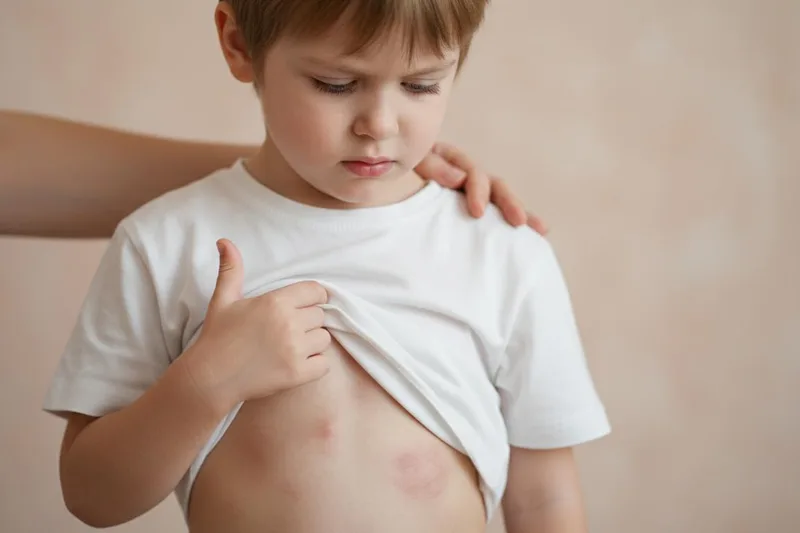
How would you feel if your child suddenly said, "Mommy, look, my body is itching and red..."? You may have noticed that his body, especially his chest and stomach, is red and has small, blister-like bumps. This is what we call 'hives' or medically known as 'urticaria'. It's normal to feel a little scared when you see this, but don't worry. This condition is very common among children. The most important thing is that these are usually temporary and do not leave scars.
Simply put, what are these 'hives'?
Hives are red, swollen bumps that suddenly appear on the surface of our skin. They start as small bumps, similar to mosquito bites, and sometimes they can merge together to form large patches. They are most commonly seen on the chest, stomach, or back of children.
Imagine, our body is like a very skilled security guard. When something foreign, for example an allergen, enters the body, our immune system releases a chemical called 'histamine'. The purpose of this is to attack the foreign substance. But during this fight, the fine blood vessels in our skin are also slightly affected, and a liquid (plasma) leaks out of them under the skin. That's when the skin surface becomes inflamed and swollen like this.
Are there two types of these?
Yes, hives can be divided into two main types. They are classified according to the duration of their existence.
| Type of pest | Description |
|---|---|
| Acute Hives (short-term effects) | These are the most common. They can last from a few hours to a few days, up to a maximum of 6 weeks. Then they disappear completely. |
| Chronic Hives | These last for more than 6 weeks. Sometimes they subside for a few days and then reappear. In such a situation, it is very important to seek medical advice. |
What do these wounds look like? How does the baby feel?
The appearance and the way these lesions feel to the child can vary. Some children may not experience any discomfort.
| How it looks and feels | Characteristics |
|---|---|
| How it looks outside | |
| Appearance |
|
| How the child feels | |
| Difficulties |
|
Important: In a very small number of people, hives can lead to a severe allergic reaction, called anaphylaxis. This is a medical emergency .
Warning signs that require immediate attention!
If your child has any of the following symptoms along with hives, call an ambulance immediately or take them to the nearest hospital emergency department (ETU) . Do not attempt to drive alone at this time.
- Difficulty breathing or swallowing (Dysphagia)
- Swelling of the tongue or throat
- Drooling
- Dizziness or loss of consciousness
- High fever
- Vomiting
- Joint pain
What causes children to get hives?
To be honest, it's hard to find a specific cause for this in half the cases. But if a cause can be found, it's most likely some kind of allergy.
The most common causes:
- Food: Especially milk, nuts like peanuts, and seafood like shellfish.
- Environmental factors: dust, pollen, pet dander.
- Chemicals: Some soaps, detergents, perfumes, and skin lotions.
- Viruses and infections: Hives can also be caused by things like the common cold and strep throat. The COVID-19 virus is also one cause.
- Insect bites: When bitten by animals like mosquitoes and wasps.
Other reasons:
- Dressing for prison
- Reactions to some medications
- Side effects of treatments such as radiation therapy
Very rare causes:
- Exercising
- Exposure to strong sunlight or cold
- Stress
What can be done to treat this?
Treatment depends on what type of hives the child has and how severe the symptoms are.
Simple, short-term (acute) hives, especially if the child is not in great distress, may not require any treatment . They will go away on their own within a day or two.
However, if your child has persistent itching or chronic hives, medical treatment is needed. Your doctor should be consulted to determine the appropriate treatment for your child. Antihistamines are usually prescribed to control the itching and reduce the spread of the rash.
For example:
- Cetirizine
- Loratadine
- Fexofenadine
- Diphenhydramine - Keep in mind that this medication may make the child drowsy.
Never give this medicine to a child without consulting a doctor. A doctor will determine the appropriate dosage for the child's age and weight.
Things you can do at home to comfort your baby
While you are giving the medicine or waiting for it to be given, you can try these things to help ease your child's discomfort:
- Provide a cool environment: Keep the baby away from sunlight and heat. Turn on a fan or place them in a cool airy place.
- Soak in cool water: Soak a clean cloth in cold water and gently place it on the affected area. It is also good to bathe in cool water.
- Apply calamine lotion: This helps a lot in reducing itching.
- Wear clothes that allow your skin to breathe: Wear light clothing that is not tight and made of materials like cotton.
What are the best times to see a doctor?
- If the rash is causing severe discomfort to your child, is making it difficult to sleep, or if it has spread to a large area of the body, be sure to see your doctor.
- If you have the warning signs of anaphylaxis , which we talked about earlier with hives, it's an emergency. Go to the hospital immediately.
- If hives last longer than 6 weeks (chronic hives), you may need to do things like allergy testing to find the cause. Therefore, it is essential to see a doctor.
- If you think there is a specific cause for the rash (e.g., a certain food), talk to your doctor about it and decide whether you should stop giving that food to your child or if other tests are needed.
Take-Home Message
- Hives/Urticaria are very common in children. Don't panic if you see this.
- These often heal in a few days without any treatment and do not leave scars.
- If your child has severe symptoms such as difficulty breathing or swelling of the tongue/throat, it is an emergency. Go to the hospital immediately.
- If your child is having difficulty, only give itch-reducing medication as directed by your doctor.
- If the rash persists for more than 6 weeks, it is imperative to seek medical advice to determine the cause.


💬 Comments (0)
No comments yet. Be the first to share your thoughts here.
Add Your Comment