

Have you ever seen a doctor tap your knee with a small rubber mallet? When you tap your knee, your leg usually springs back up, right? This is an automatic defense response in our body. But sometimes, we get very little or no response at all. That's what we're going to talk about today.
What is Hyporeflexia?
Simply put, Hyporeflexia is a decrease in the reflex response of our muscles. Sometimes this response can be completely lost, which we call areflexia.
Think of it this way: Reflexes are an automatic system that your body has to protect you from something that could harm you. This response occurs through a special pathway that sends nerve messages. We call this the 'reflex arc'. It has three main parts:
1. Sensory part: Nerves that carry information about damage or stimulation.
2. Central part: That is our spinal cord.
3. Motor part: Nerves that carry messages to the muscles to carry out commands received from the spinal cord.
If there is damage somewhere along this journey, whether it is to the sensory nerves, spinal cord, or motor nerves, that response does not occur properly. That is when Hyporeflexia occurs. This is usually a sign that there is a problem with the nervous system, not a separate disease.
There's another side to this, called hyperreflexia. It's when the muscles overreact.
Most of the time, a person with hyporeflexia does not experience any major discomfort. However, for a neurologist, this is a very important sign to diagnose.
How does a doctor detect this?
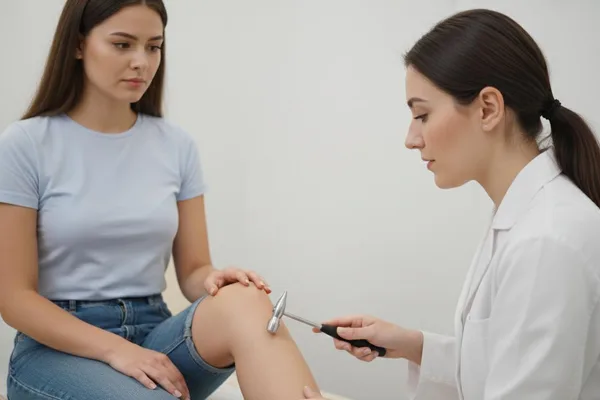
When a doctor examines your nervous system (neurological exam), they will perform a 'Deep Tendon Reflex' (DTR) test to check for hyporeflexia. The most famous of these is the hammer test, which we all know.
How the knee examination is performed
When the doctor taps your knee with a rubber mallet, the patellar tendon and the thigh muscle attached to it are pulled. At that moment, the message "muscle pulled" travels very quickly to the spinal cord via sensory neurons.
The spinal cord immediately responds to that, sending a message back through the motor neurons to that muscle to contract. That contraction is what causes your leg to automatically jump up.
If you have hyporeflexia, your leg may move very weakly , or not at all .
It's very important that you stay as relaxed as possible during this test. If you're too focused on this or tense up, the results can be inaccurate. That's why sometimes the doctor will ask you about something else and distract you by tapping on this.
In addition to the knee, responses can be tested in several other places.
| Checkpoint | Description |
|---|---|
| Elbow | Along the back of the elbow. |
| Hand flexion | The inside of the hand where the hand bends. |
| Wrist and ankle | In connection with these joints. |
| Chin | Chin muscles. |
What could be causing this?
Hyporeflexia can be caused by damage anywhere along the 'reflex arc' we discussed earlier. There are several major neurological diseases and conditions that can affect this:
- Peripheral Neuropathies: This refers to damage to the nerves that run from our brain and spinal cord. It often causes numbness, pain, and muscle weakness in the hands and feet.
- Guillain-Barre Syndrome: This is a very rare autoimmune disease. What happens here is that our own immune system attacks our own nerves. This condition destroys the 'covering' (myelin) around the nerves and can progress very quickly in a few days.
- CIDP (Chronic Inflammatory Demyelinating Polyneuropathy): This is similar to Guillain-Barre, but it happens slowly over a long period of time.
- Spinal Cord Injuries: This condition can occur when the spine or spinal cord is severely damaged, such as in a car accident or fall. Although hyporeflexia may be present initially, over time, hyperreflexia may develop, in which the response is increased below the level of the injury.
- ALS (Amyotrophic Lateral Sclerosis): This is also a progressive neurological disease. However, in this case, what is often seen is an increase in responses (Hyperreflexia) rather than a decrease.
- Lambert-Eaton Myasthenic Syndrome (LEMS): This is also a rare condition. It affects the connection between nerves and muscles.
How is hyporeflexia treated?
There is no direct treatment for this. Because this is not a disease, but a symptom of another underlying disease. Therefore, what doctors do is to find out exactly what is causing this and treat the underlying disease.
For example, Guillain-Barre syndrome is treated with special vaccines (IVIg) that target the immune system or plasma exchange treatments.
When should I see a doctor?
This is a very important question. Remember, some people's reflexes are naturally a little weak. If there are no other discomforts, it is not a big problem.
However, if you have other symptoms below along with this weak response, you should definitely see your doctor .
| If you have hyporeflexia along with these symptoms, see a doctor immediately. | |
|---|---|
| Muscle weakness | If you feel like your arm or leg strength is decreasing for no reason. |
| Muscle wasting (Atrophy) | If you feel like you're losing muscle mass and becoming thin. |
| Loss of balance in the body | If you feel like you are losing your balance when walking or standing. |
| Numbness or decreased sensation | If you have numbness or loss of sensation in your hands or feet. |
Your family doctor will examine you and, if necessary, refer you to a neurologist for further testing.
Take-Home Message
- Hyporeflexia is not a disease, but a symptom that indicates poor muscle response.
- This is usually discovered during a neurological examination (such as tapping the knee) performed by a doctor.
- It may be normal for some people to have a weak response without any other symptoms.
- However, if this condition is accompanied by other symptoms such as muscle weakness, numbness, or loss of balance, be sure to seek medical advice.
- Treatment depends on the underlying condition that caused this.




💬 Comments (0)
No comments yet. Be the first to share your thoughts here.
Add Your Comment