

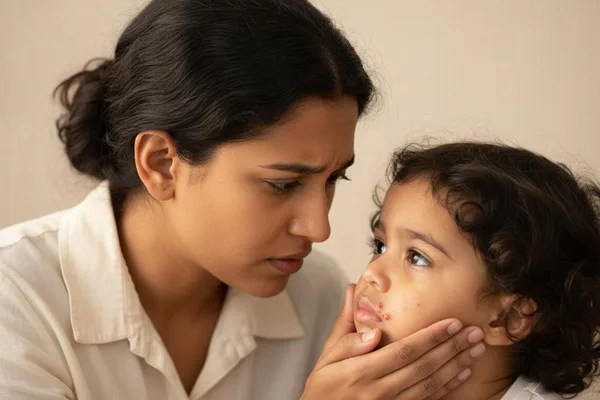
Have you ever noticed that your little one has small blisters around their mouth, nose, or on their arms and legs that break and form a honey-colored crust? Sometimes these are a little itchy, and sometimes they hurt. This condition that many mothers fear is what we call Impetigo. Even though this name may sound like a big deal, don't worry, this is something that is very common among young children. Let's talk about everything in detail and simply.
What exactly is Impetigo?
Simply put, impetigo is a skin infection caused by a type of bacteria . Most often, this bacteria can enter our body through a small scratch on our skin, an insect bite, or a wound. But surprisingly, sometimes this infection can occur even on healthy skin without any wounds.
This is especially common during hot weather, when children play outside. It starts as small blisters around the mouth and nose. It can then spread to the scalp, hairline, arms, and legs. It is a bit itchy, so when a child scratches these areas, the bacteria under their nails can easily spread to other parts of the body.
What are the main types of impetigo?
There are three main types of impetigo. These show slight differences from each other. Let's see what they are. If you look at these details in a table, it will be clearer for you.
| Impetigo Type | Symptoms & Description |
|---|---|
| Non-bullous impetigo | This is the most common type . Initially, one or more itchy blisters appear. These quickly burst. The skin where the blisters burst becomes red. Then a honey-colored crust forms over the sore. This is the main symptom of this disease. With proper treatment, it heals without scarring. |
| Bullous impetigo | This is a bit rare. It is most common in babies under 2 years old . It causes large, fluid-filled blisters. However, the skin around the blisters does not turn red. After a few days, these blisters clear up, shrink, and burst. Then they crust over and heal without scarring. |
| Ecthyma | This is the most severe and deepest stage . If an impetigo infection is not treated properly, it can progress to this stage. Here, painful blisters develop into open sores that extend deep into the skin. Thick crusts form, and the skin around the sores becomes red. Because the infection spreads to the deeper layers of the skin, there is a high chance of scarring after healing. |
Who is most likely to get this? Does it happen to adults too?
Impetigo is a skin infection that reigns supreme in the world of young children. It is most common in children between the ages of 2 and 5. Impetigo accounts for only 10% of all skin infections in children.
But it's not just limited to children. Adults can get impetigo too. It usually occurs in adults when they have another skin condition (like eczema), when they have a weakened immune system after a viral infection like a cold, or when they have a skin wound. There are several factors that may increase the risk among adults:
- If you live in a hot, humid climate.
- If you have a scabies infection, a skin disease.
- If you play sports that involve skin-to-skin contact and frequent abrasions (e.g. rugby, wrestling).
- If many people live close together in the same house.
How to distinguish impetigo from other skin diseases?
Sometimes, when you see these blisters, you might think they're some other disease. Let's see how this differs from two commonly confused diseases.
The difference between impetigo and cold sores
Cold sores are also something that occurs around the mouth. But the cause is the Herpes Simplex Virus (HSV) . Impetigo is caused by a bacteria . Cold sores usually appear as a group of small blisters. Impetigo blisters are a little larger than that.
The difference between impetigo and eczema
Eczema is not an infection, it is an allergic skin condition. However, the skin of a person with eczema is dry and easily damaged due to itching, which can lead to impetigo. The main symptom of impetigo is the honey-colored crust . In eczema, the skin is usually dry, red, and flaky.
Causes and transmission of impetigo
This is mainly caused by two types of bacteria.
1. Staphylococcus aureus (Staphylococcus aureus or “staph”) : This is responsible for 80% of impetigo cases.
2. Group A streptococcus (Group A streptococcus or “strep”) : This bacterium is responsible for about 10% of cases.
These bacteria are always on our skin. But when something happens to the skin, such as a cut, scratch, or insect bite, they can enter through the broken skin and cause an infection. Also, when a child with chickenpox or eczema scratches the area, their nails can break the skin, opening the way for bacteria to enter.
The most important thing is that impetigo is a highly contagious disease.
This is the main way it is spread:
- Skin-to-skin contact: Direct contact with the sores or blisters of someone who has the infection. This can easily happen when children play together.
- Sharing items: Using items such as towels, clothes, soap bars, and toys used by an infected person.
It can be contagious for up to 48 hours after starting treatment. If left untreated, it can remain contagious for weeks.
What complications can occur if left untreated?
Impetigo usually rarely causes serious complications, but it can sometimes cause problems if left untreated.
- Spread of infection: The infection can spread to the deeper layers of the skin, causing conditions like cellulitis.
- Kidney disease: Very rarely, impetigo, caused by strep bacteria, can cause a condition called glomerulonephritis, which affects the kidneys.
- Scarring: Permanent scars can remain on the skin, especially after deep infections like ecthyma.
To prevent things like this, we recommend that you see your doctor as soon as you notice these symptoms.
How does a doctor diagnose and treat this?
A doctor can usually diagnose impetigo by looking at the blisters and crusts on a child's skin. The honey-colored crusts are very characteristic of this condition. Sometimes, if you want to know exactly what bacteria is causing it, a small sample of the sore can be taken and sent to a lab for testing (a skin culture).
Antibiotics are the only and best treatment for this.
1. Topical antibiotics: If the infection is limited to a small area, the doctor will prescribe an antibiotic cream, such as mupirocin, to be applied to the wound.
2. Oral antibiotics: If the infection has spread to many parts of the body, or if topical treatments do not help, oral antibiotics (tablets or syrup) may be prescribed.
Important: It is essential to take the full course of antibiotics prescribed by your doctor. If you stop taking the medication when the wound is healing, the infection may return.
How to prevent impetigo and manage it at home?
The saying "Prevention is better than cure" applies perfectly to this as well.
Do these things to prevent it
- Cleanliness: Wash your hands regularly with soap. Instill the same habit in your children.
- Nails: Keep your child's nails trimmed short. This will reduce the risk of scratching and skin damage and the risk of bacteria accumulating under the nails.
- Cleaning wounds: Even if it's a small scrape or wound, wash it with soap and keep it clean. If necessary, consult a doctor and apply an appropriate cream.
- Personal items: Teach children not to share things like towels, clothes, and soap.
- Eczema and other skin conditions: If your child has skin conditions like eczema, keep them under control. Use moisturizers to keep the skin from drying out.
If you develop impetigo, take care of these things at home.
- Cover wounds: Keep wounds covered with a clean bandage. This will protect the wound and prevent it from spreading to others.
- Give the medicine exactly as prescribed: Give the medicine prescribed by the doctor in the prescribed dosage and for the prescribed period of time.
- Cleaning the wound: As directed by your doctor, gently wash the wound with lukewarm soapy water once or twice a day to remove the crust. Only then should you apply the cream.
- Stop sending your child to school: Do not send your child to school or daycare for at least 48 hours after starting treatment. This can help prevent the spread of the disease to other children.
- Washing clothes and linens: Wash items like baby clothes, bedding, and towels separately in hot water.
In most cases, this condition resolves completely within a few days of treatment. Scarring is rarely left behind. So there is no need to worry too much about this. The most important thing is to recognize it early and get the right medical treatment.
Take-Home Message
- Impetigo is a skin infection caused by bacteria, which is very common among young children.
- Its main symptom is blisters that form around the mouth and nose, which burst and form a honey-colored crust .
- This can spread very quickly through contact and using items from an infected person.
- If you notice these symptoms, see your doctor immediately. Treatment is usually with antibiotic ointments or pills.
- This can be prevented by maintaining good hygiene, keeping wounds clean, and keeping the child's nails short.
- Avoid sending your child to school for the first 48 hours after starting treatment.




💬 Comments (0)
No comments yet. Be the first to share your thoughts here.
Add Your Comment