
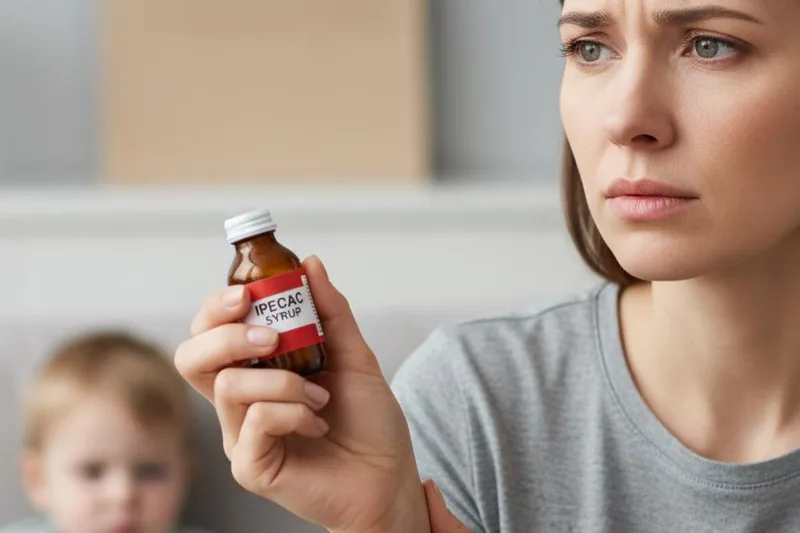
Imagine that your little one accidentally swallowed some medicine, some kerosene, or a cleaning chemical. At that time, the first thing that comes to your mind as a mother or father is to get this substance out of the stomach as soon as possible, which means making him vomit. You may have heard of the medicine called `Ipecac syrup`, which is used to induce vomiting. However, the use of this medicine is no longer recommended in many countries around the world. Why is that? What exactly is this medicine? What should we really do in case of poisoning? Let's talk about this clearly today.
What is Ipecac Syrup?
Simply put, `Ipecac syrup` is an agent that causes vomiting. In medicine, we call this `(emetic agent)`. Its main function is to stimulate the stomach and expel its contents as vomiting. Years ago, when certain toxins were ingested, this medicine was used to quickly expel the poison from the stomach before it could be absorbed.
But the most important and dangerous thing here is that inducing vomiting is not appropriate for all poisonings. In some cases, inducing vomiting can do more harm than good.
Why is this medicine not recommended now?
There are several main reasons why doctors and health organizations now discourage the use of `Ipecac syrup`. Understanding these is very important for your safety and that of your family.
- Not all toxins are eliminated: Only a very small amount of the toxins in the stomach are completely eliminated after vomiting. This means that most of the toxins remain in the body.
- Delay in other treatments: After giving `Ipecac`, the patient continues to vomit. This prevents more effective treatments such as activated charcoal, which is given in the hospital, from being given. Even if charcoal is given, it is also excreted with the vomit.
- Double damage to the esophagus: Imagine someone has drunk a corrosive substance like acid or bleach. These substances burn the throat and esophagus when they enter the stomach. When they vomit, this corrosive substance comes back up again. Then the throat and esophagus can be burned a second time, causing serious damage.
- Risk of aspiration into the lungs: When vomiting, there is a high chance that vomit and stomach acid can enter the lungs (aspiration). This can lead to very serious conditions such as aspiration pneumonia.
For these reasons, do not use this medicine at home for any reason without the clear advice of a doctor or the National Poison Information Center.
Special things to know about the use of Ipecac Syrup
Very rarely, if a doctor advises you to give this medication in a specific situation, there are a few things you should be aware of.
In these cases, Ipecac should not be given.
Be sure to tell your doctor these things:
- If the poisoned person is confused, agitated, or unconscious.
- If you don't know exactly what kind of poison has entered your body (e.g., medicine, chemicals).
- If the patient has medical conditions such as heart disease or seizures.
- If you are pregnant or a nursing mother.
- If you have allergies to Ipecac or other medications.
The correct way to give medicine
If you have to give it on the advice of a doctor, do it like this:
- Give only with a glass of water . Do not give with milk or other food.
- Measure the exact amount your doctor tells you to take. Don't use the teaspoons you have at home, use a measuring spoon or a dropper you can get from a pharmacy.
- Shake the bottle well before use.
- Do not give more than the number of times prescribed by the doctor.
Drug side effects and interactions
Ipecac syrup can also have side effects and interactions with other medications. It is important to be aware of this.
| Possible interactions with Ipecac Syrup | |
|---|---|
| What not to give | Reason |
| Activated Charcoal | Because Ipecac induces vomiting, the charcoal treatment given later does not stay in the body, making the charcoal ineffective. |
| Alcohol | Adverse effects may occur. |
| Medicines to stop vomiting | Ipecac may interfere with its action. |
| Some medications for mental illness (e.g. Phenothiazines) | Increases the risk of adverse side effects. |
| Possible side effects of Ipecac Syrup | |
|---|---|
| Notify your doctor or the Emergency Department (ETU) immediately. | |
| Allergic reactions | Skin rash, itching, swelling of the face, lips or tongue. |
| Shortness of breath and chest pain | Difficulty breathing, cough, chest pain. |
| Changes in heart rate | Fast or irregular heartbeat. |
| Other serious symptoms | Dizziness , fainting, unusual bleeding, extreme fatigue. |
| If it persists, inform the doctor. | |
| Common side effects | Headache, diarrhea, drowsiness, stomach ache. |
So, what should you actually do in case of poisoning?
This is the most important part of this entire article. If someone ingests something poisonous, don't panic and follow these steps.
1. Calm down: If you're nervous, you won't be able to think clearly. First, calm down.
2. Remove the patient from danger: Remove the patient from the toxic substance. If you can find the bottle or packet of what was swallowed, remove it safely and keep it.
3. Assess if it is an emergency: If the patient is unconscious, has difficulty breathing, or is having a seizure, immediately call 1990 for an ambulance or take them to the nearest hospital's Emergency Treatment Unit (ETU) .
4. Seek professional advice: If the patient is conscious and stable, immediately call the National Poisons Information Centre at the Colombo National Hospital. Their telephone number is 0112686143. Explain clearly what happened and follow their advice exactly.
5. Do nothing: Do not induce vomiting, give milk, or give salt water without medical advice. This can make the condition worse.
Take-Home Message
- Ipecac syrup is an old remedy used to induce vomiting in cases of poisoning, but its use is not recommended today due to its risks.
- Never, under any circumstances, attempt to induce vomiting at home with Ipecac syrup or any other method without clear instructions from a doctor or the National Poison Information Center .
- When substances such as acid and kerosene are ingested, inducing vomiting can do more harm than good.
- In case of any poisoning, the best thing to do is not to panic, but to immediately go to the nearest hospital Emergency Department (ETU) or call the National Poisons Information Centre (0112686143) .
- You can prevent such accidents by locking up all medicines, chemicals, and toxic items out of your children's reach.




💬 Comments (0)
No comments yet. Be the first to share your thoughts here.
Add Your Comment