
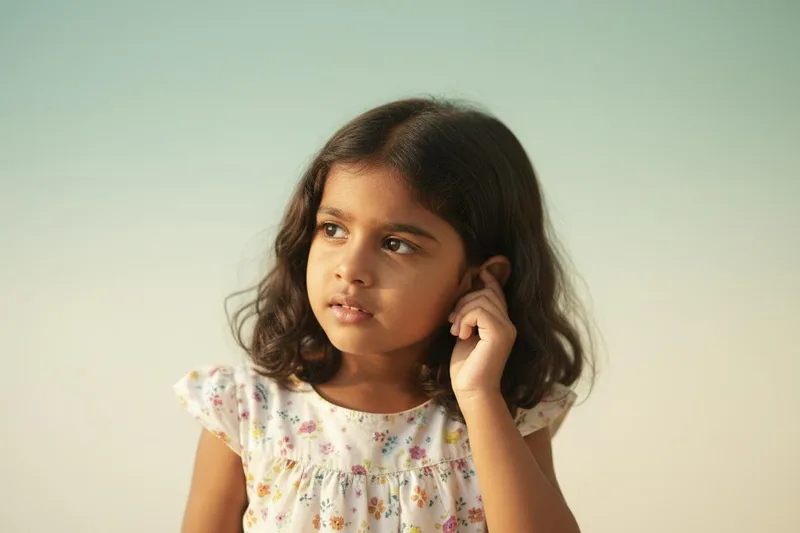
Sometimes our little ones can have hearing problems. This means they may not hear what we say clearly, or they may not hear some sounds as well as others. If you feel the same way about your child, don't worry. There is a specialist who can help us at times like these. That is called an ``Audiologist``. Today, let's talk about who this ``Audiologist`` is, what they do, and what happens when you take a little one to them.
Who is this ``(Audiologist)``? What do they do?
Simply put, an ``Audiologist`` is a hearing specialist. That is, someone who has received special training in hearing. Just like there is an ophthalmologist to look after our eyes, there is an ``Audiologist`` to look after our hearing.
Our ears are a very complex organ, aren't they? They have several parts. And the ear is directly connected to the brain. So for us to hear something, both the ear and the brain need to work properly. Think about it, it's like a detective story. Do you know why? Sometimes figuring out why this child can't hear is like solving a little mystery. An audiologist helps us solve this mystery. They know how the ear works, and how to help children with hearing impairments.
So, what an audiologist does is to find out exactly what the problem is with a child's hearing. Then, they work with doctors to find solutions to that problem. Some children need to continue seeing an audiologist. This is to see how much the child has improved with the treatments they are receiving and to see if there has been a change in their hearing.
Will it hurt to see an audiologist?
This is a problem that many parents have. And it can be a little scary for little ones, right? But, when you go to see an `(Audiologist)`, it won't hurt at all. That's for sure.
First, the `(Audiologist)` will examine your child's ears. For this, they use a device called `(Otoscope)`. You must have seen them examining the ears when you go to a regular doctor. This `(Otoscope)` is a device like a small torch. It is difficult for us to see inside the ear, it is a bit dark. So, with the light in this, you can see inside the ear clearly. You can check things like whether there is anything inside the ear and whether the eardrum is healthy.
After looking inside the ear from the outside, the audiologist wants to see how the inside of the ear works. That's why they do various tests.
What are these tests? `(Hearing Tests)`
Don't worry, these tests are very simple and don't hurt at all. Let's see what these tests are.
How do eardrums work? - Tympanometry test
The first test is called `(Tympanometry).` This checks how your child's eardrum (eardrum) moves, that is, whether it vibrates. Did you know that the eardrum vibrates? Yes, normally a healthy eardrum vibrates slowly back and forth when a sound enters the ear.
To do this eardrum test, the audiologist inserts a very soft, small plug into the child's ear for a few seconds. This plug detects how the eardrum moves. Then, you can see the movement on the machine's screen or on a printout as a diagram. You can also ask the audiologist to look at it. This will help them understand if the eardrum is working properly or if there is any fluid or fluid in the middle ear.
Soundproofing room - Booth test
Next, your child will be taken to a small room. This is called a ``Soundproof booth''. This means that the room is designed so that no sound can enter. The inside of this room is very quiet. This is done to see if the child can only hear the sounds that are being given, without any unnecessary noise from outside.
Inside this booth, the child has to put on a pair of ``Headphones''. Then the ``Audiologist'' makes the child listen to different sounds, or words. The child has to raise his hand when he hears the sound, or press a button. Sometimes he has to repeat the words he hears. For a young child, you can use fun methods, such as giving them a toy they like and asking them to point to it when they hear a sound.
Imagine, this is a little game like "raise your hand if you hear a sound."
How do the parts inside the ear work?
There is another test that looks at how the inner ear is working. To do this test, the child is made to wear something like a special ``headband.'' This ``headband'' needs to be tight. This is when it vibrates the small bones inside the ear and sends sound to the inner ear. Usually, one end of this ``headband'' is placed behind the ear and the other end is placed in front of the other ear.
Is the audiologist in a separate room?
Yes, after fitting the `(Headphones)` to the child, the `(Audiologist)` goes to a separate room next to the door to do the test. But there is a window between the two rooms. But the glass in that window can be seen a little black. There is a reason for that. Do you know why? This is done so that the child does not get any hint about the time of the sound. If they get such a hint, it is like sneaking in during an exam!
It takes about 30 minutes to complete this entire test. This can vary depending on the number of types of sounds and the number of tests the audiologist needs to perform.
When the tests are over? Will they give marks?
Here's the good news! These hearing tests are not graded like in school. So there's no need to worry. The audiologist will show you how your child responds to sounds in an audiogram. An audiogram is a chart that shows what sounds your child can hear and how well they can hear them. It's like a picture of your child's hearing.
What if you find out you have a hearing loss? What should you do?
Sometimes, after a child's hearing test, it may be discovered that their hearing is slightly impaired in one or both ears. It's normal for parents to feel a little worried when they find out. But the important thing is that there are many treatments available today to help children with hearing problems.
Simple reasons and easy solutions
Often, hearing loss in young children occurs for very simple reasons.
- Earwax: Sometimes, excessive earwax buildup can cause hearing loss. This happens to many children. Removing earwax is very easy and can be done by an audiologist or doctor.
- Fluid buildup in the ear: When you have a cold or an ear infection, fluid can build up in the middle ear. This can also cause hearing loss. This is also a very common condition. Most of the time, this fluid will drain on its own within a few days. Sometimes, you can also be given some medication.
If you need a little more help...
Some hearing problems may require a little more help.
- Hearing Aids: These are small microphone-like devices that are worn in the ear and amplify external sounds. This allows a person with hearing loss to hear clearly. Hearing aids are very small and very advanced.
- Surgery: Some hearing problems can be treated with surgery. If surgery only improves hearing a little, you may be able to hear better with a hearing aid.
- Special help: Children with hearing problems can get a variety of other help. Some children go to special schools, where everyone in the school has a hearing problem, so they get special attention. Or, they can go to a regular school and get extra help when needed.
- Speech Therapy: Speech therapy can be provided to a child either inside or outside of school. This helps the child speak and understand what others are saying. Because if we cannot hear well, speaking and understanding language can be a bit difficult.
You are not alone, we are all here!
If your child has a hearing problem, remember that you are not alone. There is a big team out there to help your child hear as well as possible. Do you know who is on this team?
- Your child: Yes, the child is the main person in this group!
- You and your family: Your love and support are greatly appreciated.
- The child's friends: Understanding friends is also helpful.
- The child's teachers: You can get a lot of support from teachers at school.
- Doctors: Doctors who look after the child's health.
- Therapists: People like `(Speech therapist)`.
- And, especially your `(Audiologist)`!
All of these people come together to help the child.
Finally, I have to tell you... (Take-Home Message)
Okay, so now I think you have a good idea about finding an audiologist.
The most important thing is, if you have even the slightest suspicion that your child may have hearing loss, don't ignore it. The best thing to do is to see an audiologist and get checked out.
- Remember, an audiologist is a friendly specialist who examines and helps our children's hearing.
- The tests they do don't hurt at all.
- Even if you have a hearing problem, there are plenty of treatments and help available today.
- You, your child, family, doctors, and an audiologist are all with you on this journey.
So, don't be afraid or worried about anything. If we do the necessary things on time, we can help our little ones be happy.
` Hearing specialist, hearing, pediatric hearing, audiologist, hearing test, hearing aid, speech therapy


💬 Comments (0)
No comments yet. Be the first to share your thoughts here.
Add Your Comment