
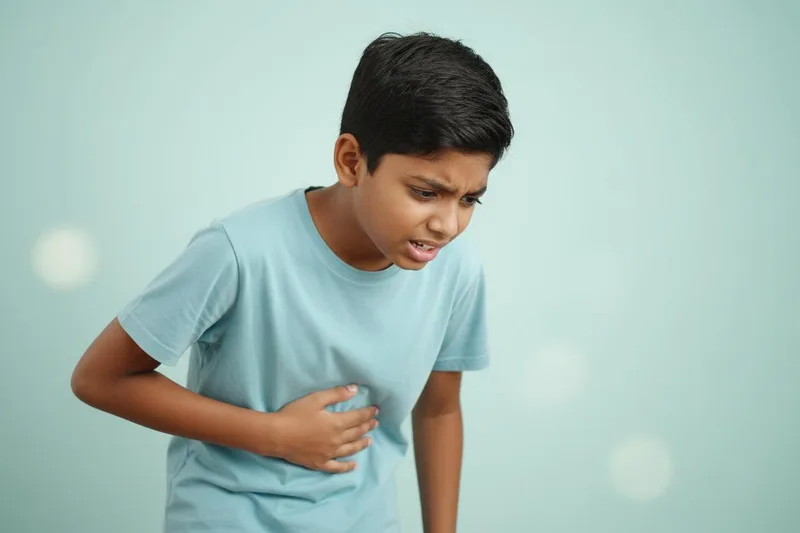
Have you ever been playing, running, or jumping and suddenly felt a sharp blow to your stomach, or your back was completely crushed to the ground, and you couldn't breathe? It's like the air in your chest is trapped, and it feels very difficult and scary at that time, right? Many of us call this 'a blow to the wind'. Some even say 'a gasp for air'. So today, let's talk about what this really is, why it happens, what to do if it happens, and when you should be afraid.
What does this 'windstorm' really mean?
Even though we say 'I've had a heart attack', this is not actually something directly related to the air in our chest. That is, it's not like the air is getting stuck somewhere. What really happens in this is a sudden impact on our large muscle called the diaphragm . Simply put, what happens here is that one of the most important muscles that helps you breathe temporarily stops working properly. Imagine, while you're running, someone suddenly pushes you, and your breathing rhythm is suddenly broken.
What is this great diaphragm? How does it work?
Okay, now let's see what this great diaphragm is, where it is located, and what happens to it.
The diaphragm is a large, flat, spherical muscle that looks like an upside-down saucer. It's located between our chest cavity and abdominal cavity. That is, it's like a wall that separates the part of your body that contains your lungs and heart from the part of your body that contains your stomach and organs like your liver.
This is the muscle that primarily works when we breathe in and out. Think of it like a big, dome-shaped roof between our chest and stomach.
- When we inhale: This large diaphragm moves down and flattens . This increases the space inside the chest cavity. When this space increases, the lungs can easily draw air in.
- When we exhale: This large diaphragm rises again, becoming spherical in shape . Then the space inside the chest cavity decreases, and the air in the lungs is pushed out.
It's like a bellows working, you know? This process happens all the time, without us even realizing it.
Then why do you feel short of breath when you get hit in the stomach?
Now that you have some idea about the diaphragm, what happens when you suddenly get hit hard in the stomach, or your back is bent, or your chest is hit hard by an elbow?
When you get a sudden, hard blow like this, the diaphragm suddenly jerks and tightens . As if you've been struck by an electric shock, the muscle suddenly contracts. In medicine, we call this a muscle spasm . The muscles in your leg twitch, that's what happens to the diaphragm, but it only lasts for a few seconds.
So, when this great diaphragm suddenly tightens like this, its normal function, which is to help us breathe, stops completely for a while. It feels like that muscle can't move. That's why we feel like we can't breathe, like our chest is constricted, like we're going to suffocate and die. It's a very uncomfortable, scary experience, isn't it? At that moment, it feels like the world is ending.
"To be precise, it feels like your main breathing engine suddenly 'stuck'. That's why it feels so uncomfortable."
When can something like this happen?
This 'windfall' experience can happen to anyone of any age, at any time. But it is most common in situations like these:
- During sports: This is the most common cause. Think of it this way: a ball hits you hard in the stomach while playing football, someone jumps on you while playing rugby, a fast ball hits you while playing cricket, an elbow hits you while playing netball, or a blow to the chest during a combat sport like karate. All of these can happen.
- When children are playing: When young children are running and playing, things like this can happen: they bump into each other, fall from trees, swings, or get a toy stuck in their stomach.
- Accidents: This condition can occur from things like slipping and falling down stairs, falling off a bicycle, or even a minor car accident.
- Other times: Sometimes, when laughing hard or coughing hard, the diaphragm may occasionally twitch a little and feel a little uncomfortable, but it doesn't feel as intense as that.
What to do if you get a 'windstorm'? How to recover quickly?
Okay, now let's see what we should do in a time like this. The most important thing is not to panic.
1. Calm down: The first thing to do is try to stay calm and not panic . I know it's scary when you can't breathe. But try to calm yourself down as much as possible. Remember, this usually gets better in a few seconds, a minute or two at most.
2. Try to breathe: Next, try to breathe slowly and deeply . You won't be able to take a big breath at once. Try taking small, slow breaths. Try to breathe in slowly through your nose and breathe out slowly through your mouth.
3. Change your posture: It can be easier to breathe when you are sitting, usually leaning forward a little . Some people also find it easier to lie down. Choose a position that is comfortable for you. Relax your body instead of slouching.
4. Loosen your clothes: If you are wearing tight clothing, such as a belt, tie, or tight shirt, loosen it a little . This will reduce the pressure on your chest and abdomen.
5. Help from those around you: If you are not alone, ask those around you to help you. They can calm you down, give you a hug, or give you some water.
6. Try to talk or moan: Don't be surprised, it is said that trying to talk, or even moaning a little, stimulates the diaphragm to function again.
Most of the time, you will start to feel relief within a few minutes of doing this. The spasm in your diaphragm will go away, and you will be able to breathe normally again.
When should we be worried about this? Should we see a doctor?
Although a 'windpipe' usually heals within a few minutes, sometimes it is necessary to seek medical advice, as it can sometimes be a sign of more serious internal damage than is apparent from the outside.
In cases like these, you should definitely see a doctor or go to a hospital :
- If shortness of breath persists: If shortness of breath lasts more than 5-10 minutes and gets worse, it may not be just a simple 'windy' situation.
- If you have severe pain: If you have persistent, severe, unbearable pain in your stomach, chest, or back, especially if the pain is worse when you press or touch it.
- Other symptoms:
- If you experience difficulty breathing, dizziness, blue eyes, or fainting (even for a short time).
- If you experience any kind of severe pain, tightness, or heaviness in your chest (this could be a sign of a heart attack, so be careful).
- If you cough up blood , or vomit blood.
- If your stomach feels like it's getting bigger and bigger.
- If the skin turns blue (especially the lips and fingernails).
- Severe impact: If you think the impact was very severe (for example: a fall from a height, a serious car accident, a heavy object falling on your body), it is wise to check for internal organ damage (such as the lungs, spleen, liver) as well.
- If this happens frequently: If you experience shortness of breath like this frequently for no apparent reason, it could be a sign of another medical condition.
"Remember, even though it may seem like a small thing, sometimes it can be a sign of a serious condition. So if you're in doubt, it's best to see a doctor and get advice. Don't just say, 'Oh, it's just a cold.'"
Could this have a long-term effect?
If you simply 'blow the wind' and it goes away after a while, there are usually no long-term effects . The diaphragm muscle will return to normal, without any damage.
However, as mentioned earlier, if the impact was severe, or if there were other symptoms (e.g., a broken rib, internal bleeding), long-term problems can occur if those conditions are not treated properly. That's why it's always a good idea to seek medical advice when in doubt.
Can this be prevented from happening?
This 'windfall' is often caused by accidents and unforeseen events, so it's difficult to prevent it 100%. That's life, isn't it?
However, we can reduce this risk somewhat by doing certain things:
- Safety in sports: When playing sports, especially contact sports, it is important to use protective gear appropriate for the sport. For example, some sports require chest guards.
- Correct technique: Practicing correct body posture and techniques while playing sports and lifting weights can help prevent unnecessary injuries.
- Taking care of young children: As adults, we need to be aware of places where young children can fall or stumble (sharp edges, slippery surfaces) when they are playing. Make sure the play areas are safe.
- General Precautions: It is important to be aware of hazards in our daily lives. Be careful when working at heights or walking on slippery surfaces.
So, the final take-home message:
Okay, so from what we've talked about, these are the most important things to keep in mind:
- Although we call it a 'windy' feeling when something hits your stomach, chest, or back and makes you feel suffocated, it is actually caused by a sudden spasm of the diaphragm .
- This usually goes away on its own within a few minutes . The only thing you need to do is stay calm and try to breathe slowly.
- However, if you continue to have difficulty breathing, experience severe pain, or have other serious symptoms (such as dizziness, loss of consciousness, coughing up blood), it is essential to seek immediate medical attention .
- If the impact is severe and there is suspicion of an internal injury, check that as well.
- It's always wise to see a doctor and get checked out whenever you have any doubts. Don't just dismiss it as "just something."
- This is generally not something to be afraid of, but it is something to be aware of and mindful of .
So, I hope you now have a better understanding of what happens when a 'windstorm' hits. Be careful!
` Shortness of breath, Diaphragmatic spasm, Abdominal distension, Flatulence, Difficulty breathing, Muscle spasm, First aid


💬 Comments (0)
No comments yet. Be the first to share your thoughts here.
Add Your Comment