
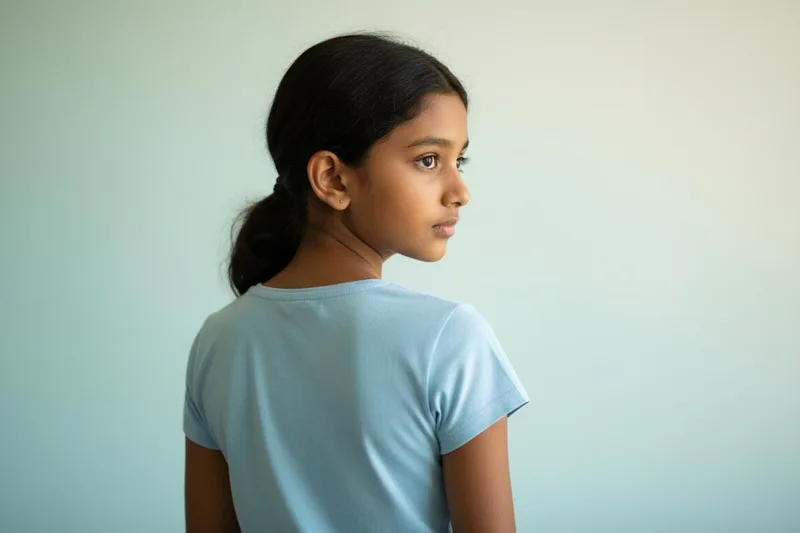
Have you ever noticed that some people's backs are slightly bent to one side? Or does your child seem to have one shoulder higher than the other when carrying a school bag? Maybe you've noticed a slight difference in your back when you look in the mirror. The cause of these things could be a curvature of the spine, which is a condition called `(Scoliosis)` in medical terms. Today we are going to talk about the two main types of `(Scoliosis)`: `(Levoscoliosis)` and `(Dextroscoliosis)`. Don't worry, this is usually not a serious problem, but it is very important to be aware of this.
What are Levoscoliosis and Dextroscoliosis?
Simply put, `(Levoscoliosis)` and `(Dextroscoliosis)` are the two main types of `(Scoliosis)`. All of us have some natural curves in our spine. If you look at us from the side, you will see that the neck curves forward, the chest curves back, and the hips curves forward. These are the natural positions of a healthy spine. However, in `(Scoliosis)`, the spine curves to one side, that is, to the left or right. It looks like an 'S' or a 'C'.
- Levoscoliosis is when your spine curves to the left , making your spine look like the letter "C".
- Dextroscoliosis is when your spine curves to the right . This is the opposite of levoscoliosis. The curve of your spine can look like an inverted "C" or a circle with the left side missing.
In most cases, if the condition is mild , either ``Levoscoliosis'' or ``Dextroscoliosis'', no special treatment is needed. However, a doctor will check your spine every few months to see if the curvature is getting worse. Because sometimes, if the curvature gets worse, it will need to be treated.
How do these conditions affect our bodies?
The main thing is the unnatural curve that the spine appears to have. `(Levoscoliosis)` condition usually affects the lower part of the spine, that is, the `(Lumbar spine)` . `(Dextroscoliosis)` condition most often affects the `(Thoracic spine)` . However, it is important to remember that these curvatures can occur in any part of the spine.
If this stretching is significant enough, it can cause unnecessary strain on the back muscles or even put pressure on the nerves in the spine.
It is very rare, but if the strain is severe , it can cause damage to the internal organs around the spine. For example:
- Heart
- Lungs
- Spinal cord
Although this kind of situation rarely occurs, it is good to be aware of it.
Scoliosis and various areas of the back
As we mentioned earlier, both `(Levoscoliosis)` and `(Dextroscoliosis)` can affect any of the three main parts of our spine:
- Cervical spine : This refers to the bones in your neck.
- Thoracic spine : The upper part of the spine from the neck to the end of the ribs.
- Lumbar spine : The lowest part of the spine.
How common are these conditions?
Scoliosis is actually not that common. It affects less than 5% of the population. It is also most common in young children .
Consider this: Scoliosis can run in families. That is, about 30% of people with scoliosis have a family member (parents, siblings, or grandparents) who also has the condition. Dextroscoliosis (right-sided scoliosis) is slightly more common than levoscoliosis (left-sided scoliosis).
Who gets levoscoliosis and dextroscoliosis?
These conditions can affect anyone, from young children to adults. However, scoliosis is most commonly seen in young children . Girls are more likely to develop this condition than boys.
Scoliosis usually occurs in the thoracic spine in children and young adults. In adults, it most commonly occurs in the lumbar spine.
What are the symptoms of these conditions?
Scoliosis rarely causes noticeable symptoms, such as a change in posture. Most of the time, it doesn't cause any pain or discomfort . In fact, you may not even know you have the condition until it's diagnosed by a doctor.
Usually, changes in your posture are the easiest for someone else to notice . For example:
- Your shoulders are not level .
- A curve that is clearly visible when someone looks at your spine.
- Your hips are not at the same level when you are sitting or standing.
If you have a very mild form of scoliosis, it may be difficult to detect without special testing.
What are the causes of levoscoliosis and dextroscoliosis?
There may be several reasons for these situations:
- Idiopathic scoliosis: This is the most common type. ``Idiopathic'' means "of unknown cause." This means that no specific cause has been found. However, because it tends to run in families, it is believed to have a genetic basis.
- Congenital scoliosis: This is a very rare birth defect . That is, the child is born with a defect in the spine.
- Degenerative scoliosis: This is caused by the wear and tear of the bones and joints of the spine as we age . This is the main reason why adults develop scoliosis.
- Neuromuscular scoliosis: This is caused by abnormalities in the muscles and nerves that support the spine. For example, it can occur in people with conditions like Cerebral Palsy, Spina Bifida, and Muscular Dystrophy.
Misconceptions about scoliosis and posture
Many people think that sitting incorrectly or slouching causes scoliosis. This is completely wrong. Bad posture never causes scoliosis. True, things like poor posture and lifting weights incorrectly can damage your back health and posture, but they do not cause back pain.
Also, small children and young children do not develop scoliosis from playing sports or lifting heavy bags. This is also a misconception among many parents.
How are levoscoliosis and dextroscoliosis diagnosed?
A doctor usually diagnoses scoliosis through a physical exam.
They will ask you to take off your shirt, drop your shoulders, and bend forward. This is also called the Adam's forward bend test . This will allow them to see your spine clearly and check for any abnormal curves caused by scoliosis. This test can also help diagnose kyphosis, a condition similar to scoliosis.
Schools often screen children for scoliosis. If your child's school sees something like this, they will let you know, and you can then visit your child's regular doctor and take the necessary steps.
What tests are done to diagnose this condition?
In addition to examining your spine, the doctor may also use a device called a scoliometer . This is a hand-held device that looks like a combination of a ruler and a level. The doctor places the scoliometer on your spine to look for any abnormal curvature. This helps to determine the exact location and direction of the curvature more accurately than is possible with the naked eye.
If you see signs of scoliosis, either through a physical exam or a scoliometer, you may need to have several imaging tests to find out exactly what's going on inside your body. These include:
- X-rays
- MRI tests `(MRI)`
- CT scan
After these tests, the doctor will conclude whether you have ``Levoscoliosis'' or ``Dextroscoliosis'', depending on the side of your spine that is curved.
How are levoscoliosis and dextroscoliosis treated?
Treating scoliosis is not about curing a disease. The focus is on stopping the condition from getting worse over time. If your scoliosis is mild, you will likely only need to see your doctor every four to six months to monitor your scoliosis. Your doctor will then examine your spine and measure any changes in the curvature. If it has not gotten worse, you may not need any further treatment.
However, if the scoliosis continues to change and the curvature of the spine increases, there are several treatment options:
- Bracing: This involves wearing a specially designed brace (similar to a corset). This provides support to the spine and prevents further strain. The brace usually extends from the armpit to the waist. Your doctor will tell you how long you should wear it and for how long. Most people need to wear it for at least 20 hours a day.
- Scoliosis surgery: Surgery is rarely necessary for scoliosis. If the curvature is severe or gets worse over time, your doctor may recommend spinal fusion surgery . You may also need bone grafting to straighten your spine and reduce the curvature. Your surgeon or doctor will explain what type of surgery you need, how long it will take, and how long it will take to heal.
- Schroth method: Some scoliosis conditions can be treated with a special physical therapy method called the Schroth method . This is usually used for pediatric scoliosis. Your doctor or physical therapist will teach your child stretches, posture-correcting movements, and breathing exercises. These movements strengthen the muscles around your child's back and help bring the spine into a more natural curve.
How do I take care of myself?
If you have either `(Levoscoliosis)` or `(Dextroscoliosis),` you probably won't need to make any major changes to your daily life. Just go to your doctor regularly and monitor your spine for any changes.
You don't have to stop exercising or playing sports just because you have this condition. In fact, staying active can help strengthen the muscles around your spine and reduce the impact of scoliosis on your body. However, if you have had surgery to correct your scoliosis, you may need to avoid certain physical activities until you recover. Talk to your surgeon or doctor about this.
If you notice any changes in your back, especially if you experience new symptoms like pain or numbness in your limbs , tell your doctor immediately.
Can I prevent Levoscoliosis or Dextroscoliosis?
In fact, `(Levoscoliosis)` and `(Dextroscoliosis)` cannot be prevented .
As we mentioned earlier, there is no known cause for `(Idiopathic scoliosis)`. `(Degenerative scoliosis)` occurs with age-related changes in the body. `(Congenital scoliosis)` and `(Neuromuscular scoliosis)` are caused by other health conditions, and even those are often things we cannot prevent. Therefore, don't think that it is your fault when this condition occurs.
What happens if I have either Levoscoliosis or Dextroscoliosis?
This condition is unlikely to have a major impact on your life. Most people with scoliosis just need to see their doctor regularly to make sure their spine is not changing significantly.
Technically, you will have to live with scoliosis for the rest of your life. However, once your spine has stopped growing, meaning it has reached a point where it can no longer curve, you will no longer need any special treatment in the future.
Even if you need treatment, once your spine is stabilized, whether after a brace or surgery, you can make a full recovery.
When should I see my doctor?
Talk to your doctor about how often you should see your doctor. Most people with either ``Levoscoliosis`` or ``Dextroscoliosis`` need to have their spine checked every four to six months.
What questions should I ask my doctor?
- What type of scoliosis do I have?
- How often will I need to have my spine checked in the future?
- Do I have to put a `(brace)`?
- Will I have to have surgery in the future?
It can be scary to learn that you or your child has a back problem. However, scoliosis is a rare, painless condition that rarely requires treatment. Whether you or your child has scoliosis, whether it is levoscoliosis or dextroscoliosis, the chances of long-term complications are very low.
If you notice any changes in your back or spine, or if your child's shoulders or hips seem out of alignment, talk to a doctor.
Finally, remember this (Take-Home Message)
Okay, so here are some of the most important things we've talked about to help you remember them:
- Levoscoliosis and Dextroscoliosis are two types of scoliosis, a condition in which the spine curves to one side.
- This is usually not a serious problem , especially if the swelling is minor.
- The most important thing is to have regular medical checkups and see if the swelling increases.
- If the stretching increases, there are treatments such as bracing and physical therapy (Schroth method). Surgery is rarely necessary.
- This situation cannot be prevented , so don't feel guilty about it.
- Live a normal life, stay active, and follow medical advice.
Remember, if you or your child has any doubts about something like this, the best thing to do is to see a doctor and get advice. Then you can rest assured.
` Back pain, scoliosis, levoscoliosis, dextroscoliosis, back, spine, lower back pain




💬 Comments (0)
No comments yet. Be the first to share your thoughts here.
Add Your Comment