
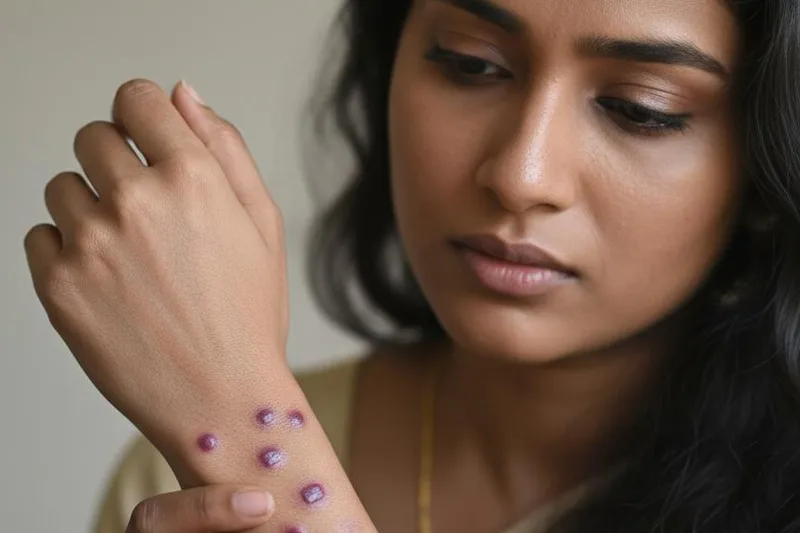
Have you suddenly developed small, itchy, flat, purple-colored, shiny blisters on your body, especially on your wrists, elbows, and legs? Or are there white, mesh-like lines on the inside of your mouth and on the sides of your cheeks? Maybe you've noticed a change in your nails? It's normal to feel a little scared and worried when you see these things. But don't worry. Today, we're going to talk about a skin condition that affects many people, but is not that dangerous, called lichen planus.
Simply put, what is Lichen Planus?
Lichen planus is a skin condition that causes small, raised bumps (papules) to appear on the skin, mouth, nails, scalp, and sometimes genitals. These can appear in just one spot, or they can appear in multiple areas of the body at once.
The main areas that this disease can affect are:
- Skin: Especially on the wrists, elbows, and legs below the knees.
- Inside the mouth (Oral Mucosa): Inside the cheeks, tongue, and lips.
- Scalp: The skin where the hair is.
- Nails: On the hands and feet.
- Genitals: Male and female genital areas.
This is actually a condition caused by a small misunderstanding of our immune system. Let's look at it in a little more detail.
Is this an autoimmune condition? Why does this happen?
Although lichen planus is not exactly classified as an autoimmune disease, it involves a similar process. Think of it this way: our immune system is like our army. Their job is to protect us from foreign invaders (like viruses and bacteria). A special part of this army is called T cells.
In a healthy person, these T cells only fight germs that come from outside. But in someone with lichen planus, these T cells go awry and start attacking a protein in our own skin and mucus membranes, thinking it's an enemy.
The exact reason why these T cells suddenly behave this way is still unknown. That's why it's called an idiopathic, or "unknown" condition.
Difference Between Lichen Planus and Lichen Sclerosus
These two names are a bit similar, which can be confusing for some people. Both are conditions that affect the skin and the exact cause is unknown. But there is a key difference.
- Lichen Sclerosus: This is a condition in which the skin gradually thins, becomes itchy, sores form, and eventually scars form. Although it can occur anywhere on the body, it is most commonly seen around the genitals and anus. This condition is common among women who have gone through menopause. Importantly, lichen sclerosus rarely occurs inside the mouth.
- Lichen Planus: This is the condition we are talking about. This commonly affects the skin as well as the inside of the mouth.
Difference Between Lichen Planus and Psoriasis
Psoriasis is also a skin disease that many people are familiar with. Both of these can be confused because they cause skin patches. But there are differences. In psoriasis, the patches on the skin take on a white, scaly appearance . Also, psoriasis does not usually occur inside the mouth.
Who is most likely to get this condition?
Anyone can develop lichen planus, but certain groups are more likely to develop it.
- This usually occurs in people between the ages of 30 and 60 .
- Women are about twice as likely to develop this disease than men.
- This condition is more likely to occur in women in their 60s and in men in their 40s.
Importantly, if you have lichen planus on your skin, you have a 50% - 75% chance of developing it inside your mouth (Oral Lichen Planus).
What are the symptoms of this disease?
Symptoms depend on where on your body the lichen planus condition affects you. Let's take a look at what the symptoms are for each area.
| Affected location | Symptoms that are seen |
|---|---|
| Skin and genitals | Small, raised bumps (papules) on the skin. These can start as small as a pinhead (0.4 mm) and can grow to be as large as the width of a pencil (1 cm). They are purple in color. They are flat and shiny on top. They can be very itchy . Sometimes they can become sores. |
| Inside the mouth (Mouth) | Small white dots or web-like lines appear on the inside of the cheeks, tongue, or lips. In some severe cases, the surrounding skin may become red, inflamed, and sore. You may feel a burning sensation when eating spicy, hot foods. |
| Nails | Things like discoloration of the nails, streaking, cracking, nail growth stopping, or nail loss may occur. |
| Scalp | It can cause redness, inflammation, and sometimes scarring of the scalp, leading to permanent hair loss. |
Lichen planus is usually not painful. However, if you scratch the skin, it can lead to infections and pain. Therefore, you should avoid scratching as much as possible.
What causes this condition to flare-up?
Some things can cause this disease to suddenly worsen, or flare-up. Some of them are:
- Hepatitis C virus infection.
- Some vaccines .
- Some painkillers (NSAIDs) .
- Some medications taken for arthritis, heart disease, or high blood pressure .
- Allergies to certain chemicals, metals (e.g. mercury used in dental fillings) , or pigments.
Is this a contagious disease?
No. This is not a contagious disease at all. This disease cannot be transmitted to another person through skin-to-skin contact or sexual intercourse. So don't be afraid of this.
How does the doctor recognize this?
A doctor can usually tell if it's lichen planus by examining your symptoms and looking at the patches on your skin. They look for a few specific signs called the "Six Ps" to help identify it.
- Pruritic (itchy)
- Polygonal (has a multi-shaped shape)
- P lanar (flat on top)
- Purple
- Papules (small blisters)
- Plaques (skin patches)
However, sometimes the doctor may decide to perform several more tests to confirm the diagnosis.
- Allergy test: See if this condition is aggravated by any allergies you have.
- Skin biopsy: This involves taking a very small piece of skin from the area where the mole is and examining it under a microscope. This can confirm the disease 100% of the time.
- Hepatitis C test: Sometimes lichen planus is associated with the hepatitis C virus, so this test may also be done.
What are the treatments for this?
There is no permanent cure for lichen planus. But don't worry. In most cases, lichen planus on the skin will get better on its own within a few months or a year or two without any treatment.
However, if symptoms like itching and burning are bothersome, your doctor will prescribe treatment to control them.
Medical treatment
- Corticosteroid creams/ointments: These help reduce inflammation and itching.
- Antihistamines: These are useful for controlling itching.
- Phototherapy: This involves directing ultraviolet (UV) light emitted from special lamps onto the skin to control symptoms.
- Immunosuppressants: If the disease is severe, pills that reduce the activity of the immune system (such as oral corticosteroids, azathioprine) may be given.
- Retinoids: These medications, made from vitamin A, are available in pill or cream form. However, women who are pregnant or planning to become pregnant should definitely talk to their doctor before using them.
Things you can do at home and lifestyle changes
In addition to medical treatment, there are things you can do yourself to reduce discomfort.
- Aloe vera: Applying aloe vera gel can speed up the healing of inflammation and wounds.
- Oatmeal treatment: Mix some finely ground oats (colloidal oatmeal) with a little water to make a paste. Apply this to the itchy areas, leave it on for about 10 minutes, and then wash it off.
- Manage stress: Stress is a factor that can aggravate any skin condition. So try to keep your mind calm through breathing exercises, meditation, and yoga.
- If it is inside the mouth (Oral Lichen Planus):
- Maintain good oral hygiene. Brush your teeth thoroughly.
- Avoid spicy, sour, and hot foods and drinks. Things like chilies, sauces, citrus fruits like oranges, tomatoes, and alcohol can increase inflammation.
- Avoid smoking completely.
- Some people may be allergic to amalgam fillings . If you suspect this, talk to your dentist about it.
When should I see a doctor?
If you have any of the following, definitely see a doctor.
- If you develop new symptoms.
- If there is no improvement in symptoms after treatment.
- If skin blemishes have been present for longer than expected.
- If the area where the spots are appears infected (e.g. red, swollen, or oozing pus).
You can ask these questions when you go to see the doctor.
- Can you tell for sure if this is lichen planus?
- If not this, what other skin diseases could it be?
- How long will it take for this condition to heal?
- What kind of medicine is good? Do they have side effects?
- What treatments can be done at home?
Lichen planus is a condition that can be embarrassing, itchy, and embarrassing, but remember, it is not a dangerous or contagious disease. It usually clears up on its own. The most important thing is to take care of your skin and seek medical attention if necessary.
Take-Home Message
- Lichen Planus is a condition that causes itchy, purple blisters on the skin, mouth, and nails.
- Although the exact cause of this has not been found, it is believed to be caused by some misunderstanding in the immune system.
- This is not a contagious disease at all. It cannot be spread from one person to another.
- In most cases, this condition resolves on its own within a few months or a year or two without any treatment.
- There are medical treatments and home remedies to control symptoms such as itching and inflammation.
- It is very important to keep your mind relaxed, as stress can aggravate this condition.
- If you notice any unusual changes in your skin, see your doctor immediately for advice.


💬 Comments (0)
No comments yet. Be the first to share your thoughts here.
Add Your Comment