
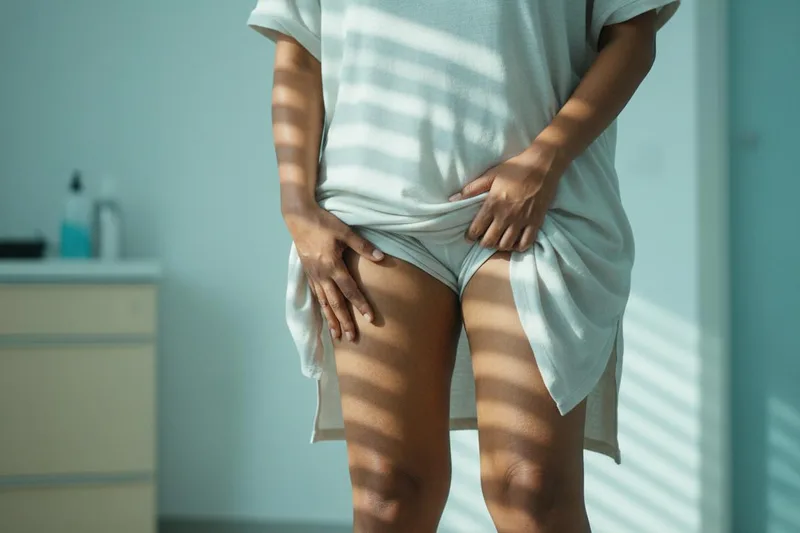
Do you sometimes feel like some areas of your body, especially your legs, thighs, and buttocks, are bigger than the rest? Maybe it even hurts when you press on it. Even though you've dieted and exercised, your upper body has become thinner, but these areas remain the same? Then this is something that may be very important to you. This condition is called `(Lipedema)`.
What is `(Lipedema)`? Let's understand it exactly?
Simply put, `(Lipedema)` is a long-term condition in which fat accumulates abnormally in our bodies, especially in the lower part – that is, in places like the buttocks, thighs, and buttocks . Think of it like fat accumulating only in certain parts of the body. For some people, it can also occur in the hip area or the upper part of the arms. However, it is said that it does not affect the palms or soles of the feet in most cases.
Many people think that this is just being overweight or a disease called `(Lymphedema)` that causes swollen lymph nodes. But these are actually three different conditions. However, people with `(Lipedema)` are also more likely to develop `(Lymphedema)` later in life. Many people with `(Lipedema)` have a body mass index, that is, `(Body Mass Index - BMI)`, which is more than 35.
The most important thing is that no matter how much you diet and exercise and lose weight in the upper body, the fat deposited in the lower part of the body (Lipedema) does not easily decrease. This is a matter that makes many people uncomfortable.
Are there different types of `(Lipedema)`?
Yes, there are different types of `(Lipedema)`. You may have more than one of these types depending on where you have symptoms. Let's see what they are:
- Type I: In this type, fat is stored between your buttocks and hips.
- Type II: Here, fat accumulates from the pelvis to the knees.
- Type III: In this type, fat can be present from the pelvis to the ankles.
- Type IV: This affects both arms. Fat is deposited from the shoulder to the wrist.
- Type V: In this type, fat accumulates from the knees to the ankles.
How common is this condition called `(Lipedema)`?
It is difficult to give exact statistics on how common lipedema is. Some studies suggest that it affects about one in 72,000 people. However, experts believe that the number could be much higher. This is because the condition is often confused with obesity or lymphedema, a swelling of the lymphatic system. Another global estimate is that about 11% of women suffer from lipedema . It is very rare in men.
What are the symptoms of `(Lipedema)`? See if you have these too
Okay, now let's see what the main symptoms of `(Lipedema)` are. It is very important to be aware of these.
- Fat accumulation on both sides of the body: You have symmetrical fat accumulation on both sides of your body, in places like your buttocks, thighs, hips, and sometimes on the upper arms.
- Lumps under the skin: In these areas where fat is deposited, lumps of something, like small pebbles, can be felt under the skin.
- Pain: This is one of the main symptoms of `(Lipedema)`. For some, this pain may be a slight ache that only occurs when you press on it. For others, it may be a constant, unbearable pain.
- Heaviness in the legs: The feeling that the legs are very heavy and dragging.
- Swelling: The affected areas may be swollen.
- Bruises easily: The skin is very delicate, so even a small bump can easily bruise or turn blue.
- Constant fatigue: Feeling more tired and exhausted than usual.
What are the causes of `(Lipedema)`?
To be honest, doctors still haven't been able to pinpoint the exact cause of Lipedema. However, there are several factors that are thought to contribute to it:
- Hereditary factors: It is often thought that this may run in families. Research has shown that between 20% and 60% of cases are hereditary. This means that if your mother or grandmother had the condition, you are more likely to develop it too.
- Hormonal Influence: Since this condition is most common in women, it is suspected to be related to hormones. Lipedema can begin or worsen during the following times:
- Puberty is the time of puberty.
- During pregnancy.
- During menopause.
- When taking birth control pills containing hormones.
- Obesity and Lipedema: Obesity does not cause Lipedema. However, more than half of people with Lipedema have a body mass index (BMI) greater than 35. This suggests that there may be a link between the two conditions.
Who is at higher risk of developing `(Lipedema)`?
You are at slightly higher risk of developing ``Lipedema`` if you have these factors:
- Being a woman: As mentioned earlier, this is most common among women.
- Family history: If anyone in your family has `(Lipedema)`.
- Having a high `(BMI)` value: If the body mass index `(BMI)` is more than 35.
Other complications that can occur due to `(Lipedema)`
If this condition is not managed properly, it can lead to other health problems. Therefore, it is very important to take care of this.
- Difficulty walking: Fat accumulation in the legs can make it difficult to walk and perform daily tasks.
- Psychological effects: Mental conditions such as shame, anxiety, and depression about one's appearance may occur.
- Secondary Lymphedema: This is also called Lipo-lymphedema. This occurs when the lymphatic pathways are blocked, causing lymph to accumulate and cause swelling.
- Venous disease: Problems with the veins in the legs can occur.
- Flat feet .
- Joint problems: Pain and stiffness in joints such as knees and ankles may occur.
- Knock knees: A condition in which the knees knock together when standing with the legs apart.
How do you know if you have `(Lipedema)`?
If you have these symptoms, the best thing to do is see a doctor. So how does a doctor diagnose this as `(Lipedema)`?
This is usually determined by a doctor after a physical exam and a medical history. The main thing is that the fat deposits in `(Lipedema)` are painful to press on. Normal fat does not hurt when pressed. That's a big difference.
Also, in people with `(Lipedema)`, there is a clear difference in size between the unaffected soles of the feet and the affected legs. It is as if the leg is swollen, but the sole is normal in size.
What tests can be done?
There is currently no specific test to tell for sure if this is `(Lipedema)`. However, doctors can do some tests to rule out other conditions (for example, `(Lymphedema)` or general obesity) and to look for other conditions that may be present with `(Lipedema)`. These include:
- Ultrasound scan: A test that uses sound waves.
- DEXA scan: A test that uses X-rays to measure bone density.
- Magnetic Resonance Imaging (MRI): A scan that uses a magnetic field and radio waves.
- Computed Tomography (CT) Scan: A scan that uses X-rays and a computer.
- Nuclear medicine imaging: A scan performed by injecting a radioactive substance into the body.
Stages of Lipedema
For most people, this condition (Lipedema) gets worse over time. For some, it gets worse slowly, while for others, it can get worse quickly. Let's take a look at the main stages of this:
- Stage 1: At this stage, your skin may look normal, but you may be able to feel small pebbles under your skin. You may also experience pain and bruising at this stage.
- Stage 2: At this point, the skin surface is uneven. It may look like the surface of a mattress, or like the skin of a walnut, or like cottage cheese, with dimpling.
- Stage 3: At this stage, the legs may look like inflated square balloons. Large folds of skin and fat develop. Fat on the legs may protrude, making it difficult to walk.
- Stage 4: This is the most severe stage. Here you have both `(Lipedema)` and `(Lymphedema)` (also called `Lipo-Lymphedema`).
What are the treatments for `(Lipedema)`?
Unfortunately, there is no cure for this condition, ``Lipedema''. But don't worry! There are many treatments that can help reduce pain, control swelling, and improve your quality of life. These treatments can help you find relief.
Simple treatments
First, you can start with simple treatments that are not too taxing on the body.
- Exercise: Exercise is very important. Things like swimming, cycling, and walking help to move your body and reduce swelling. Exercising in a pool is especially good because it reduces pressure on your joints.
- Diet: Eating an anti-inflammatory diet and a heart-healthy diet can also help control the worsening of lipedema. This is especially important if you catch it early. However, keep in mind that lipedema cannot be reduced by diet alone, as is the case with normal body fat.
- Compression stockings: Wearing these helps reduce swelling and improve blood circulation.
- Skin moisturizer: It is a good idea to use a good skin moisturizer to prevent skin dryness and keep it healthy.
- Medications and supplements: Your doctor may recommend certain medications or supplements to help with things like pain and swelling. For example, some painkillers and anti-inflammatory drugs (such as Amphetamines, Phentermine, Metformin, Resveratrol, Diosmin, and Selenium) may be considered by your doctor. These should always be used as directed by your doctor.
- Antioxidant herbs: Some herbal remedies with antioxidant properties can sometimes help, but these should also be taken with medical advice.
Noninvasive treatments
Next, there are several non-invasive treatments that don't cause much harm to the body:
- Lymphatic drainage massage: This is a very gentle massage technique that helps to move lymph fluid and reduce swelling.
- Complex decongestive therapy (CDT): This involves massage followed by the application of a special compression wrap.
- Pneumatic compression devices: These are devices worn on the legs. They apply gradual pressure to the legs to reduce swelling.
Invasive therapies such as surgery
In some severe cases, you may need to resort to things like surgery:
- Liposuction: Liposuction is a surgical procedure that removes excess fat, reducing pain and improving mobility. Doctors usually recommend specialized liposuction techniques, such as wet-jet assisted liposuction, that minimize damage to lymph vessels.
- Bariatric surgery: If you have lipedema and a body mass index (BMI) of over 35 (i.e., severe obesity), your doctor may recommend bariatric surgery.
Let's also be aware of the side effects of treatments.
Any medication or herbal supplement can cause side effects in some people. If you are experiencing any discomfort, it is best to talk to your doctor about it.
Some complications can occur even after undergoing `(Liposuction)` or `(Bariatric surgery). For example:
- Swelling
- Bleeding
- Infections
- Blood clots
This is why it is important to discuss any treatment thoroughly with your doctor and understand the pros and cons before starting it.
How long does it take to recover after treatment?
It usually takes about four to six weeks to fully recover after liposuction. It also takes several weeks to recover after bariatric surgery. Doctors advise avoiding strenuous activities and heavy lifting for about six weeks after a surgery like this.
Is there a way to prevent `(Lipedema)`?
Since the exact cause of lipedema is not known, it is difficult to completely prevent it. However, if you have a family history of lipedema, or if you are a woman, it is a good idea to try to maintain a healthy weight. Talk to your doctor about a healthy diet and exercise plan to help you manage your weight.
What is the future for someone with `(Lipedema)`?
For some people, ``Lipedema`` may get worse over time (for some, faster). However, for others, the symptoms may not be as severe, or may remain the same.
Early detection and early treatment can help prevent complications. Exercise and wearing compression stockings can help. Some people may find significant relief from treatments such as liposuction.
If you have other health conditions, such as depression, obesity, or lymphedema, your lipedema may worsen. Therefore, it is important to get those conditions treated properly. If necessary, your doctor may refer you to counseling, physical therapy, or pain management.
How do you take care of yourself?
When living with Lipedema, it is very important that you take care of yourself.
- Follow your doctor's instructions: Take the treatments and medications your doctor prescribes exactly and on time. If you have any doubts about things like when to take your medications or how long to wear compression stockings, don't be shy about asking your doctor.
- Go for scheduled checkups: By seeing your doctor on scheduled days, he can monitor changes in your condition and the success of your treatment.
- Take care of your skin: Keep your skin clean and moisturized. Avoid cuts and scratches.
- Healthy lifestyle: Eat as healthy a diet as possible, drink plenty of water, and get enough sleep.
When to see the doctor
Your doctor may need to see you once a month or every few months to monitor your treatment. Also, talk to your doctor if:
- If you have any problems or side effects from the treatment.
- If the treatment doesn't show results within the time frame discussed.
- If symptoms suddenly worsen.
Emergency treatment (ETU) cases
If you have any of these symptoms, go to an emergency room immediately:
- If your legs suddenly become red, painful, swollen, and warm.
- If you have flu-like symptoms (fever, chills, and body aches).
These could be a serious skin infection (cellulitis), which requires immediate treatment.
Questions to ask the doctor
When you go to see your doctor, asking questions like these can help you get a better understanding of your condition:
- What type of `(Lipedema)` do I have? What stage am I in?
- What is the best treatment method for me?
- How successful has this treatment been for others with `(Lipedema)`?
- How often should I come back for follow-up appointments?
- What can I do at home to control this condition?
Finally, this is what I have to say to you (Take-Home Message)
Living with lipedema – an abnormal accumulation of fat on your lower body, sometimes on your arms and legs – can sometimes be a mental and physical challenge, as it can limit your ability to move around and cause pain.
But remember, you are not alone. There are many other people who are going through this. Talking to others – even in an online support group – can be a great source of strength. They, and your doctor, will understand that lipedema is a condition that is different from normal body fat and that requires special attention.
Don't worry, don't give up hope. With the right medical advice, proper treatment, and your own dedication, you can definitely manage this condition, reduce pain, and live a more comfortable life.
` Lipedema, lipedema, fat deposits, leg swelling, women's diseases, hormones, painful fat, lymphatic system, Lymphedema, lymphedema, body mass index, BMI


💬 Comments (0)
No comments yet. Be the first to share your thoughts here.
Add Your Comment