

Have you ever seen a small child, or sometimes an adult, with small red spots all over their body and a fever? It could be measles. This is not a game, it is a disease that can be dangerous if not taken care of properly. Let's talk about this in detail today.
What exactly is measles (Rubeola)?
Simply put, measles is a highly contagious viral disease. It is caused by a virus belonging to the Morbillivirus family. It causes spots all over the body, along with symptoms such as fever and cough. But measles is not just a few spots. It can make you very sick, and sometimes it can lead to serious conditions such as encephalitis , which can be life-threatening, or pneumonia . Not only that, measles also weakens your immune system, making you more susceptible to other diseases. In the past, before a vaccine was available, millions of people around the world died from measles. It is still seen in some countries. There is no specific treatment or cure for it.
Measles is also called rubeola, 10-day measles, and scarlet fever. But this is not German measles (Rubella), it is a separate disease.
How is measles transmitted?
Measles is a highly contagious disease that spreads through the air . When someone with measles breathes, coughs, sneezes, or talks, tiny virus particles are released into the air. These virus particles can remain in the air for up to two hours after the person with measles leaves the room. They can also remain on surfaces such as tables, chairs, and doorknobs. If you touch such surfaces and then touch your mouth, nose, or eyes with the same hand, you can become infected.
These are some of the main ways measles can be spread:
- Being around someone who has measles. This means talking, sharing food and drinks, kissing, shaking hands, and hugging.
- Touching a surface or object that has the virus on it and then touching your mouth, nose, or eyes with the same hand.
- If a pregnant mother has measles, she can pass it on to her baby during pregnancy, childbirth, or breastfeeding. This is called vertical transmission.
Imagine, if one person with measles comes into a room with ten people who haven't been vaccinated against measles, doctors say that nine of those ten have a high chance of getting measles. That's how contagious it is! You can infect someone from four days before you get the rash until four days after the rash appears.
What are the symptoms of measles?
Measles symptoms don't appear all at once. They come on gradually. You may notice things like this at first:
- I'm getting a high fever .
- A barky cough is coming on.
- Eyes become red, or tears come out of the eyes (red or bloodshot eyes).
- Runny nose.
- I feel very tired.
- Small red spots with a white center (called Koplik's spots) may appear inside the mouth and on the cheeks. These spots usually appear within two to three days and fade as other spots on the body begin to appear.
- Then the rash starts to appear all over the body .
- Some people may experience digestive symptoms such as stomach upset, diarrhea, and vomiting.
- My throat hurts.
- Body aches and headaches may also occur.
First, symptoms such as fever, cough, runny nose, and red eyes appear. It is only after two to three days that the so-called ``Koplik's spots'' appear inside the mouth. The spots on the body begin to appear even later, about three to five days after the initial symptoms begin. When the spots appear, the fever can return.
What do measles spots look like?
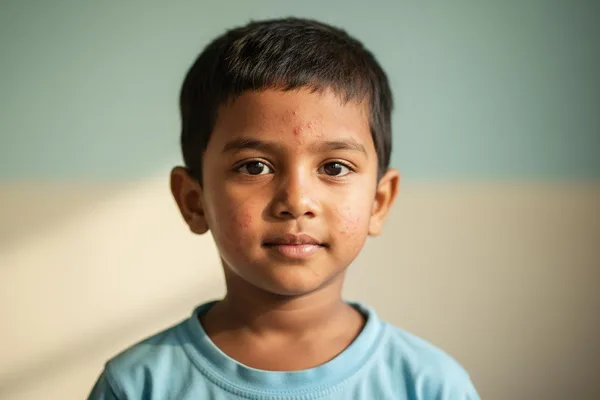
Measles spots usually start on the face. They appear as flat spots. If you have light skin, they will look red. If you have dark skin, they may be purple or darker than the surrounding skin. Sometimes they can be hard to see clearly.
These spots then spread to the neck, chest, back, arms, legs, and soles of the feet. As they spread, some spots may join together and become larger. In some places, they may be raised like bumps, and in some places, they may be flat. However, these spots usually do not itch .
Who is most at risk of developing measles?
Some people are more likely to develop serious complications from measles. These include:
- People over 20 years old and children under 5 years old.
- Pregnant mothers.
- People with a weak immune system are ``immunocompromised.`` That means people who are taking medication for diseases like cancer, are infected with HIV, or have a reduced ability to resist disease for other reasons.
What are the dangerous complications that can occur due to measles?
While some complications from measles are minor, others can be serious and life-threatening. Check out these:
- Ear infections.
- Dehydration due to severe diarrhea.
- Bronchitis.
- Laryngitis.
- Pneumonia : This is the leading cause of death in young children from measles.
- Loss of sight (Blindness).
- Swelling or inflammation of the brain (encephalitis) . This can cause permanent brain damage and, rarely, even death.
- Subacute sclerosing panencephalitis (SSPE) is a rare but fatal infection of the nervous system. It can occur years after measles.
- Measles inclusion body encephalitis (MIBE) is a brain inflammation. This can also occur days or years after measles. People with weakened immune systems are especially at risk.
- Ultimately, even death can occur.
Most importantly, if you get measles during pregnancy, your baby may be born prematurely or have a low birth weight .
How do doctors diagnose measles?
A doctor may suspect measles based on your medical history, physical examination, and the nature of the rash. However, they may also do tests like these to be sure:
- Blood tests .
- Testing samples of fluid taken from your nose or throat (swabs from nose or throat).
- Urine tests .
Is there a cure for measles?
Unfortunately, there is still no cure or specific treatment that can completely cure measles.
But if you are hospitalized, your doctor may give you vitamin A to reduce the risk of serious complications. However, you should not take vitamin A on your own without a doctor's supervision. Taking too much vitamin A can cause a serious condition called vitamin A toxicity, which can damage your internal organs. Vitamin A does not cure measles or prevent it from developing.
How long does measles last?
If you don't have any other complications, measles usually lasts about 10 to 14 days.
When should you see a doctor?
Be sure to talk to a doctor in cases like these:
- If you have questions about the vaccine.
- If you think you may have been exposed to someone who has measles (your doctor may be able to give you immunoglobulin (antibody) treatment to reduce your risk of developing the disease).
- If you want to check your measles antibody levels (antibody `titers`) to see if you have immunity to measles.
You should go to the emergency room if you have any of these symptoms:
- If you have difficulty breathing.
- If you have chest pain.
- If your eyes are too sensitive to light (Sensitivity to light).
- If you feel a stiff neck.
- If you have a bad headache.
- If there is confusion.
- If you are vomiting a lot or have diarrhea.
What happens if you get measles?
Measles can make you very sick. It is estimated that about two out of every five people who get measles will need to be hospitalized .
Even after you recover, you may be more likely to get other infections. This is because measles can destroy the cells in your immune system that remember your immunity to previous illnesses. This is called 'immune amnesia' .
Also, life-threatening complications can occur months or years after measles, especially if you have a weakened immune system.
Should I stay away from others if I have measles?
Yes, absolutely. You should stay away from other people for at least four days after you have measles and the rash appears. You should wear an N95 mask. Also, the doctors, nurses, and other people who treat you should wear an N95 mask. Ask your doctor when you can go to work or school and when you can socialize with others.
How to relieve measles symptoms at home?
If you or your child gets measles, ask your doctor about safe ways to manage your symptoms at home. He or she may suggest things like:
- Take acetaminophen (such as paracetamol) or non-steroidal anti-inflammatory drugs (NSAIDs) (such as ibuprofen) for body aches and fever.
- Rest well.
- Drink plenty of fluids like water and fruit juice.
- Gargle with salt water to soothe your throat.
How can you protect yourself from measles?
The best and most effective way to protect yourself from measles is to get the measles vaccine . To be fully protected, you must have received both doses of one of these two types of vaccine:
- The measles, mumps, and rubella vaccine (MMR vaccine).
- The vaccine for measles, mumps, rubella, and chickenpox (MMRV vaccine).
Many people get the MMR or MMRV vaccine when they are young, but you can also get the vaccine when you are older.
Can you get measles even after getting the vaccine?
If you have received both doses of the vaccine correctly, your chances of getting measles are very low . But if you have only received one dose, the chances of preventing the disease are even lower.
In the past, even in some developed countries, measles was a common childhood disease. Thanks to public health programs, the disease has now been largely eliminated from those countries (meaning it is no longer spreading). However, there are still cases and people are dying from measles. If people stop getting the measles vaccine, the disease could start spreading rapidly around the world again. If you think you may have been exposed to someone who has measles, see a doctor right away. He or she can tell you how to manage your symptoms and what you can do to reduce your risk of serious illness, if any.
What is the most important thing we want to take home from this story?
Measles is not a disease to be trifled with, my friends. It is a highly contagious viral disease that can cause serious complications. Fortunately, there is a very effective vaccine (the `MMR vaccine` or `MMRV vaccine`) to protect against it. If you or your children have not received this vaccine, be sure to seek medical advice and get it.
If you have symptoms of measles, or have been in contact with someone who has measles, see a doctor immediately . With prompt treatment and proper advice, you and those around you can protect yourself and others from this disease. Remember, health is the greatest asset!
` Measles, Rubeola, Measles Symptoms, Measles Transmission, Measles Vaccine, MMR Vaccine, Pediatrics




💬 Comments (0)
No comments yet. Be the first to share your thoughts here.
Add Your Comment