
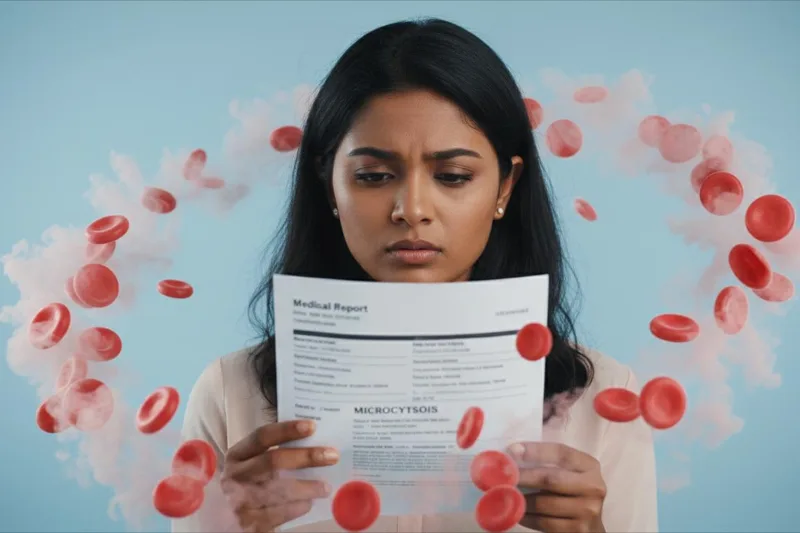
Sometimes when you get a blood test done, you feel a little scared when you see some words on the report, don't you? One such word is 'Microcytosis'. But don't be scared, this is not the name of a serious disease. It just means that your red blood cells are a little smaller than normal. Today, we'll talk about this in detail, very simply.
What is Microcytosis?
Simply put, microcytosis is when the red blood cells in your blood are smaller than normal. We don't consider this a disease, but rather a finding that can be seen after a blood test. This is what you can usually find out with a complete blood count (CBC). Think of it like a report that gives details about the blood cells in your body.
There is a value in this `CBC` report, which is called `Mean Corpuscular Volume` (MCV) . This `MCV` value is used to measure the average size of your red blood cells. In the case of an adult, if this `MCV` value is less than 80 femtoliters `(80 fL)`, then we say that there is microcytosis.
Often, this condition called microcytosis can be a symptom of a type of anemia called microcytic anemia . In this microcytic anemia, there is a lack of enough hemoglobin in the red blood cells. Did you know that hemoglobin is a very important protein that helps our red blood cells carry oxygen throughout the body?
How common is this condition?
In fact, this condition called Microcytic Anemia is a very common type of anemia seen among adults and young children. Therefore, it is very important to be aware of this.
What are the symptoms of Microcytosis?
Most of the time, there are no specific symptoms. All that is seen in the report is that the `MCV` value is low.
However, if symptoms do appear, they are similar to the symptoms of the condition Microcytic Anemia that I mentioned earlier. They are:
- Feeling tired all the time. As if there is no life in the body.
- Pale skin. Sometimes the lips and tongue may also become pale.
- Difficulty breathing. You may feel faint even with a little exertion.
- Heart rate increases.
- A condition called 'Pica'. This only occurs when iron deficiency causes microcytosis. 'Pica' is the desire to eat inedible things like dirt, ice cubes, and clay.
In addition to these symptoms, you may also experience symptoms related to the underlying cause of microcytosis.
Why does this microcytosis occur?
The most common cause of microcytosis is not getting enough iron in your body. This is called iron-deficiency anemia . Remember, I said that iron is essential for making hemoglobin.
Additionally, environmental factors, certain medical conditions (both congenital and acquired), and certain habits can also cause microcytosis.
The main causes of microcytosis:
- Iron deficiency:
- Not getting enough iron from food: Sometimes the food we eat may not provide enough iron to our body. Vegetarians especially need to be careful about this.
- Problems with iron absorption: Imagine, even if you eat foods that contain iron, if you have a condition like 'Celiac disease' or a stomach infection like 'H. pylori infection' , the body cannot absorb that iron properly. Also, this condition can occur after surgeries like 'Gastric bypass surgery' for weight loss.
- Iron deficiency due to bleeding: For women, heavy menstrual bleeding during menopause can cause iron deficiency. Also, gastrointestinal (GI) bleeding due to an ulcer in the stomach or intestines is another cause.
- Thalassemia:
- This is a genetic disease that is inherited. In this condition, the body is unable to produce hemoglobin properly. A person with thalassemia may have a normal or increased number of red blood cells, but the amount of hemoglobin inside those cells is low. This is called hypochromic microcytosis . In some mild forms of thalassemia, only microcytosis may be seen without anemia.
- Anemia of chronic disease:
- Inflammation caused by long-term illnesses such as autoimmune diseases ( e.g. rheumatoid arthritis), chronic infections, kidney disease, and cancer can impair the body's ability to use iron to make healthy red blood cells.
Rare causes of microcytosis:
These are a bit less, but good to know:
- Rare genetic conditions that interfere with the production and function of red blood cells.
- Mineral deficiencies (for example, copper deficiency).
- Lead poisoning.
How do you accurately determine if you have microcytosis?
As I said before, microcytosis is not an official name for a disease. It just means that your red blood cells are smaller than normal.
Your doctor will consider your symptoms, your age, gender, and your medical history to determine what might be causing this. For example, if you have heavy bleeding during your period, it could be iron deficiency anemia. Or, if someone in your family has thalassemia, that could also be a cause.
The doctor can do more tests to find out exactly what the real cause is.
What tests are being done for this?
There are several tests that can help the doctor find the cause of this condition:
- Peripheral blood smear: This involves taking a sample of your blood and looking at it under a microscope. This can confirm whether your red blood cells are actually small and if they have any other abnormalities. If your red blood cells are of varying sizes and shapes (Poikilocytosis), it can be a clue to some of the diseases that cause microcytosis.
- Red cell distribution width (RDW): This also measures the variation in the size of your red blood cells. This is also a value found in the CBC report. Normally, red blood cells are the same size. However, if there is a large variation in cell size (Anisocytosis), it can also give an idea about some diseases.
- Iron levels: Low iron levels in the blood are a sign of iron deficiency anemia.
- Ferritin levels: Ferritin is a protein that stores iron inside our cells. By looking at this ferritin level, you can find out how much iron is available in the body.
- Total iron binding capacity (TIBC): This test, when performed in conjunction with iron and ferritin levels, can be a great help in diagnosing iron deficiency. It can also help in detecting anemia caused by chronic diseases or inflammation.
Once it is confirmed that there is no iron deficiency, to know for sure whether the cause is thalassemia, tests such as hemoglobin electrophoresis and genetic tests will need to be performed.
How is Microcytosis treated?
Treatment depends on the cause of your low red blood cell count. Sometimes, if you have no symptoms and the test results are not too serious, treatment may not be necessary.
Depending on the cause, the following treatments may be done:
- Dietary changes: Adding iron-rich foods (e.g., fish, soy products (tofu), peas, beans, greens, fruits) to the diet.
- Iron supplements: These are given to people with iron-deficiency anemia.
- Blood transfusion: This is done only if the anemia is very severe.
The most important thing is to follow the treatment plan your doctor gives you exactly according to the underlying problem.
Can Microcytosis be reversed?
That also depends on the cause. In most cases, microcytosis will go away once the underlying condition is treated. Your doctor can tell you how treatment will affect your blood cells and overall health.
What happens if left untreated?
Not everyone with microcytosis or microcytic anemia will need treatment. However, if you have a serious underlying condition that is causing your red blood cells to be small, it is important to get it diagnosed and treated quickly. Follow your doctor's instructions about whether you need treatment and what to expect from treatment.
Is Microcytosis serious?
Microcytosis is just one characteristic of your red blood cells. It can be a sign of a disease that needs treatment (along with other symptoms). But most of the time, it's not that serious, and it may just be something you see on the report.
Your doctor will tell you whether your microcytosis indicates a condition that requires treatment.
What can I do to reduce this risk?
It's not possible to prevent all diseases that can cause red blood cell destruction. However, you can reduce your risk by following certain health habits.
The key to this is to make sure you are getting enough iron from your diet. Foods rich in iron include:
- Seafood like tuna and mackerel
- Soy-based products (Tofu)
- Legumes like peas, green beans, chickpeas, and lentils
- Dark green leafy vegetables like spinach, kale, and collard greens
- Fruits like dates and raisins
- Meats, especially red meat (beef, goat) and poultry
Also, if you have had gastric bypass surgery or have another condition that reduces your ability to absorb iron from food, talk to your doctor about what iron supplements you need.
If you have a condition that puts you at risk for anemia, such as thalassemia or an autoimmune disease, follow your doctor's advice on how to reduce your risk.
What should I ask the doctor?
If you find out you have microcytosis, follow your doctor's instructions about what to do next. You may want to ask questions like:
- 'Should I be worried about my low MCV?'
- 'What other tests will I need to do to find the cause of the microcytosis?'
- 'Will I need treatment?'
- 'What kind of results should I expect from the treatment?'
- 'What lifestyle changes can I make to reverse this microcytosis?'
Is there a link between microcytosis and cancer?
Microcytosis can sometimes be a sign of cancer, but it is often a sign of other conditions. Microcytosis is most often a sign of iron deficiency. The important thing is not to panic and assume it is cancer (or something else) until your doctor can explain what is going on with your blood tests.
It's normal to feel anxious when you see an unusual result on a medical test. However, having abnormal ranges doesn't mean you're sick or need treatment. Values like ``MCV'' are just information that helps your doctor understand your overall health. Ask your doctor for guidance on how your test results might affect your future treatment.
So, what are the things we need to remember from all of this?
Okay, let's simply go over some of the most important things you need to remember from what we've talked about:
- Microcytosis is not a disease, it just means that your red blood cells are smaller than normal.
- This is often detected with a ``CBC`` (complete blood count).
- The most common cause is iron deficiency, but there can be other causes, such as thalassemia and chronic diseases.
- Many people do not show symptoms. If they do, they may experience fatigue, paleness, and difficulty breathing.
- The doctor will do more tests to find the cause.
- Treatment depends on the cause. Sometimes, treatment may not be necessary at all.
- Don't panic! If you notice that your MCV is low, talk to your doctor to find out exactly why and what to do.
- It is important to maintain a healthy diet, especially eating foods rich in iron.
Remember, this information is for informational purposes only, not to scare you into thinking you have an illness. If you have any doubts or questions, it is best to see a doctor for advice.
` Microcytosis, Red blood cells, Anemia, Iron deficiency, Hemoglobin, MCV




💬 Comments (0)
No comments yet. Be the first to share your thoughts here.
Add Your Comment