
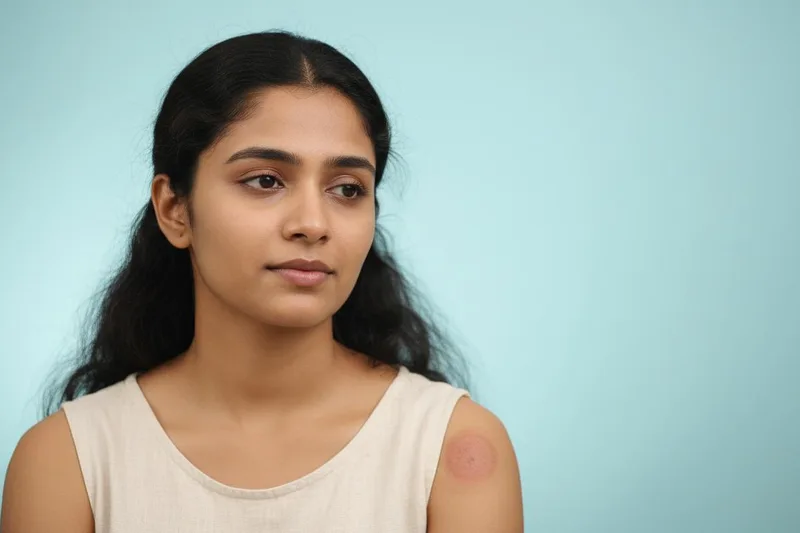
Do you also sometimes keep scratching the same area of your body, and no matter how much you scratch, the itch won't go away? Not only that, but the area you're scratching has become red, the skin has thickened, and sometimes has turned a different color? If so, it's very important for you to be aware of this skin condition that we're going to talk about today, namely neurodermatitis. Don't worry, this is not a life-threatening disease, but it can be a little annoying.
What exactly is this skin disease called neurodermatitis?
Simply put, neurodermatitis is a skin condition that causes persistent itching in one or two areas of the skin. Doctors also call it lichen simplex chronicus.
This rash can appear anywhere on the body. But it is most often seen on the arms, shoulders, elbows, legs, ankles, wrists, palms, back of the neck, or scalp. Some people may also experience this rash around the anus and genital areas, as well as on the face.
Imagine how intense this itching can be. Sometimes you just want to scratch it all the time. Or, it starts again after a while. This itching is especially noticeable when you are resting or trying to sleep. Some people wake up from sleep scratching or rubbing these areas. When you keep scratching, the nerve endings in the skin are stimulated and the itching becomes even worse. Then you scratch more. If this cycle of "itching-scratching-itching again" continues, this can become a chronic condition.
What does the skin look like when you have neurodermatitis?
These itchy spots appear as patches on the skin. These patches are usually about 3 to 6 centimeters wide and 6 to 10 centimeters long. These patches may look like this:
- It can be dry .
- The skin may appear thickened .
- It can take on a coral-like appearance.
- It can look like leather .
- The color can vary . It can be red, brown, yellow, gray, or even purple.
- Old spots may turn white or light in the center, with a darker color around the edges.
- Over time, scars may develop .
The important thing is that by continuing to scratch, the nerve endings in the skin become more stimulated, making the itching worse. It's like a vicious cycle.
Who is most likely to develop this condition?
Research has found that about 12% of the population develops neurodermatitis. It is said that people between the ages of 30 and 50 are most likely to develop this condition. Women are twice as likely to develop this disease as men.
Also, people with anxiety disorders, obsessive-compulsive disorders (OCD), and a family history of other skin conditions such as eczema or contact dermatitis are also at increased risk of developing neurodermatitis.
Some recent studies have suggested that people with certain personality traits – such as poor social skills, inflexibility, avoidance of pain, dependence on others, always trying to please others, and excessive commitment – are more likely to develop neurodermatitis. However, other studies have not found a link between these personality traits and the disease. So it’s still hard to say for sure.
What are the causes of neurodermatitis?
In fact, the exact underlying cause of neurodermatitis is still unknown. However, it has been observed that the itching begins during times of severe stress, anxiety, emotional trauma, or depression. Sometimes, the itching may continue even after the stress has subsided or stopped.
Some other things can also aggravate neurodermatitis:
- Nerve damage.
- Insect bites.
- Dry skin.
- Wearing tight clothing, especially clothes made from synthetic fibers like polyester or rayon, can cause sensitive skin to overreact and start itching.
- Other skin conditions. Sometimes, neurodermatitis can also occur as a result of skin conditions such as eczema and psoriasis.
What are the symptoms of neurodermatitis?
In addition to itching, constant scratching, and dry, discolored patches of skin, neurodermatitis can have other symptoms:
- Pain.
- Hair loss due to itching and scratching of the scalp.
- Constant scratching causes the skin to break and bleed.
- Infection. If the wounds are oozing a yellow fluid or have pus-filled blisters, it could be an infection.
- Scarring due to scratching.
- The affected skin begins to look like wrinkles .
How do you know for sure if this is neurodermatitis?
If you have these symptoms, the best thing to do is see a dermatologist. He or she will examine your itchy area, possibly using a special instrument (a `scope`).
First, the doctor will check for other skin conditions, such as eczema and psoriasis, to make sure they are not. Then, they will ask you about your complete medical history, and may ask questions like:
- When did the itching start?
- Is it constant, or does it come and go?
- Did you do any treatment at home?
Diagnostic tests
Sometimes, the doctor may also need to do some more tests:
- Skin swab tests: To find out if there is an infection.
- Patch testing: To determine if the problem is due to an allergy.
- Fungal tests: Check for other skin diseases and sexually transmitted infections in the area.
- Skin biopsy: To find out if you have conditions like psoriasis or mycosis fungoides (a type of lymphoma).
- Blood tests.
How is neurodermatitis treated?
Neurodermatitis rarely resolves without treatment. Therefore, a dermatologist will develop a treatment plan that is tailored to you. The main goal is to stop the itching and scratching.
Treatment options include:
Types of drugs
- Corticosteroids: These medications can be applied to the affected area or injected into the area. Corticosteroids reduce redness, swelling, inflammation, itching, and stiffness. They also help soften thickened skin.
- Antihistamines: Taken before bed, they can help reduce itching at night. They can also help prevent allergic reactions that can make the condition worse.
- Antibiotics: These are prescribed if the area where the spots are infected. These can be given as a topical cream or as pills.
- Moisturizers: These reduce skin dryness and itching.
- Coal tar preparations: These medications help to remove dead skin cells and slow down the growth of new cells. They can be applied directly to the skin or added to bath water.
- Capsaicin creams: These can reduce both pain and itching.
Other advice given by the doctor
Your doctor may also suggest things like:
- Applying a bandage: Using bandages, socks, or gloves can help prevent scratching at night. This can help you sleep better. Applying a bandage also helps the skin absorb the medication better. (This is also called `(occlusion)`).
- Cool compresses: These can be applied to the skin for about five minutes before applying corticosteroids. This will soften the skin and help it absorb the medication more easily, and reduce itching.
- Antidepressants and/or therapy: If anxiety, depression, or stress are thought to be the cause of the itching, these treatments may be suggested.
Other treatments
If none of these treatments work, there are several non-traditional treatments:
- Applying a solution of aspirin and dichloromethane to the itchy area.
- Commonly used treatments for atopic dermatitis/eczema are tacrolimus and/or pimecrolimus.
- Botulinum toxin (Botox®) injection. This is a toxic protein that can weaken the body's muscles. In a study of three patients with neurodermatitis, all three had reduced itching within a week of starting treatment, and the itchy spots had disappeared by four weeks.
- Light therapy (`Phototherapy`): This is not suitable for the genital areas.
- Traditional surgery to remove the itchy spot, or cryosurgery, which uses extreme cold to destroy unwanted tissue.
What if the itching causes a wound?
If you have a scrape wound due to neurodermatitis, your doctor may cover the area with a bandage.
Another treatment is called ``negative-pressure wound therapy .'' This involves using something like a vacuum to remove fluid from the wound and increase blood flow to the area.
Hyperbaric oxygen therapy involves placing the patient in an oxygen chamber and breathing pure oxygen. This increases the body's ability to heal itself. Surgery for the wound is another option.
Things you can do to speed up recovery
If you have neurodermatitis, you should follow the treatment plan your doctor gives you exactly. Also, try to stay calm and not panic. This can be exacerbated by anxiety and stress. Also remember these things:
- Try your best to stop scratching and rubbing. However, keep your nails trimmed short. This will help minimize the damage that can occur if you accidentally scratch them.
- Apply ice, an itch-reducing medication, or a cold compress to the itchy area.
- Take a cold bath. This will reduce the body heat and reduce itching. Add colloidal oatmeal to the bath water. This will also reduce itching.
- Maintain a comfortable, cool body temperature.
- It is best to wear loose clothing, and as much cotton as possible.
- Cover the itchy area with clothing, apply a corticosteroid-containing bandage, or apply an Unna boot, a bandage containing healing ingredients such as zinc oxide. This type of covering can discourage scratching.
- Do not use anything that is harmful to the skin or causes allergies.
What is the future for people with neurodermatitis?
With the right treatment plan, neurodermatitis can be completely cured. However, both the doctor and the patient may have to change the treatment plan and try different plans. The most important thing is to work according to the plan. Neurodermatitis can be a little difficult to cure, especially if it has developed in the genital area.
Unfortunately, neurodermatitis can recur due to triggers. In that case, treatment may be required again. Sometimes, a doctor may continue to treat a patient who has recovered from the condition to prevent a recurrence.
Very rarely, neurodermatitis can develop into skin cancer, such as squamous-cell carcinoma or verrucous carcinoma. This can be caused by constant scratching and rubbing. This can activate chemicals that can cause skin cells to become cancerous. Therefore, it is important to seek medical advice immediately if you have symptoms.
The most important things you need to remember (Take-Home Message)
Okay, so now you know a lot about neurodermatitis. Remember, although it can be annoying, it is a treatable condition with proper treatment.
- If you have these symptoms, definitely see a dermatologist. Don't self-medicate.
- Follow the treatment plan your doctor gives you exactly. Don't stop taking the medication as soon as the itching subsides, continue taking it for as long as your doctor tells you to.
- Control scratching as much as possible. Keep your nails short, and cover your hands at night if necessary.
- Try to reduce stress . Things like yoga and meditation can help.
- Wear loose-fitting clothing made from natural fibers like cotton that are gentle on the skin.
- Stay away from things that are harmful to your skin.
I hope this information is useful to you. Stay healthy!
` Neurodermatitis, Skin Disease, Itching, Skin Rashes, Stress, Dermatologist, Neurodermatitis


💬 Comments (0)
No comments yet. Be the first to share your thoughts here.
Add Your Comment