

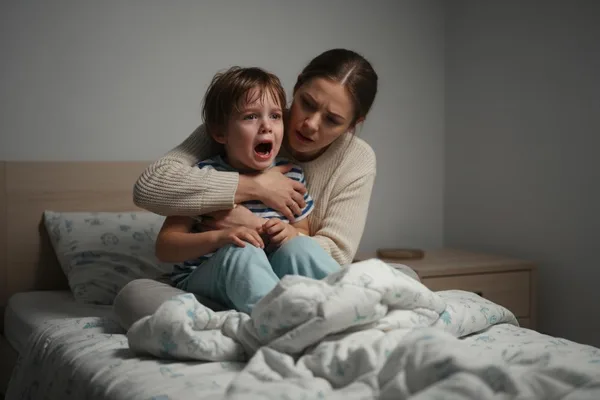
Does your little one sometimes suddenly scream in the middle of the night, try to get out of bed and run? Does he not recognize you even though his eyes are open, does he sweat, does he have difficulty breathing, and seems very agitated? No matter how much you try to comfort him, it is difficult to control him at that time, isn't it? Surprisingly, when you ask him in the morning, he doesn't even remember any of this. This is what we call night terrors , sometimes sleep terrors . Don't worry, this is something that happens to many people, especially young children. Let's talk about this in detail.
What are Night Terrors?
Simply put, a night terror is when your brain is in a state where it feels like you're half asleep and half awake. It's like you're stuck between a dream and reality. It can be very scary and overwhelming. You or your child may start to sit up in bed, jump out of bed, cry, scream, sweat, and have a fast heart rate. This usually lasts from one minute to about 30 minutes. Then you fall back asleep.
It's very difficult for anyone else, whether it's your parents or the person you're sleeping with, to comfort you at this time. Because you're not conscious. But surprisingly, when you wake up in the morning, you don't remember any of this!
Night terrors are a type of parasomnia , a group of behavioral and movement disorders that occur during sleep. They often occur during the deepest stage of sleep, called NREM (Non-Rapid Eye Movement) , which is the first few hours after we fall asleep.
Night Terrors in Children
Night terrors are most common in young children, especially those between the ages of 3 and 7. In most cases, they go away on their own as children get older, such as during adolescence. So there's nothing to worry about.
At this time, young children may be open-eyed, but may not recognize you, as if they are unconscious. Sometimes they may even close their eyes. They may not respond to you when you speak, and may become more agitated if you try to comfort them. Some children may do things like kick their feet, mumble, or read things that are not clear. Children with night terrors may also later experience things like sleepwalking and wetting the bed. But in the morning, they will not remember anything.
Imagine, Nadeesha is a mother. Her four-year-old son, Senuka, sometimes suddenly gets out of bed at around eleven at night and screams. When Nadeesha goes to look, Senuka is sitting on the bed, his eyes wide, sweating, and crying loudly. When his mother asks, "What happened, son?", Senuka doesn't even seem to recognize his mother. He reaches out and tries to touch something, trembling with fear. When his mother tries to hug him, he struggles, and sometimes even tries to hit his mother. After about ten or fifteen minutes, Senuka falls back asleep. When he wakes up in the morning, Senuka doesn't remember anything that happened that night. Although this was a big problem for Nadeesha, it was only when she saw a doctor that she realized that this was a night terror.
Night Terrors in Adults
Night terrors are not that common among adults. However, if adults experience them, they are more likely to be injured than children. This is because many people jump out of bed and run around at this time. As a result, they can get injured by bumping into objects such as tables and chairs around the bed.
When adults experience night terrors, it can sometimes be a symptom of a mental health problem. For example, someone with Post-Traumatic Stress Disorder (PTSD) , a condition related to a severe trauma, or an anxiety disorder, may experience these things.
What is the difference between Night Terrors and Nightmares?
Many people confuse night terrors with the scary dreams we have (Nightmares). But there are big differences between the two. Let's see what they are.
- In Night Terror:
- I don't remember anything in the morning.
- Even if someone tries to comfort them, it's hard to do, and they don't respond.
- There is room to get out of bed, scream, struggle, and run.
- It occurs during the deepest stage of sleep (`NREM`), in the first few hours after falling asleep.
- You can keep your eyes open, but you're not aware of anything around you.
- In nightmares:
- Usually, you remember the dream, which is why you wake up scared.
- If someone speaks, they can recognize and feel comforted.
- He is sitting in bed, scared, and less likely to run around or squirm.
- It happens during the `REM' stage of sleep, when dreaming occurs, often just before waking up.
- When you wake up, you are fully conscious.
"Simply put, a night terror is a fear that occurs during deep sleep without awareness, without knowing what you are doing. A nightmare is a fear that occurs after having a bad dream and is conscious."
How common are night terrors?
One study found that the condition may affect between 1% and 6.5% of children between the ages of 1 and 12. It is much less common in adults.
What are the symptoms of night terrors?
There are several symptoms that can be seen in this situation:
- Physical signs:
- Sweating
- Screaming or crying
- Breathing rapidly (`Hyperventilating`)
- Fast heart rate
- Dilated pupils
- Rapid, violent movements (thrashing)
- Sleepwalking
- Symptoms experienced:
- Fear
- Panic
- Confusion
- Loss of awareness of surroundings
- Not being able to be comforted or respond to what others are saying
- Difficulty waking up
- No memory of the night terror in the morning
What are the causes of night terrors?
In fact, the exact cause of night terrors is still unknown. Research suggests that it occurs when your consciousness is stuck between deep sleep and waking. Because you are not fully awake, it is difficult for others to comfort or wake you.
What are the triggers for night terrors?
Some things can cause or worsen this night terror. They are:
- When you have a fever (`Having a fever`)
- Sleep deprivation or sleep deprivation
- Obstructive Sleep Apnea, a condition in which breathing is interrupted during sleep
- Severe stress or anxiety
- Severe emotional stress (`Emotional tension`)
- Drinking alcohol (especially in adults)
Who is at higher risk of developing night terrors?
It can develop at any age. However, studies show that if someone in your family has had the condition (hereditary), you are more likely to develop it too .
Also, if you have other sleep-related conditions, such as obstructive sleep apnea or periodic limb movement disorder ( a condition that causes your limbs to twitch during sleep), you are at higher risk of developing night terrors.
Can night terrors cause complications?
Yes, sometimes this can cause problems. One is that it disrupts your or your child's sleep and reduces the quality of sleep.
The other thing is the occurrence of physical injuries.During this time, there is a risk of severe thrashing, falling out of bed, or bumping into tables and chairs near the bed, causing injuries. Sometimes, you may even notice bruises on your body when you wake up in the morning. There are also cases where some injuries are serious and require medical attention.
How to diagnose night terrors?
When you see a doctor, they will ask you or your child's parents about your symptoms and perform a physical exam to determine if it is a night terror. If it happens very rarely, like a few times a year, it usually doesn't require any major treatment. But if it happens frequently, like several times a week, you should definitely see a doctor.
In most cases, no additional tests are needed. However, if your doctor feels it necessary, he or she may order an EEG (Electroencephalogram) (a test that measures brain activity) or a polysomnography (an overnight sleep study) to check for other conditions with similar symptoms (e.g., Obstructive Sleep Apnea).
How to stop night terrors?
There is no one treatment that works for everyone.
The first thing to do is to ensure the safety of the person with night terrors. Then, it is best to wait until the event passes on its own. Since the person experiencing night terrors has no memory of it the next day, talking about the event the next day and explaining it to them can provide relief. Also, identifying and treating triggers such as sleep deprivation, Obstructive Sleep Apnea, or fever can reduce the frequency of these events.
Your doctor may recommend ways to reduce stress, such as talking to a mental health professional . Your mental health can have a big impact on your sleep.
Are there medications for night terrors? (Medications)
Doctors don't usually prescribe medication to treat night terrors. Medication is only needed very rarely, that is, if the symptoms are severe enough to cause frequent injuries, and if the symptoms do not improve after treating the aforementioned `triggers`. Even then, it is given to treat other underlying conditions, such as anxiety, for example.
What happens if you have night terrors?
Night terrors are very distressing, not only for you but also for others in your household. Parents, caregivers, and co-sleepers can be very scared when they see this, as it can be very difficult to comfort the person at that time.
However, night terrors are not always present. Many children outgrow them by the time they reach high school. Sometimes they are associated with an underlying medical condition, and when that condition is treated, the night terrors will subside.
If this happens frequently, and you're not sleeping well, definitely tell a doctor.
How to prevent night terrors? (Prevention)
A doctor can advise you on improving your sleep hygiene . This can help you get the amount and quality of sleep you need. It can also reduce the frequency of night terrors. Here are some things you can do to help:
- Get into the habit of going to bed at a set time and get age-appropriate sleep.
- Avoid drinking alcohol or caffeinated beverages (tea, coffee) before bed.
- Remove distractions from your bedroom, such as bright lights and loud noises.
- If you have other sleep-related conditions, such as sleep apnea, get them treated.
- For safety at night , keep potentially dangerous items, such as tables and chairs, away from the bed.
Should you wake someone up when they're having a night terror?
No, experts say that you should not try to wake someone up when they are having a night terror.
Your first reaction may be to try to grab the person and stop them. But that can be dangerous for both you and the person with the night terror. Because their brain is in a deep sleep and they won't wake up easily. In fact, trying to wake them up can actually make the night terror worse.
The best thing you can do is, if he gets out of bed, gently walk him back to bed and speak slowly, calmly, and softly. This will help him go back to sleep when the event is over. It is also important to stay with him and provide security until he falls back asleep.
When should I see a doctor?
In cases like these, you should definitely talk to a doctor:
- If night terrors occur frequently (several times a week).
- If you or your child are not getting good sleep.
- If you or your child is injured after a night terror.
- If these events happen frequently every night, especially in the second half of the night.
- If the events last less than a minute (this may be a different situation).
- If there are other symptoms such as snoring, mouth breathing, and excessive daytime sleepiness .
What questions should you ask the doctor?
- Why is my/my child having night terrors?
- Do I/my child need a sleep study?
- How can I improve my sleep hygiene?
- How can I stay safe when I have a night terror?
If you hear someone screaming and struggling violently in the middle of the night, the worst thing that can happen to you is that you feel like there's nothing you can do to comfort them. On the other hand, when you wake up in the morning, someone might tell you that you had symptoms of a night terror. But you don't remember any of it.
As the name suggests, night terrors are a very frightening experience for everyone. These symptoms can make it difficult for you and others in your household to get a good night's sleep.
If you have frequent night terrors, be sure to talk to a doctor. He or she can help you find the cause, avoid triggers, and/or manage any underlying medical conditions.
The most important things to remember (Take-Home Message)
So, night terrors are nothing to be afraid of, especially when it comes to young children. Most of the time, they go away on their own as they get older.
- Don't try to wake someone who is having a night terror. Instead, calmly guide them to bed and ensure their safety.
- Getting good sleep (Sleep Hygiene) is very important. Go to bed at a regular time and avoid things like caffeine before bed.
- If this happens frequently, if you get injured, or if you have excessive daytime sleepiness, see a doctor.
- If adults experience night terrors, it could be a sign of stress or another health problem. So seek medical advice.
If you have any further questions about this, don't be afraid to talk to a doctor. Remember, you are not alone, and there is help available.
👩🏽⚕️ Additional questions (FAQs)
💬 Is Puerperal / Postpartum Psychosis a mental illness that occurs in a mother after giving birth?
This is a 'Psychiatric Emergency' that is 1000 times more dangerous than normal depression! This is an extremely rare condition called 'Psychosis', where hormones suddenly plummet within a few days of having a baby, causing the mother to lose control of herself and become completely detached from reality.
💬 How dangerous is the behavior of a mother with a mental illness like this?
This situation is extremely dangerous! This mother is having 'hallucinations - for example, a bird or a demon speaking to her'. She is very afraid that 'the baby is possessed by a demon, or that someone is coming to kill the baby and me' (delusions). Because of this fear, this mother is very likely to 'kill the baby or commit suicide' (infanticide/suicide).
💬 How do you care for/help a mother who is experiencing this type of mental illness?
If there are any such symptoms, the mother should be admitted to a psychiatric ward of a hospital without delay! You cannot just sit at home and dance around with a stick. Because that would endanger the lives of both the baby and the mother. By administering antipsychotics and mood stabilizers at the hospital, this mother can be 100% cured within a few weeks.
` Night Terrors, Sleep Terrors, Parasomnia, NREM sleep, PTSD, Anxiety Disorder, Sleep Deprivation, Obstructive Sleep Apnea, EEG, Polysomnography, Sleep Hygiene, Night terrors, Sleep problems, Child health, Mental health, Sleep terrors, Sleep screaming




💬 Comments (0)
No comments yet. Be the first to share your thoughts here.
Add Your Comment