
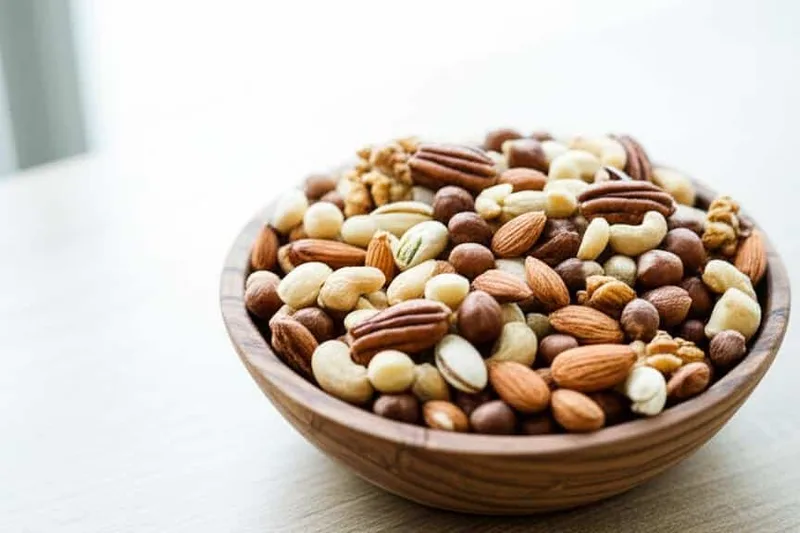
Many people think of nuts as salty, fatty, and high in calories, or more accurately, "junk food." They're often seen as something you'd find in a snack bowl at a bar or sold at a street food cart. But you'd be surprised to learn that this is completely wrong.
Why are nuts really good for our bodies?
The truth is, nutritionists are now saying that these nuts are a must-have in the kitchen of every healthy person (unless, of course, you're allergic to them). Because these nuts contain so many valuable things, including protein, fiber, healthy monounsaturated fats, vitamins, nutrients, and antioxidants .
In particular, numerous studies have proven that these types of nuts have an amazing ability to reduce the levels of bad cholesterol in our bodies.
This is so well-established that in 2003, the U.S. Food and Drug Administration (FDA) issued a "qualified health claim" for peanuts and certain tree nuts, such as almonds, hazelnuts, pecans, pistachios, and walnuts. That is, they allowed food packages to state that "consuming one ounce (about 28 grams) of nuts daily may reduce the risk of heart disease."
So, now is the time to take a fresh look at nuts. But remember, moderation is key.
Some special types of nuts that are good for the heart
"There are many types of nuts, but not all are created equal," nutritionists say. Let's take a look at a few of them that are particularly beneficial.
Walnuts - Good for the brain and heart
Walnuts are a truly amazing food because they contain high levels of a valuable nutrient called omega-3 fatty acids , which are also found in oily fish like salmon and tuna.
Simply put, these omega-3s are:
- It reduces the bad fats called triglycerides in our blood.
- It prevents the development of plaques, which are fatty deposits that form inside blood vessels.
- It also helps prevent blood clots.
In a study of 58 adults with diabetes, they were given a handful of walnuts in addition to their daily healthy diet. The results were truly amazing. Those who ate walnuts saw their levels of good cholesterol (HDL cholesterol) increase and their levels of bad cholesterol (LDL cholesterol) decrease by about 10% .
Almonds - Rich in Vitamin E
Almonds are another super nut with many health benefits. Like other nuts, they are rich in protein, fiber, healthy fats, and minerals. In addition, almonds are rich in vitamin E , a powerful antioxidant.
A researcher gave a group of people with high cholesterol a handful of almonds every day for three months. The result was a 4.4% reduction in their bad cholesterol (LDL). Those who ate two handfuls of almonds saw their LDL levels drop by a whopping 9.4%! That's how much it can be worth to eat a few almonds a day.
Other healthy nuts
In addition to walnuts and almonds, nuts like peanuts, hazelnuts, pecans, and pistachios have also been recognized by the FDA as being very good for the heart. Let's take a quick look at the benefits of a few of these nuts.
| Nut type | Main health benefit |
|---|---|
| Walnuts | Very rich in Omega-3. Reduces bad cholesterol (LDL) and triglycerides. |
| Almonds | Rich in vitamin E, fiber, and healthy fats. Significantly reduces bad cholesterol (LDL) levels. |
| Pecans | Reduces bad cholesterol (LDL) and triglycerides, and increases good cholesterol (HDL) levels. |
| Peanuts | High in protein. Contains heart-healthy fats. (Choose those without added salt and oil). |
However, Brazil nuts, macadamia nuts, and cashew nuts are not included in the FDA's health claim because they are a bit higher in fat. However, in moderation , they can still provide some health benefits.
How do we add these types of nuts to our diet?
It's easy to add nuts to your daily diet. You can buy them shelled at the supermarket. There's no special preparation required.
- Eat about a handful a day as a snack.
- Sprinkle a few on your salad, your breakfast oats, or your yogurt.
- You can also add it to things like pasta salads.
But the most important thing here is:
"When choosing nuts, make sure to choose raw and unsalted ones," nutritionists emphasize. Honey-roasted, chocolate-coated, and sugar-coated nuts add unnecessary calories and sugar to your body, which reduces their health benefits.
How much should you eat per day?
You don't need to eat a bag of nuts a day to get these health benefits. A handful a day, about 1 to 1.5 ounces (about 28-42 grams), is plenty. Nuts are high in protein and fiber, so you'll feel full even after eating a small amount.
So, remember not to overdo it .
"No matter how good nuts are, they are also high in calories. If you eat too much, you can gain weight," he says. If you gain weight, the heart-healthy benefits of nuts can be negated.
The best thing to do is to replace the unhealthy fats you eat (such as saturated fats found in meat) with nuts. That way, you can get the benefits of nuts without adding extra calories. If you have a problem like cholesterol, it's best to talk to your doctor about this.
Take-Home Message
- Nuts are a valuable food that lowers bad cholesterol (LDL) and protects heart health.
- Eating a handful of nuts (about 28-42 grams) daily is sufficient. Eating more than that can lead to weight gain.
- When buying nuts, always choose raw/unsalted ones, without added salt, sugar, or other additives .
- By replacing unhealthy fats in your diet with nuts, you can reap the benefits without adding extra calories.
- If you have any pre-existing medical conditions, it is very important to consult your doctor before making such changes to your diet.


💬 Comments (0)
No comments yet. Be the first to share your thoughts here.
Add Your Comment