
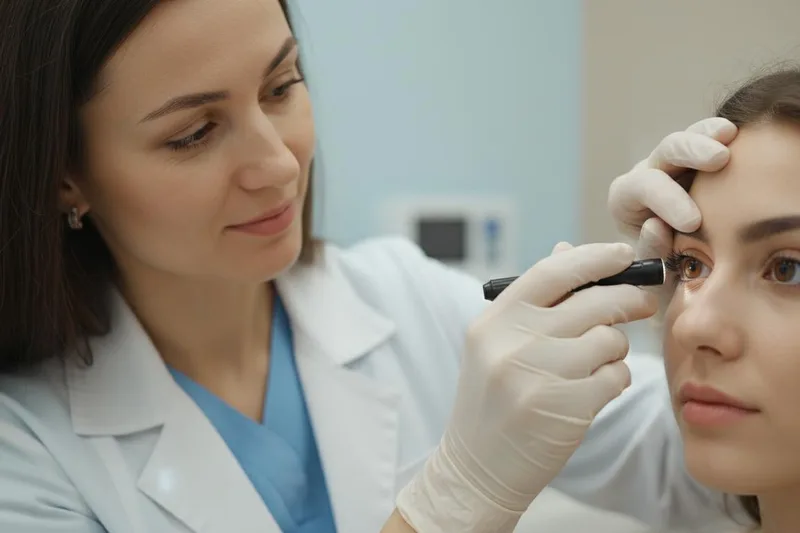
Our eyes are like two precious gems, aren't they? It is very important to take care of these two eyes that help us see the world. Sometimes, our eyes can get little problems and diseases. Then who do we ask for help? That's where the help of an (Ophthalmologist) , that is, a doctor who specializes in eye diseases , becomes essential for us. So, who is this (Ophthalmologist)? What do they do? Let's talk about all this today.
Who exactly is an ophthalmologist?
Simply put, an ophthalmologist is a doctor who has received special training in the field of eyes and vision. You know, they are not just people who look at eyes. They are doctors who have completed a degree in medicine (MD - Doctor of Medicine) or an osteopathic degree (DO - Doctor of Osteopathy). This means that they have the ability to diagnose any disease of the eyes, any weakness of vision, treat it, and even perform surgery if necessary.
Now you might be thinking, "So who are the people in the optician's shop, the other people who look at eyes?" Yes, there are optometrists and opticians. They also help with eye health. But an ophthalmologist is someone who has more in-depth medical training and the ability to perform surgeries . We'll talk more about that difference later.
How much do you need to study to become an ophthalmologist?
Imagine how much dedication and time it takes to become such an expert!
This is the general path to becoming an ophthalmologist:
1. First degree: A four-year science degree, often as preparation for medical school.
2. Medical School: Then you need to go to medical school and get a medical degree (MD or DO).
3. Internship: Next, you need to undergo a one-year internship.
4. Specialist training: Then comes the most important part. You need to have at least three years of specialized medical and surgical training in eye diseases and surgery.
After all this is done, you also need to obtain a license to practice medicine from the relevant state regulatory board. Look, what a long journey! That's why they have such in-depth knowledge about our eyes.
What does an ophthalmologist do?
An ophthalmologist can provide a complete service for your eyes. This means:
- Eye exam: We check how your vision is and if there are any problems with your eyes.
- Vision-related services: Recommending things like glasses and contact lenses.
- Diagnosis and Treatment: Various eye diseases (e.g., cataracts, glaucoma) as well as the effects of other diseases on the eyes (e.g., damage to the eyes due to diabetes mellitus) are diagnosed and treated.
- Prescribing medications:They give things like eye drops and oral medications.
- Eye surgery: If necessary, various eye surgeries such as cataract removal and glaucoma surgery are performed.
Simply put, an ophthalmologist can take care of everything from A to Z related to the health of your eyes.
When should we see an ophthalmologist?
An ophthalmologist can diagnose and treat a wide range of eye and vision problems. For example:
- Farsightedness/Hyperopia
- Nearsightedness/Myopia
- Astigmatism (blurred vision due to a change in the shape of the lens of the eye)
- Amblyopia (Lazy Eye)
- Posterior Vitreous Detachment (PVD) (pulling away of the jelly-like substance inside the eye)
- Eye problems that come with aging (e.g., macular degeneration)
You should see an ophthalmologist, especially if:
- If you have cataracts (surgery may be required)
- Glaucoma (increased eye pressure)
- Retinal Detachment
- Corneal Disease (Disease of the transparent front part of the eye)
- Diabetes-related Retinopathy
- Cross-eye (Strabismus)
- If there is a serious injury to the eyes
Imagine, your mother or father says that as they get older, they find it difficult to watch TV or read a newspaper, and that their eyes seem to turn blue when they look at the light. That could be a sign of cataracts. Then, they should see an ophthalmologist, get checked, and if necessary, have a minor surgery to correct it.
How often should you have your eyes checked?
By having your eyes and vision checked regularly, an ophthalmologist can identify any problems early . The average frequency of eye exams varies depending on your age:
- Young children: Until your child starts school, their pediatrician will check their eyes at every clinical checkup. After that, every year or two.
- Adults under 40: Every five to ten years.
- Adults between 40 and 54 years old: Every two to four years.
- Adults over 55 years of age: Every one to three years.
Most importantly! If you have diabetes, you should definitely have your eyes checked at least once a year . Because diabetes is more likely to cause eye damage, it is easier to treat if it is detected early.
If you wear glasses or contact lenses, you may need to have your eyes checked more often. It's best to ask your ophthalmologist or healthcare provider about this.
If you have these symptoms, see a doctor immediately!
If you notice any sudden changes in your vision, or if you develop new eye symptoms, see an ophthalmologist or other eye care professional without delay . Be aware of the following:
- Eye pain that doesn't go away for several days.
- Blurred vision.
- Double vision (Diplopia).
- Redness of the eyes.
- Difficulty looking at light, blurred vision (Photophobia).
- If you feel that your clear vision is gradually decreasing .
- If you start to see small black objects floating in front of your eyes, or if you see flashes of light .
If you see a sign like this , don't panic, but don't be lazy either. It's wise to seek medical advice immediately.
What should I ask my ophthalmologist?
When you visit an ophthalmologist, don't be afraid to ask any questions or concerns you may have. They are there to help you. Here are some questions you can ask:
- How often should I have my eyes checked?
- What other treatments do I need?
- Will I need eye surgery?
- If I have surgery, how long will it take to recover?
By asking questions like these, you can gain a better understanding of your condition and treatment.
What is the difference between an ophthalmologist and an optometrist?
Even though both of them work in eye health, there are slight differences.
- Ophthalmologist: These are doctors who have a medical degree (MD or DO) and have studied at a medical school. They can diagnose and treat any condition that affects the eyes and vision. Most importantly, they can also perform eye surgery.
- Optometrist: These are doctors of optometry (OD). They can also diagnose and treat many eye problems. But they do not perform eye surgery. If your Optometrist thinks your eyes need surgery, he or she will refer you to an Ophthalmologist.
Simply put, you can go to an optometrist for a routine eye exam and glasses. But if you have a condition that requires surgery, such as cataracts or glaucoma, or if your eyes are complicated by diabetes, you should definitely see an ophthalmologist.
Finally, things to remember (Take-Home Message)
An ophthalmologist is a doctor who can help you take care of all aspects of your eye health. They can perform routine eye exams, treat vision problems, and even perform surgery for complex eye conditions.
Some people go to an ophthalmologist for every eye exam. Others only go when they need surgery or special treatment. However, when you see an ophthalmologist, don't be afraid to ask questions. They are committed to giving you a clear understanding of every test you have, the results you get, and the treatment you need.
It's your responsibility to take care of your eyes. It's never too late to get the best medical advice!
👩🏽⚕️ Additional questions (FAQs)
💬 What is the difference between an ophthalmologist and an optometrist?
If you are blind and want to buy glasses and have your power measured, you go to an optometrist (they cannot perform surgery). But an 'Ophthalmologist' is a senior doctor who, in addition to studying at a specialist medical school, diagnoses eye diseases and 'treats serious eye diseases like cataracts, blindness, and glaucoma by performing major surgeries and laser treatments.'
💬 For what types of illnesses should I see an ophthalmologist?
More than just a simple eye condition like watery eyes or itching, you should see an ophthalmologist when you have a 'medical emergency'. That is, when you suddenly lose vision, see black spots or flashes of light in front of your eyes, need cataract removal, have LASIK eye surgery, and prevent blindness due to diabetes/high blood pressure.
💬 Do you have to go to them to get your children's eyes checked?
An optometrist can examine the eyes and prescribe glasses. However, if the baby has strabismus, an eye infection, or another congenital disease inside the eye, it is essential to see a pediatric ophthalmologist for treatment.
` Ophthalmologist, eye doctor, eye examination, cataracts, glaucoma, diabetes and eyes, eye surgery


💬 Comments (0)
No comments yet. Be the first to share your thoughts here.
Add Your Comment