
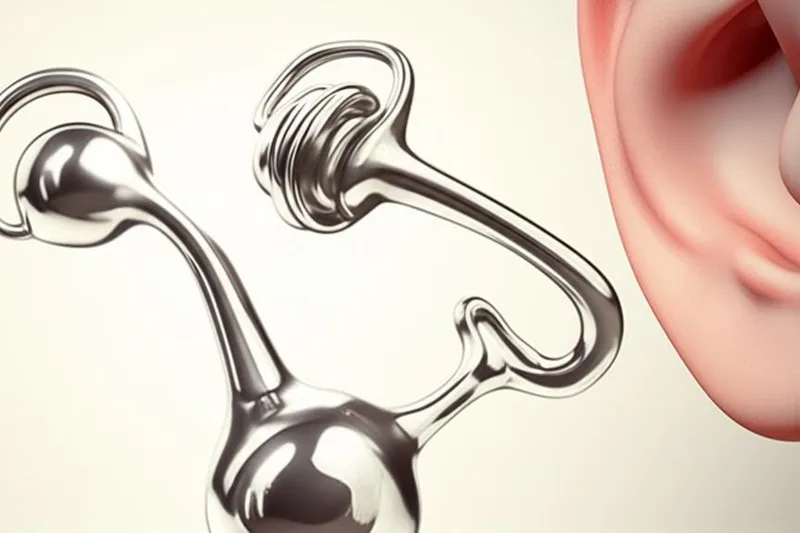
Have you ever wondered how you can hear all sounds clearly? This is thanks to the tiny, but very important parts inside our ears. Those little parts are called ossicles . These are actually three of the smallest bones in our body. Today, we will talk in detail about these ossicles, their function, and the problems they can cause.
What are ossicles? Where are they located?
Simply put, the ossicles are three tiny bones in your middle ear . They are connected together like the links of a chain. These three bones are:
1. Malleus: This is also called the "hammer" because it is shaped like a hammer.
2. Incus: This is also called an "anvil". It works like an anvil that is struck with a hammer.
3. Stapes: This is the smallest bone in our body. It is also called the "strap" because it resembles the shape of a horse's saddle.
Think about how small these three bones are! But without them, we wouldn't be able to hear anything properly. This chain of ossicles starts at your eardrum (tympanic membrane) . The eardrum is a thin membrane between your outer and middle ear. The chain of ossicles ends at the cochlea in your inner ear .
If you go a little deeper...
- Malleus: One side of this is connected to the eardrum. When the eardrum vibrates, the malleus also vibrates. The other side of the malleus is connected to the incus.
- Incus: This is like an intermediary between the malleus and the stapes. The function of the incus is to receive vibrations from the malleus and transmit them to the stapes.
- Stapes: This tiny bone picks up vibrations from the incus and pushes them to a place called the oval window , a kind of door in the cochlea in the inner ear.
Do you now understand how complex and important this little mechanism is?
How do ossicles work? How do they help us hear sound?
Okay, now let's see how these little bones called ossicles help us hear sound. It's like a chain reaction .
1. First, sound waves from outside enter your ear and hit your eardrum. The eardrum then starts to vibrate . Just like when you hit a drum, it vibrates.
2. The malleus bone, which is connected to the eardrum, also moves with the vibration.
3. When the malleus moves, the incus bone, which is attached to it, also moves.
4. Next, the incus transmits this vibration to the stapes bone.
5. The stapes bone pushes this vibration into the oval window of the cochlea in the inner ear.
The important thing is that when sound vibrations travel through this chain of ossicles, they are amplified . That is, the cochlea receives a stronger sound signal than the sound signal from the eardrum. This is why we can hear even soft sounds clearly.
The cochlea contains a fluid and some very sensitive hair cells . Vibrations from the stapes move this fluid, stimulating the hair cells. These hair cells convert the sound vibrations into electrical signals and send them to the brain. The brain interprets those signals and tells us, "Oh, that's a buzzing sound."
Imagine, all this happens in the blink of an eye! Amazing, isn't it?
What are the common diseases and conditions that affect the ossicles?
If there is a problem with these small bones, sound vibrations do not travel properly to the inner ear, which can lead to conductive hearing loss . Some conditions that affect the ossicles include:
- Congenital ossicle abnormalities: Very rarely, some babies are born without an ossicle, with it not developing properly, or with it growing too much. Sometimes these bones may not connect properly, or may be far apart or fused together.
- Otosclerosis: This is when one of the ossicles (usually the stapes bone) becomes stuck to the surrounding tissue and cannot move freely, as if it were stuck in a dead body.
- Cholesteatoma: In this, skin cells build up inside the middle ear, forming a lump. This can damage the ossicles and limit their movement.
- Chronic middle ear infections: Persistent ear infections can cause the middle ear to become inflamed, fill with fluid, and interfere with the movement of the ossicles. If not treated properly, permanent damage may occur.
- Ossicular-chain dislocation: If there is a severe head injury, this chain of ossicles can become dislocated or broken. This prevents vibrations from being transmitted properly. This chain can also be broken by some abnormal growths (tumors) or chronic ear infections.
What symptoms are present in this situation?
If there is a problem with your ossicles, you may experience symptoms like:
- Hearing loss in one or both ears, deafness, or not hearing at all.
- Hearing a ringing sound in the ears (tinnitus) .
- Ear pain.
- A pus-like fluid is draining from the ear.
- A feeling of heaviness or fullness in one or both ears.
- Balance issues (including if the condition affects the vestibular system in the ear, which is responsible for balance).
If you have one or more of these symptoms, you should definitely see a doctor .
What tests are done to find out if there is a problem with the ossicles?
When you see a doctor, he or she will likely examine your ear. The following tests are usually performed:
- Otoscopy: This involves looking inside your ear with a small instrument (an ``otoscope'') that has a light. This can check for things like the eardrum, fluid in the middle ear, and infection.
- Hearing tests (Audiometry): These tests can find out how well you can hear and what sounds you can't hear.
- Tympanometry test: This measures the movement of the eardrum and the pressure in the middle ear, giving an idea of whether there is fluid in the middle ear or a problem with the ossicles.
- CT scan: Sometimes, a CT scan may be done to clearly see the damage to the ossicles, their location, and the condition of the surrounding tissues.
What are the treatments for these ossicle-related problems?
Treatment depends on the condition you have. Common treatments include:
- Antibiotics: If the problem is caused by a bacterial infection, antibiotics can be given to treat it.
- Hearing aids: If you have poor hearing, you can use hearing aids to help you hear better.
- Surgery: In some cases, surgery may be necessary, for example to remove a tumor such as a cholesteatoma, to free a trapped bone in the case of otosclerosis, or to realign broken/displaced ossicles (ossiculoplasty).
Remember, early diagnosis and treatment are very important. This will help prevent permanent damage.
How do we keep our ear ossicles healthy?
The best thing you can do to keep these tiny but very precious ossicles of yours healthy is to take steps to prevent ear infections and seek medical advice promptly if you notice any changes in your hearing.
- Avoid getting water in your ears. Be careful when bathing and swimming.
- When cleaning your ears, do not put objects like cotton buds inside your ears as this could damage your eardrum.
- When you get sick with a cold or flu, make sure they don't affect your ears.
- Use earplugs when in very loud places.
Many conditions that affect the ossicles can be treated and cured. However, if treatment is delayed, long-term damage can occur. So, see a doctor as soon as you notice even the slightest change in your hearing.
Finally, a few things to remember
The ossicles are truly an amazing creation in our bodies. The great work these three little bones do together is what allows us to hear and enjoy the diverse sounds in the world.
Ossicles are three small bones called the malleus, incus, and stapes. They are located in the middle ear and pick up sound vibrations from the eardrum, amplify them, and send them to the cochlea in the inner ear. There, the vibrations are converted into electrical signals that travel to the brain, allowing us to understand sound.
So, take care of your ears. If you have any hearing problems, don't ignore them and seek medical advice immediately. Then these three little heroes will continue to help you hear the sounds of the world!
` Ear bones, ossicles, malleus, incus, stapes, hearing, eardrum, hearing loss, middle ear, inner ear, cochlea


💬 Comments (0)
No comments yet. Be the first to share your thoughts here.
Add Your Comment