

Have you ever heard of strange lumps that sometimes grow inside the ovaries, containing things like hair, teeth, and skin? It sounds a little strange, doesn't it? But this is a real thing. This is what we medically call an 'Ovarian Dermoid Cyst' or 'Mature Cystic Teratoma'. Although the name may sound scary, this is most often not cancer. So, shall we talk about this in detail and simply today?
What exactly is an ovarian dermoid cyst?
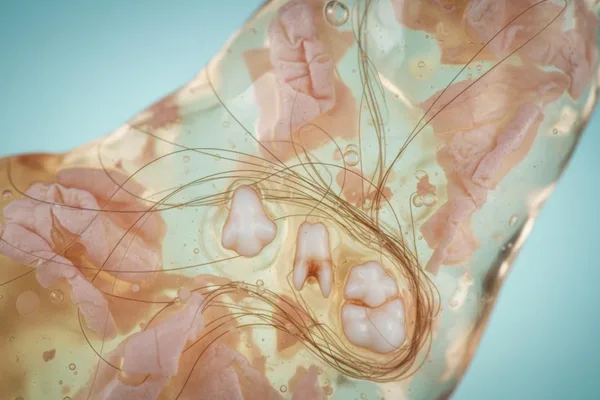
Simply put, it's a fluid-filled sac that forms in your ovaries. But inside this sac is not just fluid. It's tissue from other parts of your body, like your hair follicles, skin cells, teeth, and sometimes nerve tissue. Think about it, it's a little strange, isn't it?
Unlike other cysts that usually form on the ovaries, these dermoid cysts are not associated with your menstrual cycle. They are actually formed when fully developed tissue accumulates in an abnormal place, such as your ovary.
The most important thing is that these ovarian dermoid cysts are mostly non-cancerous conditions . That means there is nothing to worry about. However, if these cysts grow larger than their size, some complications can occur. Therefore, it is best to get this checked out by a doctor and get advice on whether to remove them or not, if necessary.
Who gets dermoid cysts? How common are they?
Anyone with ovaries can develop an ovarian dermoid cyst. It is often believed that these are present at birth . However, many people only find out they have one during an imaging procedure done for another reason. For example, it is common for a cyst to be discovered incidentally during an ultrasound scan during pregnancy.
Ovarian Dermoid Cysts are the most common type of benign ovarian germ cell tumor that develops in the ovaries. They are also the most common type of ovarian cyst found during pregnancy. About one-third of noncancerous cysts diagnosed during pregnancy are ovarian dermoid cysts. Sometimes, in 10% to 15% of cases, they are found in both ovaries.
What effects can these tumors have on the body? Are there any complications?
Usually, the biggest problem with these ovarian dermoid cysts is if they cause any complications. The bigger the cyst, the more likely it is to cause problems.
There are two main possible complications:
1. Ovarian Torsion: These dermoid cysts can sometimes grow quite large. When this happens, the ovary containing the cyst can twist around its axis. Think of it like a heavy object hanging from a string spinning. When this twist occurs, the blood supply to the ovary is reduced or even completely lost. If not treated quickly, the ovary can be damaged and even die. This is an emergency.
2. Rupture: This can cause the cyst to burst and spill its contents into the abdominal cavity. Most of the time, the body will absorb the contents and it won't be a big problem. However, sometimes this rupture can lead to infection. If this happens, emergency medical treatment is needed.
Important: The chances of these ovarian dermoid cysts becoming cancerous are very low, less than 2%.
However, the risk of developing cancer may be slightly increased in the following cases:
- If you are over 45 years old .
- If the tumor is growing very quickly .
- If the diameter of the tumor is more than 10 centimeters .
If your doctor suspects that the tumor will rupture, rupture, or become cancerous, he or she may recommend removing it.
What are the symptoms of Dermoid Cysts?
Most of the time, these ovarian dermoid cysts don't cause any symptoms , especially if the cyst is small. If you do develop symptoms, it's usually when the cyst is quite large. The main things you may notice are:
- Pain in the lower abdomen
- A feeling of pressure in the stomach
- A feeling of fullness
In addition to these, you may also experience the following symptoms, although less frequently:
- Nausea
- Vomiting
- Constipation
- Changes in appetite
- Pain during sexual intercourse (Dyspareunia)
Imagine, Nimali had been having a similar pain in her lower abdomen for a while. She thought it was normal. Later, she saw a doctor and had a scan, and it was discovered that she had a dermoid cyst in her ovary. So, if you are also experiencing these symptoms, it is a good idea to see a doctor.
Why do these ovarian dermoid cysts form? Why do they have hair and teeth?
This is a bit of a complicated story. These ovarian dermoid cysts form before you are even born, that is, during the embryonic stage . Our body has cell types that are supposed to form things like skin, hair, and the nervous system, and some of those cells grow abnormally in these dermoid cysts. Scientists still haven't found a specific reason why they grow this abnormally.
These cells develop into fully developed tissue. This means that this tumor can contain fully formed skin, hair, teeth, nerve tissue, and sometimes even brain tissue! All of these types of tissue come together to form a benign mass inside your ovary.
Also, tissue from sweat glands can grow inside this cyst. These glands secrete an oily fluid called 'sebum'. It is because of that sebum that this cyst gradually grows. Dermoid cysts grow slowly . You see the most growth during your reproductive age, that is, when you can have children.
Why are there things like hair and teeth inside these nuts?
This is because Dermoid Cysts are formed from a special type of cell called 'germ cells'. These germ cells are the cells that later become egg cells or sperm cells. When an embryo develops, there are three layers of these germ cells. These three layers are what give rise to the various tissues, organs, and systems of the body:
- Ectoderm: This is where things like skin, hair, sweat glands, and teeth are formed.
- Mesoderm: This is where muscle and connective tissue form.
- Endoderm: This is where the digestive tract (gut) and various internal organs form.
So, sometimes these layers grow abnormally , and the fully developed tissue comes together to form a dermoid cyst. That's why these cysts can contain things like hair and teeth. But not only hair and teeth, these cysts can contain tissue that develops from any of the three layers of a germ cell.
How do you know if you have this, doctor?
As I mentioned before, most of the time, these ovarian dermoid cysts do not cause symptoms, so you may only find out that you have one during a routine imaging procedure done for another reason.
Your doctor can find this out with an abdominal ultrasound or a transvaginal ultrasound . Dermoid cysts have a unique appearance, making them easy to identify on a scan. An experienced sonographer who analyzes ultrasound images can almost completely identify dermoid cysts.
Very rarely, an MRI (Magnetic Resonance Imaging) test is used to diagnose these ovarian dermoid cysts. If the information provided by an ultrasound test is not enough, an MRI (Magnetic Resonance Imaging) test can help to learn more about the contents of the cyst.
Do these ovarian dermoid cysts need to be removed?
No, not all ovarian dermoid cysts need to be removed. Your doctor may recommend removing the cyst in the following cases:
- If the tumor is quite large (usually more than 5 centimeters in diameter).
- If you are experiencing symptoms due to the tumor.
- If there is a suspicion that the tumor may be cancerous (malignant).
Some types of ovarian cysts go away on their own over time. However, dermoid cysts do not go away on their own . They only go away if they are removed.
How is it treated?
Treatment for ovarian dermoid cysts involves surgically removing the cyst . In rare cases, the entire ovary containing the cyst may need to be removed. The treatment you choose will depend on how severe the cyst is and whether you plan to have children in the future.
There are two main surgical options:
1. Ovarian Cystectomy: This involves removing only the part of the ovary that contains the cyst. This procedure preserves your ovaries, so your fertility will not be affected.
2. Oophorectomy: In this, the entire ovary is removed along with the tumor.
Many doctors remove ovarian dermoid cysts using a procedure called laparoscopy . This is also called 'keyhole surgery.' This involves making a few very small incisions in your abdomen, inserting a camera and fine instruments through them, and removing the cyst. This can also help you recover faster.
However, if your cyst is quite large, if you have cysts in both ovaries, or if there is a suspicion that the cyst may be cancerous, your doctor may recommend another surgery called a laparotomy . This involves making a slightly larger incision in your abdomen.
Your doctor will explain to you which surgical option is best suited to your situation.
Is there a way to prevent these tumors from forming?
No. There is nothing you can do to prevent this. As I said before, ovarian dermoid cysts form before you are born, during the embryonic stage. So this is something that is out of your control.
What to do if you have a dermoid cyst? What to expect?
If your doctor suspects that the tumor will rupture or rupture the ovary, he or she may recommend surgical removal. If the risk is not too great, he or she may continue to monitor the tumor. This means having regular scans to see if the tumor changes in size or shape.
The good news is that once these tumors are surgically removed, the chance of them coming back is very low. That means there is a small chance of them coming back, somewhere between 3% and 4%.
What are the special occasions when you should see a doctor?
In addition to having regular ultrasound scans to monitor your cyst, you should also be on the lookout for signs of a ruptured cyst or ovarian torsion. If you notice any of these symptoms , see a doctor immediately:
- Severe, unbearable pain in the stomach (often in the lower right side of the abdomen, but not always).
- Nausea and/or vomiting.
- Feeling dizzy.
- Abnormal bleeding.
- Fever.
Since these could be emergencies, if something like this happens, it's best not to delay, right?
Is this ovarian dermoid cyst a baby?
No, not at all. An ovarian dermoid cyst is not a baby. It is just a collection of fully developed tissue and sticky fluid, caused by abnormal cell growth.
When you find out that you have a tumor inside your body that contains things like skin and hair, you may feel a little scared, strange, and maybe even disgusted. That's normal.
But the good news is that these tumors are non-cancerous (benign). Being diagnosed with one of these tumors means that your doctor knows about it and can monitor it. If there is a risk of complications that could harm you, it can be removed. So be open with your doctor about any concerns or fears you may have.
Finally, things to remember (Take-Home Message)
So, we've talked a lot about Ovarian Dermoid Cysts. Here are a few things to keep in mind:
- These are a type of tumor that forms in the ovaries and can contain tissue like hair, teeth, and skin, and are often noncancerous .
- These can be present from birth and often do not show symptoms.
- If it gets bigger, complications such as ovarian torsion or rupture may occur.
- It can be easily diagnosed with an ultrasound scan.
- Not all tumors need to be removed. Only if necessary, they are removed surgically.
- These cannot be prevented from occurring.
- These are not babies.
- If you find out that you have a tumor like this, don't panic and follow your doctor's advice. If you experience symptoms like severe pain, nausea, or vomiting, see a doctor immediately.
I hope you find this information useful. Stay healthy!
` Ovarian Dermoid Cyst, Ovarian Dermoid Cyst, Ovarian Cyst, Teratoma, Women's Health, Gynecology, Ovarian Surgery




💬 Comments (0)
No comments yet. Be the first to share your thoughts here.
Add Your Comment