
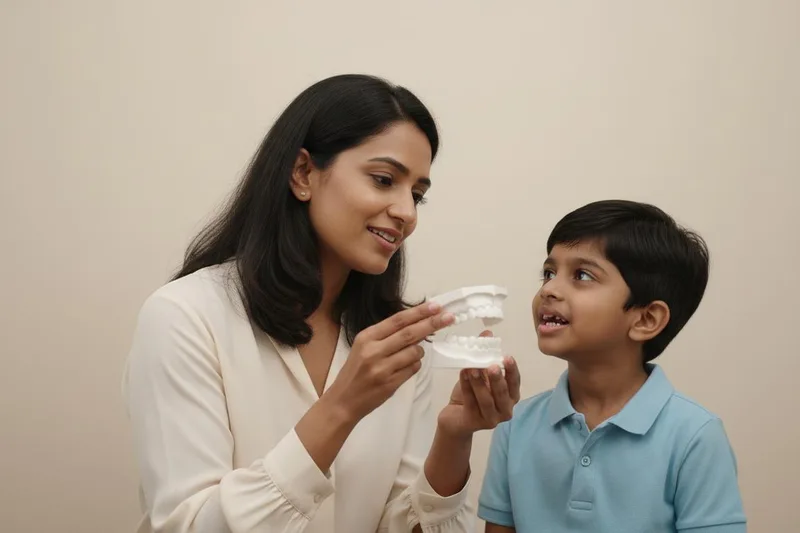
When you look at your child's mouth, have you noticed that their teeth are crowded together and pulled together? Or do you have a problem where the upper and lower teeth don't fit together properly when eating? The reason for this may be that your upper jaw is a little narrow. So today we are talking about a special device that widens this narrow upper jaw a little and makes room for the teeth to sit nicely.
Simply put, what is this Palate Expander?
A Palate Expander is a special device used in dentistry that is attached to the roof of your mouth (palate). Some people also call it an orthodontic expander. Its main function is to gradually and very carefully widen the narrow upper jaw. Imagine that our upper palate is formed by two main bone fragments coming together in the middle. What this device does is to gently push those two fragments to the sides, creating space between them.
Although this is mostly used by young children, it can also be used by young people and adults if desired.
Who needs this device?
There are several situations in which your dentist or orthodontist may recommend this device for you or your child.
| Problem | Simple explanation |
|---|---|
| Crowded teeth | If your teeth are crowded together due to lack of space in your mouth. |
| Crooked teeth | If the teeth are crowding due to lack of space. |
| Misaligned bite | Conditions where the upper and lower teeth do not meet properly when the mouth is closed. For example, a crossbite (where the lower teeth are positioned further apart than the upper teeth). |
| Impacted teeth | If there is not enough space in the jaw, some teeth cannot come up through the gums and are stuck inside. |
| Obstructive Sleep Apnea | In some cases, widening the upper jaw can make it easier to breathe through the nose and relieve sleep apnea. |
Simply put, this widens the jaw and creates space for the teeth to be in proper alignment.
What is the best age to put this on a child?
This can be used at any age. However, the results obtained with this are very successful in young children. The reason is that children's jaw bones are not yet fully developed. They are still growing. Therefore, specialist doctors usually recommend starting this treatment at the age of 7-8 years.
Treating the jawbone in this way at a young age offers a great opportunity to prevent having to undergo major surgery in the future.
A child can usually see the desired results in as little as two to three months. However, in young people and adults, the jawline will take a little longer to widen, as their bones are fully developed and strong. It can take up to a year.
Are there types of Palate Expander?
Yes, there are several types to use depending on your needs.
Removable Palate Expander
This is like a retainer that is placed on your teeth. But it is made of chrome metal. The doctor recommends this for those who do not want to make their upper jaw very wide, but only want to make a small change.
Rapid Palate Expander (RPE)
This is the most commonly used type. It is attached to the upper jaw and attached to the back teeth. There is a small screw in the middle of this. You need to turn this screw a little bit every day with a special key that the doctor gives you. The gentle pressure that occurs when you do this causes the two jaw bones to move apart from each other. This can widen the jaw at a rate of about 0.5 millimeters per day. You can usually see results in 3-6 months.
Surgically Assisted (SARPE)
This is usually used for adults or those with a significant narrow jaw. This is because the jaw bones of adults are completely fused together. So an oral surgeon performs a small operation and loosens the suture in the middle of the upper palate. Then the expander is inserted. This, like the RPE, must be activated daily with a key.
Implant-supported Expander
This is also used mostly on young people and adults. Instead of attaching the expander to the teeth, an oral surgeon attaches it to four mini dental implants that are placed in the jaw. This allows the pressure to be directed to the jawbone rather than directly to the teeth.
Does it hurt when you put this on?
As with any new dental appliance, you may experience some discomfort and stiffness for the first few days after you have it in place. You may also feel a slight pressure when you turn the key. This is not a serious pain. For this discomfort, talk to your doctor and take an appropriate pain reliever (e.g. acetaminophen, ibuprofen).
However, if you experience unbearable pain or anything unusual, call your dentist immediately.
What are the advantages and disadvantages?
Advantages
- Many problems, such as crowding of teeth and jaw protrusion, can be resolved.
- Using this during childhood can prevent major surgeries in the future.
- Once this is in place, it can be used with other dental appliances, such as braces, if necessary.
Things to be aware of (Risks and Complications)
Rather than calling this a disadvantage, it would be better to mention the temporary side effects that may occur during treatment.
- A little discomfort or pain: This is normal in the early days.
- Headache : Some people may experience a slight headache.
- Drooling: There may be a little extra saliva at first because there is something new in the mouth.
- Lisping: Because of the lisping device, some words may feel a little different at first, but you will get used to it after a while.
- A gap between the front teeth: As the jaw moves apart, a small gap forms between the two front teeth. This is a good sign! It means the expander is working properly. Later, braces will completely close this gap and straighten the teeth.
- Food stuck: Food particles and dirt can get stuck around the appliance. Therefore, it is essential to rinse your mouth thoroughly and clean the appliance after every meal. Otherwise, you may develop a bad breath.
The important thing is that while braces can move teeth, they cannot widen the jawbone. If the jaw is narrow due to a bone problem, an expander like this is definitely needed.
Finally, after the expander has widened your jaw, your doctor will likely recommend that you keep it in your mouth for another 4-6 months to allow the newly formed bone to strengthen. Therefore, it is important to be patient and complete the treatment.
Take-Home Message
- A Palate Expander is a special dental device used to widen a narrow upper jaw.
- This is a great help in resolving teeth crowding, pulling, and jaw problems.
- This treatment is most effective in childhood (ages 7-8), but it can also be done in adults.
- Although there may be minor discomfort (pain, difficulty speaking) in the first few days, they are temporary.
- It is very important to keep the equipment clean.
- Your dentist or orthodontist is the best person to decide if you or your child needs this treatment, so talk to them and get advice.





💬 Comments (0)
No comments yet. Be the first to share your thoughts here.
Add Your Comment