
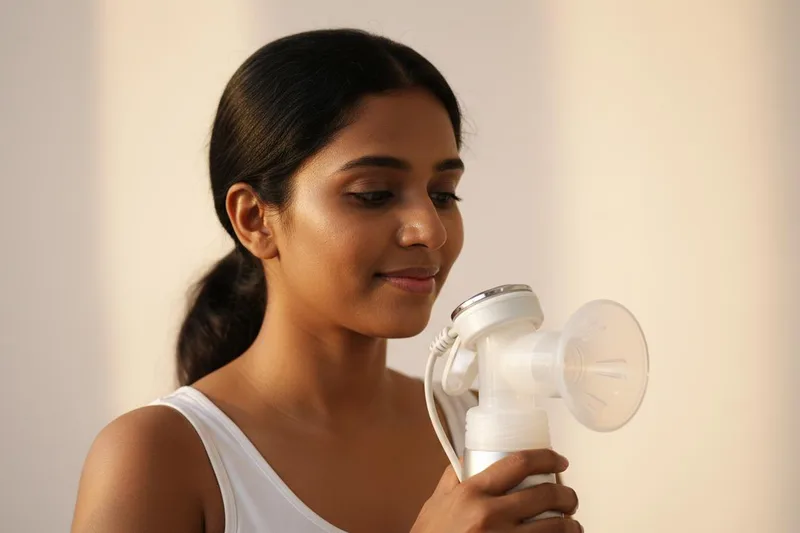
Many breastfeeding mothers pump their breast milk to give to their baby when they are away from their baby, for example, when they are at work. So today we are going to talk about pumping this milk, that is, about breast pumping, about the equipment used for it (breast pumps), how to use them, and how to pump safely. You must have a lot of questions about this too, right? Let's try to find the answers to them.
What kind of pump is right for me?
Now you're probably thinking, "Hmm... what kind of pump is right for me?" It really depends on how often you plan to use the pump. Simply put, if you only need to pump occasionally, a manual pump is a good choice. But if you plan to pump regularly, or more often, an electric pump is a better choice.
Manual Pumps
Speaking of `(Manual Pump)`, these are small and relatively cheap when compared to `(Electric Pump)`. They usually cost less than $50, which is about eighteen thousand to twenty thousand rupees in our money (according to the current exchange rate). However, expressing milk requires a little manual effort and takes a little more time. That is why it is said that these are good to use occasionally. Many mothers keep a `(Manual Pump)` at home, as a `backup` in case of an emergency. Just think, if there is a problem with your `(Electric Pump)`, or if the power goes out, this will be useful.
Electric Pumps
Electric pumps (also known as automatic pumps) are much easier to use than manual pumps. You know what? They don't require much effort and can be used relatively quickly. Some electric pumps allow you to pump from both breasts at once. This saves you valuable time, doesn't it? Not only that, but pumping from both breasts at once can also help increase your milk supply. Electric pumps come in a variety of sizes and styles. Many can be plugged into a wall outlet or can be used wirelessly using a battery.
How do I find a `Pump`?
Find out if you can get a breast pump through your insurance plan. Some insurance plans cover this. Alternatively, you can buy or rent one from a lactation consultant, hospitals, some baby stores, or online.
Important: Some countries have special programs (such as `WIC`) that provide free or low-cost `Pumps` to low-income mothers. To find out about such special programs in our country, check with your local Family Health Service Officer (Midwife Nona) or the Office of the Medical Officer of Health (MOH). You may also be able to get some relief.
Is it better to buy a used `Pump`?
This is not a good idea at all . Do not borrow or pay for a used `(Breast Pump)` from someone else. The reason is that bacteria and viruses from the previous user may be present inside the `pump`. No matter how much you clean or sterilize them, they will not be completely removed. This has a high chance of harming your baby's health.
However, there is a special type of pump called ``Hospital-grade pumps`` that are used at the hospital level. These are designed to be used by several people. However, even when used that way, each mother uses her own ``accessory kit``. This reduces the risk of spreading germs.
Do you need to pump immediately after the baby is born?
There are some situations where you may need to pump milk right after your baby is born. For example:
- If your baby was born prematurely (`early birth`) or has a medical condition that makes it difficult for him to suckle directly from the breast.
- If you and the baby have to be separated for some reason.
In this case, hand-express your breasts within the first two hours after your baby is born. Then start pumping every 2-3 hours . If possible, use a hospital-grade pump or a good electric pump. In the early days, you will only pump a small amount of the thick, thick milk called colostrum (also called "first milk" or "foremilk"). Don't worry about it. As you continue to pump, your milk supply will gradually increase.
However, if your baby is breastfeeding well and gaining weight well, there is no particular need to pump immediately after birth. Some mothers may think, "Oh, I should just pump and store my milk right away." But that is not a good idea. This can lead to over-supply. This can leave your breasts feeling full, engorged, and painful.
When is the best time to start pumping to collect milk?
If you are returning to work after maternity leave, or if you plan to be away from your baby for some time, it is a good idea to start pumping about two weeks before that date. This will give you time to get used to the pump and get used to using it. It will also help your baby get used to drinking from a bottle.
The amount of milk a mother can pump varies from person to person. You may not be able to pump enough milk to fill a bottle in the early days. Don't be discouraged. Pumping for a while will help. Some mothers say they pump more milk when they are with their baby, when they look at a picture of their baby, or when they smell their baby's clothes. Although it may take some time to get used to pumping, it is a great way to breastfeed your baby even when you are not with them.
If you have any concerns or doubts about the amount of milk you can pump, be sure to talk to a lactation consultant or your family doctor.
How to make it easier to pump?
It takes some practice and time for your body (and mind) to get used to producing milk without your baby's help, that is, without your baby sucking directly. Here are some little things that can help make pumping easier for you:
- Find a comfortable place and relax: If you are nervous, anxious, or anxious about pumping, it can affect your let-down reflex. So, sit in a comfortable place, such as a chair or bed, and relax while pumping. Don't think about other things you have to do. Listening to calming music can also help. Find a way to relax that works best for you.
- Massage your breasts before and during pumping: Gently massaging and compressing your breasts with your hands can help to remove as much milk as possible from your breasts. This can be difficult if you are pumping both breasts at once. It is easier to use a hands-free bra.
- Keep something that reminds you of your baby: Look at a picture or video of your baby on your phone. Or keep something that smells like your baby, like a piece of clothing or a blanket, nearby. This will help put you in the right mood to pump and stimulate the let-down reflex.
- Fit the Breast Shield (Flange) to Your Breast Properly: The breast shield (also called a flange) is the plastic cup-like piece that covers your nipple and areola when you pump. It should fit snugly over your entire nipple and areola, creating a good seal. If it doesn't, you may feel uncomfortable and may not be able to pump as much milk as you need.
- Choose the right size flange for your breast: When you pump, your nipple should move freely inside the flange's tunnel without getting stuck. Also, you don't want too much of your areola to be pulled into the tube. If that happens, or if you feel pain or discomfort while pumping, try a different size flange. Many pumps come with different sizes of flanges. So choose the one that fits you best and is most comfortable.
- If you are using an electric pump, adjust the speed and suction to a level that is comfortable for you: This can help avoid unnecessary discomfort. It is best to use the lowest setting that allows the milk to flow easily.
Where can I `Pump` at work?
If you have to pump at your workplace, find a place that is comfortable for you, has some privacy, and is not crowded.
Many companies provide designated pumping and nursing areas for their employees. If your company doesn't have such facilities, you can talk to your supervisor or HR department to see if there is a room or other private space that you can use.
Remember: A bathroom is not a good place to pump. It is generally accepted that employers should provide a suitable, clean space and a reasonable amount of time for this. You can discuss this with your employer.
How do you clean the parts of the `Pump`?
This is very important . If the parts of the pump are not cleaned properly, germs can be passed on to the baby.
- Before using for the first time: Wash the breast pump accessories (for example, breast shields and any other parts that come into contact with your breasts or milk) thoroughly, then sterilize them by boiling them in water for 5 to 10 minutes . Check the pump manufacturer's instructions for how long to boil them.
- You can use a countertop sterilizer or a microwave sterilizer, but boiling is just as good and less expensive.
- After each use: Wash bottles, nipples, and other pump accessories thoroughly in hot, soapy water after each use. Or you can put them in the dishwasher. If not cleaned properly, bacteria can grow on them and make your baby sick.
The most important things for you to remember (Take-Home Message)
Pumping milk can be a bit challenging at times, but it's so rewarding for both you and your baby.
- Choose the pump that suits your needs.
- It is very important to stay relaxed before and while you start pumping.
- Install the flange properly, using a setting that is comfortable for you.
- Always keep the pump parts clean.
- If you have any questions or doubts, don't be shy about asking a doctor or a lactation consultant.
This sacrifice you are making is a big investment in your baby's healthy future. You can do it!
` Breastfeeding, Expressing Milk, Breast Pump, Manual Pump, Electric Pump, Milk Supply, Colostrum, Lactation Consultant, (Breast Pumping), (Manual Pump), (Electric Pump), (Colostrum), (Lactation Consultant), (Let-down reflex), (Flange)


💬 Comments (0)
No comments yet. Be the first to share your thoughts here.
Add Your Comment