
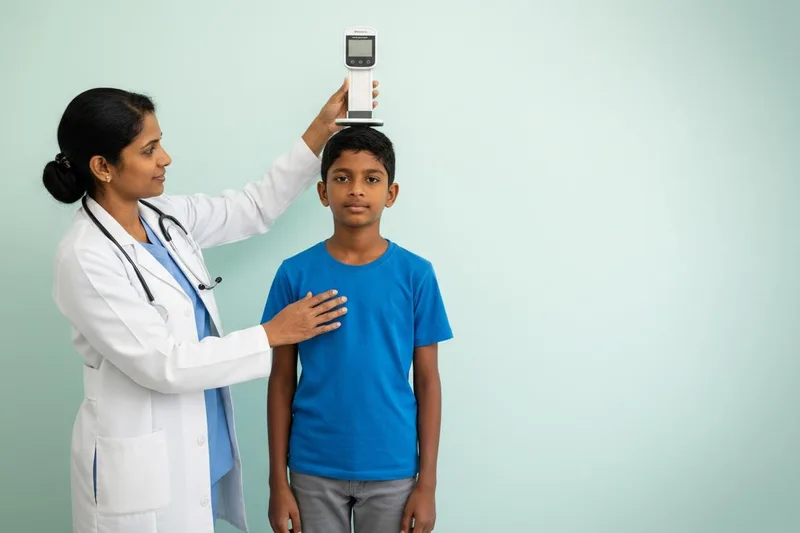
Your child is now 14 years old, right? This age is a very important time in their life, and a time of many changes. So it is very important to check on their health during this time, that is, to have a 'well-child visit'. Let's see what happens at this doctor's appointment, and what we should expect?
What happens during this doctor's appointment?
Your doctor and/or nurse will likely do the following:
1. The child's height, weight and BMI
First, your child's weight and height are measured, and the body mass index (BMI) is calculated accordingly. Then, these measurements are plotted on a growth chart to see if the child's growth is on track. Think of it like a growth report for your child.
2. Blood Pressure and Hearing
Next, the child's blood pressure is checked. Sometimes hearing may also be checked. Although these are routine tests, they can provide a lot of important information about the child's health.
3. Take care of your mental health too! (Depression Screening)
Children of this age are more likely to experience signs of depression or anxiety . Therefore , a screening test may be done. This does not mean that your child has a problem. This is done to help identify anything early.
4. Shall we talk about your child?
The doctor will talk to you and your child about their daily lives and any problems they may have. This is a good time to discuss your concerns and seek advice. In particular, they will talk about:
How is the food and drink?
At this age, children should learn to make healthy food choices for themselves. Encourage your child to eat at least 5 servings of fruits and vegetables a day. Tell them to limit sugary, salty, and fatty foods as much as possible. Calcium and vitamin D are very important for bone development because their bodies are growing rapidly at this age. Try giving them three servings of low-fat dairy products (or something like calcium-fortified soy milk) to get about 1,300 milligrams of calcium a day.
Are you getting enough sleep?
A child of this age needs 8-10 hours of sleep a day. Poor sleep is a problem for many children these days. It can affect learning as well as sports activities. At this age , biological changes in the body make it difficult to sleep at night. However, since school starts early in the morning, it is not possible to get enough sleep.
Therefore, establish a relaxing bedtime routine for your child. It is best to remove electronic devices like TVs and phones from the child's bedroom.
Exercise and play
Encourage your child to engage in at least 60 minutes of physical activity a day. Limit screen time such as TV, video games, phones, tablets, and computers. It is best to focus on activities such as playing outdoors and taking walks.
How is the child's growth and development?
It is common for children to experience the following symptoms by the age of 14:
- Signs of puberty are shown:
- Puberty in girls usually begins between the ages of 8 and 13. It is marked by breast development and the appearance of pubic hair in the private areas . Periods usually begin about 2 years after breast development begins.
- The first sign of puberty in boys is testicular enlargement . This usually begins around age 11, but can start as early as age 9 or as late as age 15. The penis lengthens and pubic hair grows.
- The skin becomes oily and acne may appear. This is normal for this age.
- They don't always think about the future consequences of their actions. That means they can act a little recklessly.
- They are interested in working alone and being independent, as well as being with their friends and fitting in with their peers.
- They think a lot about their personal appearance and behavior.
- It can be tempting to engage in risky behaviors. As adults, we need to be aware of this.
5. Physical Exam
Next, the doctor will examine the child. This includes looking at the skin , listening to the heart and lungs , checking for curvature of the spine , such as scoliosis, and looking for signs of puberty . It is important for a parent, guardian, or other appropriate person (chaperone) to be with the child during this examination. It is best to have other siblings in the waiting room to allow the child privacy.
6. Vaccines Update
Vaccines protect children from serious diseases. Therefore, it is very important to vaccinate your child on time. Vaccine schedules may vary slightly between different medical centers. So talk to your doctor to find out exactly what is needed.
7. If necessary, blood tests
If necessary, the doctor may order blood tests and other tests to check for things like anemia , high cholesterol , tuberculosis , and sexually transmitted diseases (STDs) .
Keep these things in mind until you're 15 years old.
Be mindful of these things until your child's next checkup, which is the doctor's appointment at age 15.
How is school going?
- Encourage your child to participate in a variety of activities , such as music, art, sports, and after-school clubs.
- Praise your child for their accomplishments . Support them if they fail or struggle .
- Create a quiet place to do homework . Minimize distractions like TV and phones .
- When schoolwork gets harder , your child may have difficulty doing those things. If that happens, work with the school's teachers to find out why. It could be a learning disability , an attention problem , bullying at school , or other stressors .
- Peer pressure can lead to risky behaviors like drinking or smoking . So be aware of who your child is spending time with . Make sure they are supervised by an adult .
The child's personality and feelings
- Spend time with your teen every day . Eat meals together, be active together, talk about things that are important to your child.
- Set rules, make your expectations clear . Give fair consequences for breaking the rules. Praise good choices .
- Be prepared to answer questions your child may have about puberty and the feelings associated with it. Be open to questions about gender identity and sexuality . Encourage your child to ask you if they have any questions.
- Encourage your child to postpone sexual activity with others until they are older . Explain the risks of sexually transmitted diseases (STDs) and unwanted pregnancies .
- Encourage your child to bathe or shower daily and use deodorant .
- Children should brush their teeth twice daily , floss once a day , and see a dentist every 6 months .
- Be aware of signs of depression, such as irritability , sadness , loss of interest in activities , poor grades , and talk of suicide .
Think about the child's safety too.
- Talk to your child about the dangers of smoking, vaping, alcohol, and drugs .
- Always wear a seatbelt when riding in a vehicle. Tell your child to never get in a vehicle with a driver who has been drinking or doing drugs . Instead, tell your child to always call you for help if they need it .
- Remind your child to always wear a helmet when riding a bike, skateboard, or scooter . When playing sports, they should wear proper protective equipment, such as mouth guards and pads .
- You should apply sunscreen (SPF 30) at least 15 minutes before going outside, and reapply it about every 2 hours .
- Monitor your child's Internet use . Keep the family computer in a place where you can watch . Set up safety filters , and check the browser history to see what websites your child visits.
- Talk to your child about online safety, cyberbullying , and how to use social media wisely .
- Avoid gun injuries by not keeping a gun in the house. If you have a gun, keep it unloaded and locked away . Keep ammunition locked away . Make sure that children cannot get to the keys.
- If you have questions about your living situation, talk to your doctor. Do you have what you need to care for your child? Do you have enough food, a safe place to live, and health insurance? Your doctor can tell you about community resources or refer you to a social worker .
Finally, remember this...
Your 14-year-old's Well-Child Visit is a great opportunity to check on their physical, mental, and social well-being. Since their lives are changing so much during this time, it's important to be open and honest with your doctor and share your concerns. Maintain a good relationship with your child, and be loving, understanding, and supportive . That's the biggest strength you can give them to get through this difficult time. Because they need you the most during this time.
` Adolescence, health check-up, child development, mental health, vaccinations, parenting advice, youth health


💬 Comments (0)
No comments yet. Be the first to share your thoughts here.
Add Your Comment