
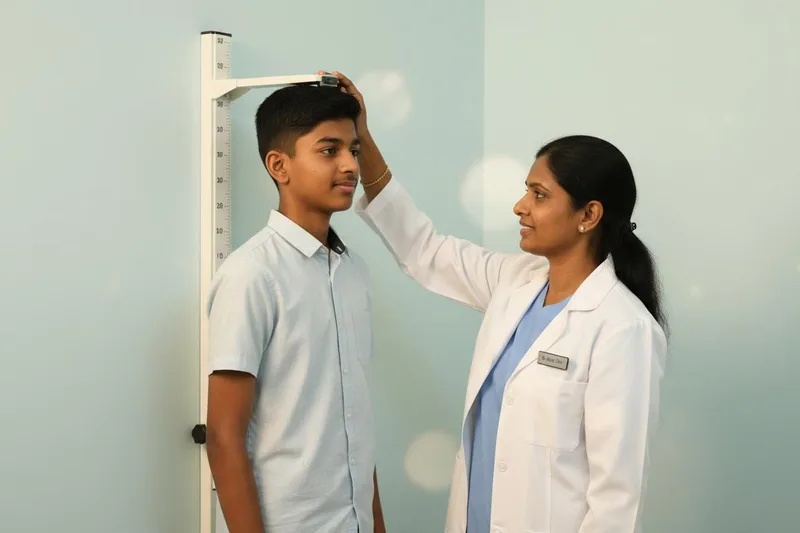
Your child is turning 16, which means they are at a very important and somewhat complicated juncture in their life. At this age, their body, mind, and emotions are all changing at an incredible rate. So, a doctor's checkup, also known as a Well-Child Visit , is very important at this time. Let's take a look at what exactly happens during this time, and what you and your child should expect?
What usually happens during this doctor's visit?
Okay, so when you and your child go to see the doctor, a few things usually happen:
1. How is the child's growth? (Weight, height, and BMI)
First, the doctor or nurse will measure your child's weight and height . Then, they will use those measurements to calculate their body mass index, or BMI. All of this is recorded on a growth chart . This can help you see if your child is growing at a healthy rate for their age.
2. Blood pressure and hearing are also checked.
Next, your child's blood pressure will be measured. Sometimes , hearing may also be checked. These are routine tests, so there is nothing to worry about.
3. Questions the doctor asks and advice he gives
This is a very important part of this checkup. The doctor will ask you and your child questions, talk about your problems, and give you some very valuable advice. Let's see what they'll talk about.
What do you need to know about food and drink?
It is very important for children at this age to eat three main meals a day. These meals should include the following:
- Good types of protein: For example, things like meat, fish, eggs, chickpeas, and green beans.
- Whole grains: Things like whole wheat, brown rice, and oats.
- Vegetables and fruits: Try to eat at least 5 servings (5 portions) a day. Include a variety of colorful vegetables and fruits in your diet.
- Milk and dairy products: You should have at least 3 servings a day of low-fat milk, yogurt, and skim milk . Calcium-rich fortified soy milk is also good.
Simply put, a balanced diet is what helps you stay healthy at this age.
Is the child getting enough sleep?
A young child this age definitely needs between 8 and 10 hours of sleep per night . However, due to biological changes at this time, they may be late in falling asleep at night. However, because school starts early in the morning, there are many times when they are unable to get enough sleep.
- Not getting enough sleep can directly affect schoolwork, sports, and exams.
- Therefore, encourage your child to do relaxing activities before bed (e.g. reading a book, listening to calming music).
- The most important thing is to stop using electronic devices like phones, computers, and tablets at least an hour before bed . The blue light they emit disrupts sleep.
How important is physical activity?
A young child should be involved in some form of physical activity for at least 60 minutes a day. That could be running, jumping, playing, or exercising.
- These days, children spend too much time looking at screens – TV, video games, smartphones, computers – and it's not good for their health.
- Therefore, encourage your child to maintain a balance between screen time and healthy activities like socializing with others, exercising, and getting enough sleep .
- It's very important for you to set a good example by limiting your screen time and exercising daily.
Child growth and development: What happens at this age
By the age of 16, children experience major changes not only in their bodies, but also in their minds and emotions.
- If it's a girl: She should have had her first period by now. If your daughter hasn't had her first period yet, talk to her doctor about it. It could be normal, or there could be a reason for it.
- If it's a boy: Signs of puberty (e.g., enlarged testicles, penis length, hair growth in the pubic area and armpits, deepening of the voice) should be clearly visible by now.
- Peer influence: At this age , the influence of one's peer group is very strong. What they say and do can have a big impact on the child.
- A time of self-discovery: "Who am I? What suits me?" With questions like, "Who am I?", you may be tempted to experiment with different identities . You may dye your hair, wear strange clothes, or try new things. These are the characteristics of this age.
- Sexual feelings: It is normal for teens to develop sexual feelings at this age. This means they may be attracted to people of the opposite sex or the same sex, and may be interested in romantic relationships. They are also exploring their sexuality, sexual orientation, and gender identity at this time.
- They begin to think differently: at this age, they are able to think abstractly, consider facts logically, and consider how to make decisions .
- However, there is still a risk: even with such deep thinking, sometimes we still have an impulse-driven nature . Therefore, we may be tempted to engage in risky behaviors without properly considering the consequences of our actions. For example, reckless cycling or unprotected sex.
4. A complete physical examination
Next, the doctor will perform a complete physical exam .
- Checking the skin (for acne, spots, or other skin conditions).
- Listening to the heart and lungs.
- They check for any curvature of the spine.
- We are examining how puberty development is progressing.
Important: To avoid making the child uncomfortable during this type of test, it is best to have a trusted adult (chaperone) – either you or another appropriate person – stay in the room with the child.
5. Updating Vaccines
During this checkup, the child's current vaccinations are reviewed and updated. Vaccinations protect children from serious diseases such as measles, mumps, and rabies. Therefore, it is very important to give them on time. Vaccine schedules may vary slightly at different medical centers, so ask your doctor about it.
6. Other tests as required
Sometimes, if the doctor has any doubts about the child, he may ask for additional tests.
- A blood test to check for anemia .
- A test to check for high cholesterol levels.
- If there is suspicion of tuberculosis, get tested for it.
- Get tested for sexually transmitted diseases (STDs) if you are at risk.
All of this is done to ensure that the child's health is at its best.
Things to keep in mind until your next checkup
After this checkup is over, there are a few things you can do to take care of your child until the next checkup at 17 years old.
About school work
- Encourage your child to participate in various extracurricular activities that interest them (music, art, sports, after-school clubs, volunteer work). These will help develop their personality.
- Teach your child to take responsibility for their schoolwork . Praise their successes and support them when they are struggling.
- Talk to your child about what they want to study in the future, their college or work plans, and guide them toward their dreams.
- If your child is struggling with schoolwork, consider whether the cause is bullying , depression , or learning or attention problems . It is important to seek medical advice for these conditions.
About the child's personality and feelings
- Spend some time talking to your child every day. Eat a meal together, do some activity together, ask about things that are important to your child.
- Praise your child for making good decisions and doing a good job. Ask for their opinion and involve them in family decisions.
- Set house rules and make your expectations clear. The consequences for breaking the rules should be fair, and instead of punishing, explain the mistake.
- Encourage your child to delay sexual activity . Talk openly and clearly about the risks of sexually transmitted diseases (STDs) and unwanted pregnancies . Also talk about birth control and the importance of using condoms .
- Remind your child to brush their teeth twice a day, floss once a day, and see a dentist every 6 months .
- Make your child understand the dangers of smoking, vaping, alcohol, and illegal drugs . Also talk about the dangers of prescription drug misuse or taking more than the recommended dose . Praise your child for saying "no" to these things.
- Be on the lookout for signs of depression . These include frequent outbursts of anger, feeling sad all the time, losing interest in things you used to enjoy, poor grades in school, and talking about suicide. If you have any of these symptoms, seek medical advice immediately.
- Encourage your child to take responsibility for their own medical care . For example, schedule doctor's appointments, renew prescriptions, and learn how to treat an existing illness.
These are the things to consider for safety
- Teach your child to always wear a seatbelt when riding in a vehicle.
- When your child starts driving , set limits on the number of passengers they can carry at one time and the amount of time they can drive. Strictly tell your child not to text or talk on the phone while driving.
- Talk about the deadly dangers of drinking and driving . Never get in a car with someone who has been drinking or taking drugs. Instead, tell your child to always feel free to call you if they need help .
- Apply sunscreen with an SPF of 30 or higher at least 15 minutes before going outside, and reapply every 2 hours . Avoid using tanning beds, as they greatly increase the risk of skin cancer.
- Make sure your child is aware of online safety, cyberbullying, and how to use social media wisely . Tell them not to share personal information with strangers.
- Avoid gunshot wounds by not keeping a gun in your home. If you have a gun, keep it unloaded, locked up, and out of reach of children. Keep bullets locked up separately.
- If you have concerns about your living situation (e.g., not having enough food, not having a safe place to live, not having health insurance), talk to your doctor about it. He or she can tell you about community resources or refer you to an appropriate social worker.
In summary, things to remember!
Just think, 16 years is a wonderful age in a child's life when many changes occur, challenges arise, and new things are tried. This medical checkup (Well-Child Visit) is the best opportunity to check whether the child's physical and mental health is in order, and to get the guidance and advice that you and the child need.
It is very, very important to talk openly with your child, listen carefully to what he or she says, and give him or her your unwavering love and support. Remember, you are not alone in this journey, and never hesitate to seek medical advice if you have any concerns or doubts.
` Well-Child Visit, 16-year health check-up, youth health, BMI, vaccinations, mental health, sexual health, safety


💬 Comments (0)
No comments yet. Be the first to share your thoughts here.
Add Your Comment