
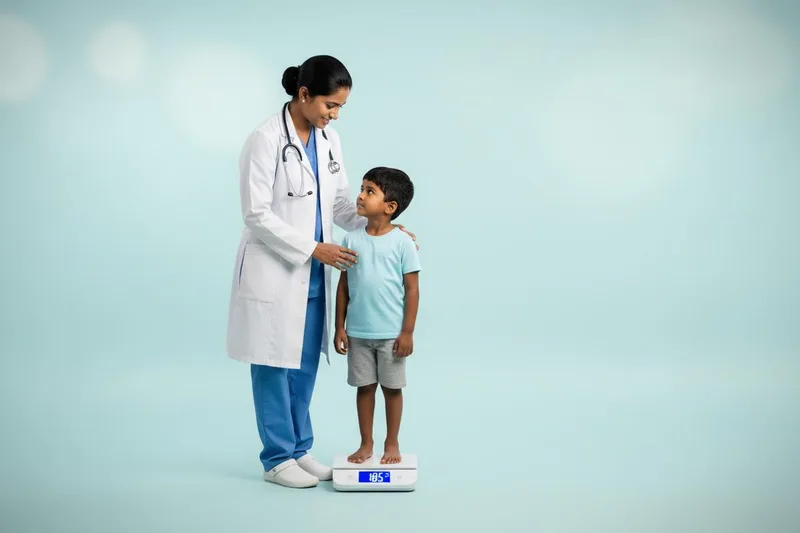
Your little one is five years old now, right? As he grows older, we need to check his health. Today, we'll talk about what happens and what to look for when you visit the doctor at this age, that is, when you go for a 'well-child visit' or a well-child clinic. This will be very important for you as well as your child.
What happens during this doctor's appointment?
When you go to see the doctor, he or the nurse there will usually do these things. There's nothing to worry about, all of this is done for the best interest of your child.
1. Measure your weight and height, see your BMI and growth chart!
The first thing they do is measure your child's weight and height accurately, and use that to calculate their Body Mass Index (BMI). Then, they record these measurements on a special growth chart they have. Think of it like a story about a child's growth. This is how the doctor sees if your child is growing healthily for his or her age. This helps to identify any deficiencies early on.
2. How is your blood pressure, eyesight, and hearing?
Next, the baby's blood pressure is checked. You may have seen it done with a strap on the arm. Also, special equipment is used to check vision and hearing. These are very simple tests and will not cause any discomfort to the baby. So don't be afraid, okay?
3. Questions on your mind, your child's habits, and valuable advice
The doctor will ask you about your baby. You can ask any questions, concerns, or doubts you have at this time. Don't hold anything back. The doctor will give you valuable advice on the following:
- About food: You probably know that you should have three main meals a day, with one or two nutritious snacks in between. If your child is a picky eater, or what we sometimes call a 'picky eater', continue to let him choose a variety of nutritious foods. Encourage your child to try new foods. But don't force them. Doing so may make your child more reluctant to eat.
- Toilet habits: By now, your child should be used to going to the washroom alone. However, some children are embarrassed to use the washroom at school , which can lead to problems like constipation. That is, difficulty in defecating daily. Therefore, remind your child to go to the washroom regularly, and gently explain, 'Don't hold back'. If you have any concerns about your child's toilet habits, be sure to discuss it with your doctor.
- How is sleep?: Children this age should generally get between 10 and 13 hours of good sleep a night. By the age of five, most children have stopped napping completely. To get your child enough sleep, you may need to put him to bed a little earlier. Sleep is essential for a child's brain development and physical well-being.
- Child Growth and Development: By the age of five, most children should be able to do these things. See if your child can do these too:
- The ability to exchange ideas back and forth at least three times when talking to another person.
- The ability to tell a short story with at least two events.
- After reading a book or story, be able to answer simple questions about it.
- Ability to follow the rules and take turns while playing.
- Being able to help with small, simple chores around the house.
- At least be able to count to ten.
- The ability to recognize some letters and numbers.
- Being able to write at least a few letters of their name.
- Camel hopping, that is, being able to jump on one leg.
- The ability to put on certain types of buttons on a garment by themselves.
This is very important: If your child has not passed one or more of these developmental milestones, or if you feel that he or she has lost some of the skills he or she once had, definitely talk to your doctor about this without delay. The sooner you know, the better.
4. Full physical examination with clothes off
Before you leave, your child will be undressed (only their underwear on) and will be given a complete physical examination. This will include listening to the heart and lungs with a stethoscope, observing the child's motor skills (i.e. how they walk, run, and jump), and talking to the child to assess their language skills (i.e. how they speak and pronounce words). During this time, the doctor will examine the child's entire body.
5. Updating essential vaccines
Vaccinations are a very important thing that protects children from serious childhood diseases like measles, mumps, and rubella. Therefore, it is essential to give your child the vaccines on time. The vaccination schedules may vary slightly at different medical centers, so talk to your doctor to find out exactly what vaccine your child needs next and when it will be given.
6. Some more tests if necessary
Your doctor may order blood tests or other tests to check for conditions like anemia, lead poisoning, and tuberculosis. These are done to further confirm your child's health.
Keep these things in mind until you are 6 years old.
Okay, let's say your child's five-year checkup is over. It's a good idea to keep these things in mind until his next checkup, which is the medical exam at age 6.
Let's be a little more careful about food and drink.
Continue to feed your child a well-balanced diet . This should include:
- Lean protein - that means things like fish, chicken, eggs, and lentils.
- Whole grains - things like bran rice, atta flour, and oats.
- Fresh Fruits - Several types of fruit of each color per day.
- Fresh Vegetables - Green vegetables as well as vegetables of various colors.
- Low-fat dairy products - things like yogurt and skim milk.
And remember these things:
- Children this age should get two and a half cups (about 600 milliliters) of low-fat milk, fortified soy milk, or other low-fat dairy products a day.
- If you are giving 100% fruit juice, don't give more than 4-6 ounces (120-180 ml) per day. It's best to give the whole fruit.
- Avoid giving your baby foods that are high in sugar, salt, and fat as much as possible. Sweetened drinks, toffee, chocolate, and foods with artificial flavors are not good for your baby.
- Whenever possible, try to eat meals together as a family. Turn off the TV and put away your phone and other electronic devices during meals. This will give you the opportunity to enjoy your meal and talk with your family.
Daily routines and child care
- Give your child plenty of time for good physical activity and free play every day. Running and playing is good for your child's body and mind. Be active as a family. Do things like go for a short walk in the evening, go to a playground, etc.
- Limit screen time - that is, time spent in front of the TV, smartphone, tablet, and computer - to one hour a day. That hour should be for good quality children's programming. If possible, watch the programming together with your child. Do not keep the TV and similar devices in your child's bedroom.
- Teach your child to brush their teeth twice a day, using a pea-sized amount of fluoride toothpaste. Take them for regular dental checkups as recommended by the dentist. To prevent tooth decay, your doctor or dentist can apply a special coating called fluoride varnish to your child's teeth two to four times a year.
- These things will help prepare your child for kindergarten/preschool :
- Practice counting numbers and singing the ABC song together.
- Encourage your child to draw, color, recognize letters, and write simple letters.
- Create a consistent routine for things like meals, snacks, playtime, reading time, nap time, getting up in the morning, and going to bed at night. This will help your child get used to planning their day.
- Give your child some responsibility for doing things on their own, such as going to the bathroom, washing their hands, brushing their teeth, and getting dressed. Provide reminders and help when needed.
- Teach your child to remember your home address and your or your father's phone number.
- Read books to your child every night before bed or at other times of the day. This will develop your child's language skills and imagination.
Safety is the most important thing!
As parents, protecting our children from danger is our greatest responsibility.
- Teach your child the correct way to cross the road (looking both ways, listening for traffic). But until they are about 10 years old, they should cross the road with you. Never let them cross the road alone.
- Always make sure your child wears a helmet when riding a bike (even one with training wheels) or scooter. Do not let them ride on the road, only in a safe place.
- Check that the playground has a soft surface (e.g. grass, sand, rubber mats) so that it is not dangerous to fall.
- Always keep a close eye on your child when they are near water (a lake, river, ocean, swimming pool). Do not leave them unattended for even a second. If possible, it is a good idea to enroll your child in a swimming class.
- Apply sunscreen (Sunscreen SPF 30 or higher) at least 15 minutes before your child goes outside to play. It helps protect the skin from the harsh sun. Reapply every two hours.
- Protect your child completely from secondhand smoke. It greatly increases the risk of heart disease and lung disease in children. Similarly, the smoke from e-cigarettes is also harmful.
- Keep your child in the back seat of the car, in a booster seat , until he or she is 4 feet 9 inches (about 150 centimeters) tall. Children usually reach this height between the ages of 8 and 12.
- Teach your child what to do in an emergency , including how to call an emergency number (for example, 119 in Sri Lanka).
- Protect your child from gunshot wounds by not keeping firearms in the home. (This is less common in Sri Lanka, but it is important to be aware of it.) If you do have one, keep it locked away in a safe place where children can never open it. Keep bullets locked away separately. Never leave keys within reach of children.
- Talk to your child about appropriate touch . This means that if someone touches them, they should tell you so, and teach them not to touch them. Explain in a loving way that some parts of the body are very private and that no one should look at or touch them except for their parents (except in special circumstances, such as during a medical examination). If someone asks to look at or touch their private parts, or asks to look at or touch someone else's private parts, or asks to keep a secret from you, tell your child to tell you right away.
- If you have any concerns about your living situation , such as not getting the things you need to care for your child (e.g., enough food , a safe place to stay ), or if you have questions about health insurance , don't be shy about talking to your doctor about it. Your doctor can tell you about community resources and, if necessary, refer you to a social worker .
The most important things to remember (Take-Home Message)
Okay, so from what we've talked about, I think you've got a good idea about taking care of your five-year-old child's health. Don't skip medical checkups like this for any reason . Always pay attention to your child's growth, eating, sleeping, daily habits, and safety. If you have any questions or even the slightest doubt, don't be afraid to ask the doctor, or put it off. Seeing your child grow up healthy, happy, and playful is your only hope, and ours too!
` Children's health, five-year-old child, medical examination, Well-Child Visit, child development, nutrition, vaccinations, child safety


💬 Comments (0)
No comments yet. Be the first to share your thoughts here.
Add Your Comment