
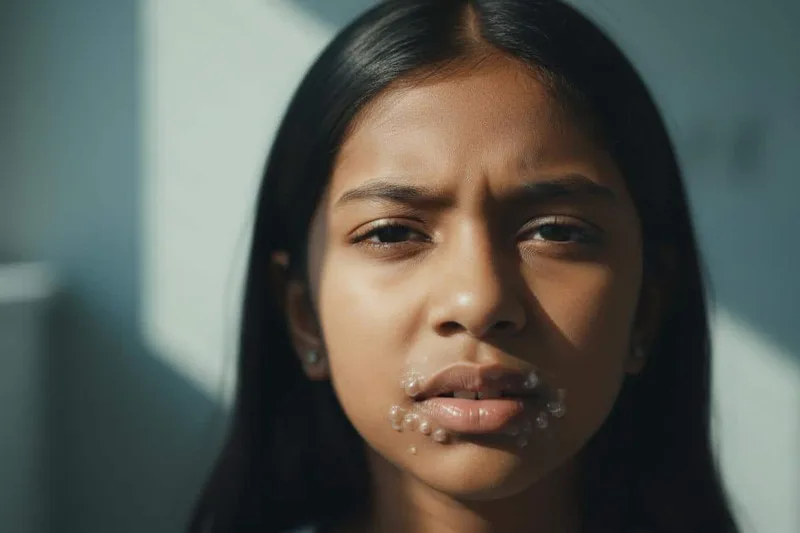
Hello! How are you? Today we are going to talk about something that is often a bit annoying, but usually not dangerous, for young children and some adults. That is, small, painful watery blisters that appear on the lips and around the mouth. Some people also call these "fever blisters". In English, they are also called `(Cold Sores)` or `(Fever Blisters)`. So, shall we talk about this in detail today? Let's see what these are, why they occur, how to cure them, and how to prevent them.
What are these cold sores?
Simply put, these cold sores are one or more small, red, slightly swollen, watery fluid-filled blisters that appear on the lips, around the lips, and sometimes under the nose or chin . They are initially itchy and numb. Then the blisters appear.
These are very common, meaning most people will get them at least once in their lives. The best part is, these blisters usually heal on their own within a week or two without any special treatment . However, they can be a little painful for a few days.
What are the symptoms of fever blisters?
Before your baby or you get these fever blisters, about a day or two before, you'll start to feel a little tingling, itching, or sometimes burning in the area where they're going to appear. It's like you're feeling like "something's going to happen here."
Then, as we mentioned earlier, one or more small fluid-filled blisters appear. These blisters burst after a few days. Then, a small, shallow wound forms in that area. That's when it becomes a little difficult to eat and drink, and it hurts . Young children may even refuse to eat because of this pain.
These wounds dry up after a few days, forming a yellowish crust on top. When this crust falls off on its own after a few days, the wound is usually completely healed, leaving no scar.
In addition to these blisters and sores, some children, especially when they first get them, may also show other symptoms:
- Gums become red and swollen.
- Fever (sometimes severe).
- Body aches, muscle aches.
- Generally feeling unwell and lifeless.
- Swollen lymph nodes (also known as "glands") in the neck.
These symptoms do not occur in everyone the same way. Some people may only have blisters, while others may have these additional symptoms.
Why do these fever blisters form?
Here's the important thing. The main cause of these cold sores is the herpes simplex virus type 1, or `(Herpes Simplex Virus type 1 - HSV-1)` . This is a very contagious virus . This means it can spread easily from one person to another.
Now you might be thinking, "When you say herpes, you've probably heard of genital herpes, right?" Yes, that's also a herpes virus. But it's mainly caused by the herpes simplex virus type 2, or HSV-2. This is what causes genital herpes.
But here's a little something to understand. Usually, the `(HSV-1)` virus causes cold sores around the mouth, and the `(HSV-2)` virus causes sores in the genital area. However, both viruses can cause sores in both areas of the body . That means, although rarely, `(HSV-1)` can cause sores in the genital area, and `(HSV-2)` can cause sores around the mouth.
Even after a child or adult has been infected with the ``(HSV-1)`` virus and has recovered from the cold sores, the virus does not completely disappear from the body . It remains dormant, or "asleep," in the body's nerve cells. It can remain there for years without any symptoms.
However, sometimes, for some reason, this "sleeping" virus can "wake up" again. That's when the cold sores appear again. There are several reasons why this can happen:
- Other infections: For example, when you get a cold or flu.
- Fever: When the body temperature rises.
- Sun exposure: Burned by intense sunlight.
- Cold weather: Exposure to extreme cold.
- Menstruation in women: Due to hormonal changes.
- Stress: Like when an exam is approaching or when work increases.
"Imagine, your baby has a big exam at school, and he's very scared and stressed about it. At a time like that, this virus can reawaken and cause fever blisters."
How do young children get these cold sores?
Because this virus (HSV-1) is very easily transmitted, children are more likely to develop it.
- By kissing or touching someone who has fever blisters.
- By using eating utensils (spoons, forks, plates, cups) that have been used by someone with fever blisters.
- By sharing things like towels and clothes.
Most people who become infected with the ``(HSV-1)`` virus are infected during their preschool years (between the ages of 3-5) . Young children can sometimes unknowingly spread the virus when they play together or share toys.
How do you treat fever blisters?
Cold sores usually heal on their own within a week or two . There is no cure for the virus yet. However, there are some things we can do to reduce the pain caused by cold sores and help them heal more quickly.
Things you can do at home:
- Cold compress: Soak a clean cloth in ice water, wring it out, and place it over the blister for a few minutes. This will reduce pain and inflammation. You can do this several times a day.
- Be careful about food and drink: Since there is pain, give the child non-spicy, non-hot, and cool foods and liquids . Things like yogurt, ice cream (low in sugar), and soups (unsweetened) are good. Spicy, sour, and salty foods can increase the pain.
- Painkillers: If your child is having difficulty coping with the pain, you can give them a painkiller like Paracetamol or Ibuprofen , as directed by your doctor. Never give aspirin to a child with a cold sore or other viral infection, as it can cause a rare but dangerous condition called Reye's Syndrome.
If you see a doctor, they may prescribe a cream or other medication to help the blisters heal faster and reduce pain.
Most importantly: Teach your child not to touch, break, or pick at a cold sore, and to avoid touching their eyes frequently . This is because if the ``(HSV-1)`` virus gets into their eyes, it can cause serious eye infections.
When should we see a doctor?
Although fever blisters are usually not dangerous, there are some cases where it is important to seek medical advice. Here are some such cases:
- If your baby is less than 6 months old and has a fever blister.
- If the child's immune system is weak (for example, due to another medical condition or taking medications that suppress the immune system), the HSV infection can spread to other parts of the body and cause complications.
- If the blisters appear and there are no signs of healing after 7-10 days .
- If there are blisters near the eyes , or if the eyes are red and painful.
- If you get frequent cold sores (several times a year).
- If there are signs of a bacterial infection (e.g., pus coming out of the wound, spreading redness, increasing fever).
- If there are other unusual symptoms (e.g. severe headache, confusion).
In a situation like this, it is definitely best to see a doctor and seek advice.
Can you prevent fever blisters?
Because the ``(HSV-1)`` virus is so contagious, it is difficult to completely prevent it. However, there are things we can do to reduce the spread of the virus. In particular, be aware of these things when a child has a cold sore:
- Keep items such as drinking glasses, eating utensils, and face towels used by your child separate from those used by other family members. Wash and clean these thoroughly after use.
- Avoid kissing other people until the wound is completely healed.
- Avoid touching or breaking fever blisters.
- Wash your hands thoroughly (with soap and water for at least 20 seconds), especially after touching a blister.
By following these simple practices, you can reduce the risk of spreading the virus to others and to other parts of your child's body.
Finally, things to remember (Take-Home Message)
Well, we've talked a lot about cold sores, haven't we?
Don't worry! Fever blisters are usually not dangerous. Although they can be a little annoying and painful, they usually heal on their own within a week or two.
- Cause: The virus called `(Herpes Simplex Virus type 1 - HSV-1)`.
- Transmission: It spreads very easily. So be careful about cleanliness.
- Treatment: Pain can be reduced with home remedies. Painkillers such as paracetamol and ibuprofen can be given (but not aspirin!).
- Medical advice: In some special cases (if the baby is under 6 months old, if the immunity is low, if it is near the eyes, if it occurs frequently, or if it lasts for less than 10 days), see a doctor.
- Prevention: Although it is difficult to completely prevent, the spread can be reduced by following hygiene measures.
So, if your baby gets a fever blister, don't panic, keep these things in mind and take the necessary steps. Get well soon! Wishing you all good health!
` Cold Sores, Fever Blisters, HSV-1, Herpes Virus, Children's Diseases, Skin Diseases


💬 Comments (0)
No comments yet. Be the first to share your thoughts here.
Add Your Comment