
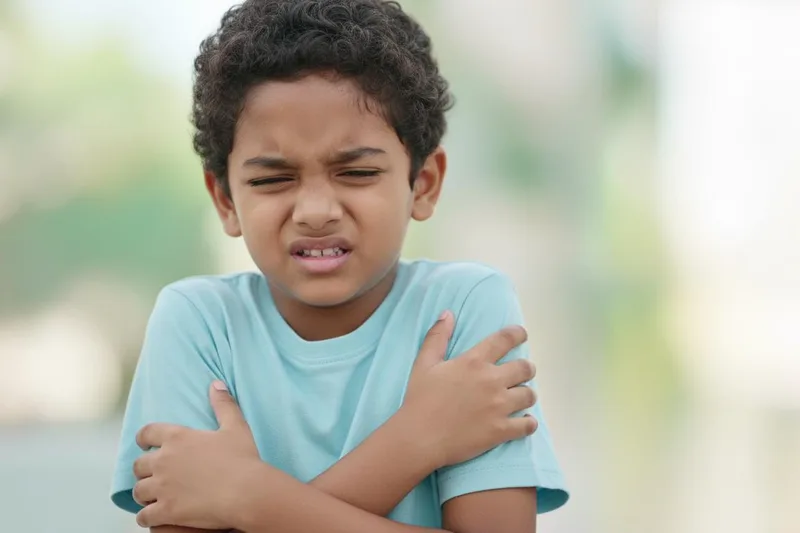
Have you ever fallen and had a sharp pain in your shoulder? Or do you remember a time when you hit your shoulder while playing sports and screamed, 'Ouch!'? You may have broken your collarbone, the small bone that connects your shoulder to your chest. This is what we call a clavicle fracture in medical terms. This is actually quite common among young people and those who play sports. So let's talk about it in more detail today, shall we?
What is the clavicle? Why is it so important?
Simply put, the clavicle is like a small 'handle' on our shoulder blade. If you put your hand under your neck, on the side of your shoulder, you will feel this bone. It is also called the 'collarbone' in English. These two pieces of bone – one on the right side, the other on the left – connect to the large bone at the top of our chest (called the breastbone or sternum) and the shoulder blade (called the scapula). Think of it like a bridge. This is what allows us to raise our arms, rotate them, and do various tasks. Also, this bone provides some protection for the important blood vessels and nerves that go to our arms. So, even though it looks small, it does a great job, do you understand?
How does this collarbone fracture? Can it happen to little ones too?
Now let's see how this collarbone breaks, or `(Fracture)`. Most of the time, this happens due to a hard fall. Imagine, if your child is running and playing on the playground and suddenly falls on his shoulder, or if you fall on your bike and reach out and support yourself on the ground, then this collarbone can be damaged at such a time. Other ways are:
- Direct blow: If something hits the shoulder directly. Like someone coming and hitting you in a game like rugby.
- During birth: Sometimes this bone can break in newborns, especially if the birth is difficult. But it heals very quickly.
- Vehicle accidents: If the shoulder is impacted in a vehicle accident.
Actually, this collarbone fracture is very common among children and young people . Because they are always running, jumping, and playing sports. Therefore, they are more likely to fall. But it is not impossible for an older person to have this, especially if their bones are a little weak.
What are the symptoms of a broken collarbone?
Okay, now you have a question, 'How do I know for sure if my collarbone is broken?'. Here are some symptoms to look for:
- Severe pain: There is severe pain at the fracture site, especially when moving the shoulder or trying to raise the arm.
- Swelling and bruising: The fracture site may be swollen and may appear blue/purple.
- Tenderness : It hurts a lot when you touch the area with your hand .
- A deformity or lump: Sometimes the broken bone may appear as a lump above the skin, or the shape of the shoulder may look different from the other side.
- A 'grinding' sound: When you try to move your hand, you may hear or feel a 'grinding' sound (Grinding or crepitus) as the broken bones rub together. However, do not try to move your hand intentionally to see this, as it will only increase the pain.
- Inability to raise the arm: It is very difficult to raise the arm and use the shoulder.
- Shoulder drooping appearance: The shoulder on the affected side may appear to be slightly drooping and leaning forward.
- If it's a child: If it's a small child, they may not stop crying and may sit on that side without moving their arm.
If you have one or more of these symptoms, it is best to seek medical advice immediately.
How does a doctor diagnose this accurately?
When you go to a doctor with these symptoms, the first thing he or she will do is ask you questions. How did it happen, how much does it hurt, and can you move your arm? Then, the doctor will carefully examine your shoulder and collarbone area (Physical Examination). This way, he or she can get an idea of whether there is swelling, pain, or if any bone fragments are moving around.
However, to know exactly if the bone is broken, where it is broken, and how it is broken, you definitely need to have an X-ray. This will clearly show the broken area. In most cases, an X-ray is sufficient to diagnose this condition.
However, very rarely, if the fracture is very complex, or if there is a suspicion of damage to blood vessels or nerves, the doctor may order another test, such as a CT scan. However, this is not usually necessary.
What is the treatment for a broken collarbone?
Okay, now let's see what kind of treatment doctors give for this collarbone fracture. The good news is that in most cases, this can be fixed without surgery!
Non-surgical Treatment
Many people use these methods:
- Arm Sling or Figure-of-Eight Brace: You may have seen a sling that is worn around the neck after a broken arm. This is the most common type of sling. This helps to reduce the weight of your arm on your collarbone, and it also helps to keep your arm from moving too much, helping to align the broken bones. Sometimes a 'figure-of-eight' brace is used to hold your shoulder back. Your doctor will decide which brace is right for you. He or she will also tell you how many days you should wear it.
- Pain Relief: Your doctor may give you medicine like ``Paracetamol`` to reduce pain. You may also be given medicine like ``Ibuprofen`` to reduce swelling. But it is important to take the medicine exactly as the doctor tells you, in the amount prescribed.
- Ice Packs: For the first two or three days, applying ice to the fracture can help reduce swelling and pain. But don't put the ice directly on the skin. Wrap it in a cloth and leave it on for about 15-20 minutes. Do this several times a day.
- Rest: This is very important. Resting your hand will help the bone heal faster. Do not lift weights or do strenuous work on your hand until your doctor tells you to.
In what cases is surgery necessary?
Not everyone needs surgery, but a doctor may decide to perform surgery in these cases:
- Significantly displaced: If the two broken bone fragments are too far apart and don't seem to be coming together.
- If the bone fragments have broken through the skin (open fracture): This is a more serious condition because germs can enter through the wound.
- If there is damage to blood vessels or nerves: If this has happened, surgery may be needed to correct it.
- Comminuted fracture: If the bone is broken into many small pieces, surgery may be needed to put them back together.
- For athletes: Some athletes may choose surgery because they want to recover quickly and return to play.
- If you are unable to use your other hand: For example, if you have a disability in your other hand, surgery may be considered because it is important to heal this hand quickly.
Surgery involves realigning the broken bones and fixing them with small metal plates and screws. These are placed inside the body. Most of the time, surgery is not needed to remove them, but sometimes the doctor may decide to do so.
How long does it take to heal? What should I do at home? (Healing and Home Care)
Now you're probably thinking, 'Oh, how long will this take to heal?' Healing time varies with age. Young children's bones heal very quickly. They can have a collarbone completely healed in about 3 to 6 weeks. But for an adult, it can take 6 to 12 weeks, or even longer.
At home, you should take care of these things:
- Use the sling/brace exactly as your doctor tells you to. Do not remove it until the prescribed period is over (unless your doctor gives you permission, such as when taking a shower).
- Control the pain. Take the medicine prescribed by the doctor on time. When the pain subsides, you will feel better.
- Start using your arm gradually. Your doctor will tell you when to start moving your arm a little and doing small tasks. Don't start lifting weights all at once.
- Physiotherapy: Once the bone has set, physiotherapy or physical therapy exercises are very important to regain proper shoulder movement and strengthen the muscles. Your doctor will refer you to a physiotherapist or will teach you exercises to do. Doing these correctly will help you use your shoulder without any problems again.
- Eat a healthy diet: Foods rich in calcium and vitamin D are important for healthy bones. Include foods like milk, yogurt, cheese, green vegetables, and eggs in your diet.
The most important thing is to follow the doctor's instructions exactly. Only then will you be able to recover quickly and completely.
You may notice a small bump at the fracture site after the bone has healed. This will often go away over time, but it may not go away completely. This usually doesn't cause any pain or make it difficult to use your hand. It's just an appearance.
Are there any complications to be afraid of?
Most of the time, a broken collarbone heals without any problems. However, it is good to be aware of a few rare complications that can occur. There is nothing to worry about, these are very rare.
- Nonunion or Malunion: Sometimes, broken bones can not fit together properly (Nonunion) or can fit together incorrectly (Malunion). Simply put, the bone does not fit together properly. If this happens, the pain may persist and the use of the hand may be difficult. Then you may need to see a doctor again, and possibly have surgery.
- Shoulder Stiffness: If you have not used your arm for a long time, or if physiotherapy is not done properly, your shoulder may become stiff. That's why exercise is important.
- Damage to blood vessels or nerves: This is very rare. Broken bone fragments can damage a nearby blood vessel or nerve. This can cause numbness, weakness, or discoloration in the arm. If you notice anything like this, you should tell your doctor right away.
- Lung Injury: This is also very, very rare, especially if the bone breaks deep into the chest.
But I repeat, these are very rare things. If you follow the doctor's instructions and get proper treatment, you don't need to worry about things like this.
Are there ways to prevent collarbone fractures? (Prevention)
It's impossible to prevent a broken collarbone 100% of the time, as accidents can happen at unexpected times. However, there are a few things we can do to reduce the risk:
- Wear protective gear when playing sports: Using items like shoulder pads can provide some protection, especially when playing contact sports like rugby and hockey.
- Be careful of falls: Be careful of slippery surfaces in your home. Keep an eye on small children when they are playing.
- Keep your bones strong: Eating foods rich in calcium and vitamin D strengthens your bones, making them less likely to break even after a minor fall.
- Improve your balance: When you exercise and improve your balance, you are less likely to fall.
Although these are small things, they can help reduce the risk of an accident.
In summary, here are the things we need to remember (Take-Home Message):
Okay, so from what we've discussed, I hope you've got a good idea about clavicle fractures. Finally, here are some important things to remember:
- Collarbone fractures are common among children and active young people.
- This can happen due to things like falls, sports accidents, and direct blows.
- If you experience symptoms such as severe shoulder pain, swelling, or inability to move your arm , see a doctor immediately.
- In most cases , this can be cured without surgery, with a support for the arm and rest.
- The healing time varies depending on age. Younger people heal faster.
- Following your doctor's instructions exactly and doing the right exercises is very important for a quick and complete recovery.
- It usually heals well without any complications, so don't be afraid, but don't ignore it either.
If something like this happens to you or someone you know, the best thing to do is not to panic and seek medical advice immediately. Wishing everyone good health!
` Clavicle Fracture, Shoulder Pain, Childhood Accidents, Sports Accidents, Fracture Treatment, Arm Sling


💬 Comments (0)
No comments yet. Be the first to share your thoughts here.
Add Your Comment