
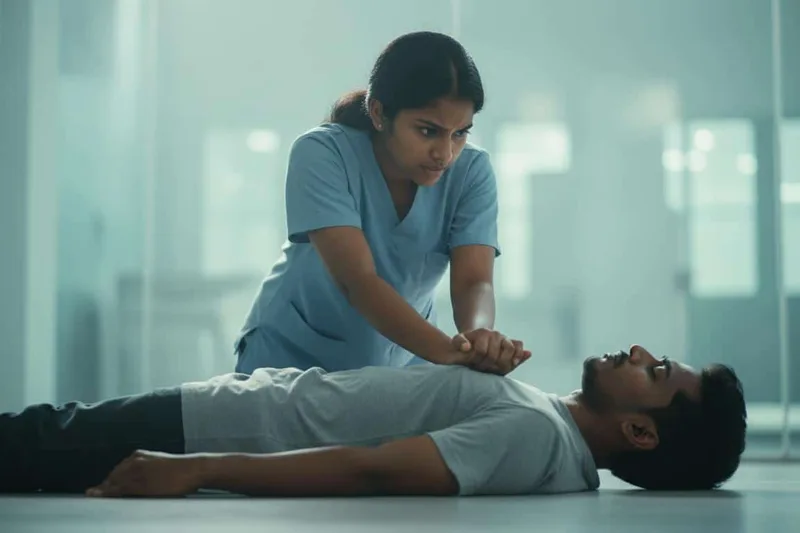
Imagine, whether you are on the road or at home, someone suddenly falls unconscious. They are not breathing, their heart is not beating. Oh my God, you can't even imagine what to do at such a time, right? It really makes you very nervous at such a time, your limbs feel numb. But, if you are properly informed, you too can save a life at such a critical moment. That is what this valuable method called CPR is for. So, today we will talk about many things in a simple way that you can understand, such as what CPR `(Cardiopulmonary Resuscitation)` is, how to do it, and when it is needed.
What is CPR? Simply put...
Okay, so let's first look at what CPR is. CPR stands for `(Cardiopulmonary Resuscitation)`. It may seem like a long word, but it does something very simple, but very important. Simply put, CPR is a life-saving procedure used when someone is not breathing or their heart is not beating.
This is a combination of two main things:
1. Chest Compressions: This involves pressing hard on the chest where the heart is. This helps to circulate blood throughout the body when the heart is not working properly. It is especially important to get oxygenated blood to the brain.
2. Rescue Breathing: This is also called mouth-to-mouth breathing. This involves giving breaths to someone who is not breathing on their own, and getting oxygen into their lungs.
Now you understand, right? If someone's blood circulation is not working properly, or their breathing is weak, CPR can send oxygen-rich blood to the brain and help them start breathing again. It's like giving a jump start to a car when the battery dies and it won't start.
In what kind of emergency is CPR needed?
Now you may be wondering, "Okay, I understand that CPR is important. But when is it needed?" In fact, CPR can save a life in any emergency. Take a look at these examples:
- Accidents: Any accident, such as an accident on the road or a slip and fall at home.
- Near-drowning: When someone drowns in water and loses consciousness.
- Suffocation: If something gets stuck around the neck or something like a plastic bag gets stuck on the head, the person suffocates.
- Poisoning: Taking an unknown drug, such as an insecticide, into the body.
- Heart Attacks: If the heart stops due to a sudden heart attack.
- Drug Overdoses: If you lose consciousness after taking too much of something like drugs.
- Smoke Inhalation: If you are unable to breathe due to a fire due to the inhalation of so much smoke.
- Electrocution Injuries: If you lose consciousness due to an electric shock.
- Suspected cases such as Sudden Infant Death Syndrome (SIDS): CPR can also be helpful in these types of sudden situations in young babies.
Very important: To get the most out of CPR, start it as soon as possible. But remember, you should only perform CPR if someone is not breathing or has a heart attack. Do not perform CPR on someone who is just panicking.
Another thing, before starting CPR, or while starting it, you should definitely call the 1990 Suwaseriya Ambulance Service. Because CPR is only first aid until the doctors arrive.
Remember the three most important parts of CPR - "CAB"!
There are three basic steps to performing CPR. It's easy to remember, with just three English letters: "CAB" .
- C stands for `(Compressions)` or chest compressions .
- A stands for `(Airway)` or respiratory tract .
- B stands for `(Breathing)` or artificial respiration .
Let's look at each of these in a little more detail .
C - Compressions (chest compressions)
This is the first and most important step in CPR. Chest compressions help keep blood flowing to the heart, brain, and other vital organs. Think of it like a water pump. If it stops, we need to apply external power to keep it going.
CPR begins with 30 chest compressions. Then, two rescue breaths are given. According to the American Heart Association, when performing chest compressions, you should "push hard, fast, and straight into the center of the chest." That is, in the center of the chest, just above the rib cage. The way to do compressions for young children and babies is a little different, and you need to learn it exactly.
A - Airway
After 30 chest compressions, we need to check if the person in distress has an open airway for breathing. Because if the airway is blocked, no matter how much we give artificial respiration, it won't get to the lungs.
Now think about it, when someone is unconscious, their tongue can fall back and block their airway. Just like when we snore sometimes when we sleep, but this is more dangerous. Or it could be a piece of food or a toy that's stuck in the throat. So, in this step 'A', what we're doing is opening up that airway so that we can breathe. Usually, we're doing this by tilting the head back a little bit and lifting the chin up.
B - Breathing (artificial respiration)
Once the chest has been compressed and the airway is clear, artificial respiration begins. This involves giving breaths for the person in distress. That is, we put our mouth over their mouth (covering their nose with our hand) and blow air into their lungs.
When doing this, you give two breaths. You give one breath, watch for chest rise, and then give the next breath. You also check for signs of life in between - breathing, movement, etc. - and you'll be taught exactly how to do all of this in a CPR course.
Why is it so important to learn CPR properly? Where can I learn it?
In fact, it's very, very important for every parent and adult to know about CPR. Just think, if your own child, a family member, or a stranger on the street had an emergency, if you knew CPR, you could help save that life.
For example, if CPR is performed in time, it has a much higher chance of saving a life. Because, until doctors arrive and provide advanced life support, CPR can continue to pump blood to the heart, brain, and other organs, and oxygen to the lungs.
So, how do you learn CPR? There are places in Sri Lanka that offer such courses.
- CPR and first aid courses are offered by organizations like the Sri Lanka Red Cross Society .
- You can also find similar courses at St. John Ambulance .
- Some major hospitals are also conducting awareness programs.
- Nowadays, there are courses available to learn CPR online . Some are classroom-based, or they are blended, combining both online and classroom learning.
In this type of course, you will be taught how to perform CPR separately for adults, children, and even breastfeeding babies. Not only that, you will also be taught what to do if something gets stuck in the throat (Choking). These are not just things you learn in a book, you will have the opportunity to try them yourself using mannequins and ask questions.
CPR is not something you can just learn once. It is something that needs to be practiced. Therefore, it is very good to refresh your knowledge and maintain your training by taking a course at least once every two years. Then, you can also learn about new advances or discoveries in CPR.
What you need to remember from what we've talked about! (Take-Home Message)
We've talked a lot about CPR today, haven't we? The most important thing to remember is this:
CPR is a simple, yet extremely valuable technique that anyone can learn that can save a life in an emergency.
>
Taking a CPR course is a great investment in yourself, your family, and the community. That knowledge could help you save someone's life, anytime, anywhere. So, find a place to learn CPR today. It could be the most important decision you make in your life!
Remember, in an emergency, don't panic, call 911 immediately, and if you know CPR, start it. Your efforts are your best hope for saving a life!
` CPR, Sinhala CPR, emergency treatment, lifesaving techniques, chest compressions, artificial respiration, emergency treatment


💬 Comments (0)
No comments yet. Be the first to share your thoughts here.
Add Your Comment