

You may have heard the term `(Ectopic Pregnancy)`, or you may know someone who has faced this condition. It is actually a bit scary, but if you are properly aware of this, if you recognize it early, you can reduce many problems. So today we will talk very simply about what `(Ectopic Pregnancy)` or a pregnancy outside the uterus is, why it happens, what are its symptoms, and how is it treated.
What is a normal pregnancy? Let's first understand that.
Simply put, in a healthy pregnancy, the fertilized egg, the tiny embryo that forms from the mother's and father's cells, implants itself directly in the mother's uterus . The uterus is a small sac-like place, a safe place for a baby to be cared for, nourished, and grown for nine months. It has everything the baby needs to thrive.
So what is an ectopic pregnancy?
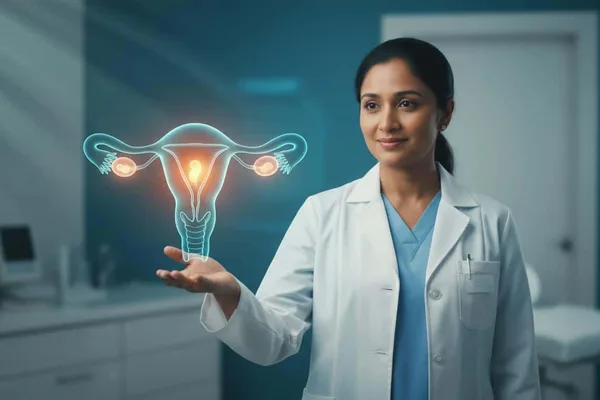
Now you probably understand the normal way. But in an `(Ectopic Pregnancy)`, the fertilized egg does not reach the uterus, but implants itself somewhere else. Most of the time, that is, about 90 out of 100, this egg implants itself in the `(Fallopian tubes)` . These fallopian tubes are two thin tubes that carry the egg from the ovary to the uterus. This is why `(Ectopic Pregnancy)` is often called `(Tubal Pregnancy)`.
However, not only in the fallopian tubes, but very rarely, this egg can also implant in the ovary , cervix , or even in the abdominal cavity .
Just think, a small plant can grow into a big tree only if we plant it in a place with fertile soil and space. In the same way, an embryo needs a womb to develop properly.
In none of these places, that is, in a fallopian tube or an ovary, is there any space or facility for an embryo to grow and be nourished properly. So as the embryo grows there, the organ in which it is implanted (for example, the fallopian tube) becomes unable to support it. Eventually, it can burst . If that happens, there is a risk of excessive bleeding and even a serious threat to the mother's life. That is why this is so dangerous.
Another thing is that an embryo that is placed outside the uterus in this way will not develop into a healthy baby.
Why does this happen? What are the risk factors that affect this?
It's hard to say for sure what the single cause is. But some factors can increase the chance of an ectopic pregnancy, or risk.
- If you have had an ectopic pregnancy before: Someone who has experienced this condition once is more likely to have it again.
- If the fallopian tubes are damaged: If the fallopian tubes are damaged, blocked, or scarred due to an infection, such as pelvic inflammatory disease (PID ), which is caused by sexually transmitted infections (STIs), the egg may not be able to reach the uterus properly.
- If you have had surgery on your fallopian tubes: For example, if you have had your fallopian tubes tied and then reattached (reversal of tubal ligation).
- Some fertility treatments: This risk may be slightly increased, especially with treatments like IVF.
- If you smoke: This risk is higher for women who smoke.
- If you are over 35 years old.
- If you get pregnant while you have an IUD: An IUD is a very effective birth control method. However, it is very rare for you to get pregnant while you have an IUD. If you do, the pregnancy is more likely to be ectopic.
What are the symptoms of this? How can we recognize it early?
This is very important, because if it is identified early, it is easier to treat and the risk is lower.
As in a normal pregnancy,
- Cessation of menstruation
- Breast pain, tightness
- Symptoms such as vomiting and nausea may appear first.
However, there are a few symptoms that are specific to an ``Ectopic Pregnancy'' and that you should definitely be aware of :
- One-sided abdominal pain: This is the main symptom. It can start as a dull , aching pain on one side of the abdomen (either the right or left), and can sometimes be severe, stabbing, or stabbing. This pain can be constant or come and go.
- Unusual vaginal bleeding: This is not like a normal menstrual period. It may be light, brown, or watery. In some people, it may even be dark red.
- Shoulder tip pain: This may seem like a strange symptom, but if there is bleeding inside the abdominal cavity, this type of pain can occur because the blood stimulates the diaphragm muscle.
- Feeling pain when defecating or urinating.
- Weakness, dizziness, fainting: These are very dangerous symptoms. They mean that there is a lot of internal bleeding and you may be going into shock . If something like this happens, you should go to the hospital without delay.
Imagine a friend of yours, let's say Shyama. She has a late period, a positive home pregnancy test, and she is very happy. But after a few days, she starts having pain on one side of her stomach, and a little bit of bleeding. She thinks, "Oh, maybe this is something else when the baby is attached." But the pain gradually increases. This is when we definitely need to see a doctor.
How exactly does a doctor diagnose this?
If you have any of the symptoms mentioned above and suspect that you are pregnant, it is best to see a doctor as soon as possible. The doctor will ask you questions and examine you. He or she may then perform several tests to confirm the diagnosis.
- A urine test or blood test: Check if you are pregnant.
- Transvaginal Ultrasound: This is the most important scan . This scan involves inserting a small instrument through the vagina and allows you to clearly see whether the embryo is inside or outside the uterus.
- Blood tests to check the level of the hormone `(hCG)`: `(hCG)` is a hormone secreted during pregnancy. In a normal pregnancy, the level of this hormone increases rapidly. However, in an `(Ectopic Pregnancy)`, the rate of increase may be slower, or it may remain at the same level. This blood test is done about every two days.
- Sometimes a `(Laparoscopy)` surgery: If other tests cannot find the exact cause, or if it is an emergency, a device with a small camera is inserted into the abdomen and looked directly at it. This is called `(Laparoscopy)`.
What are the treatments for this?
If an ``Ectopic Pregnancy'' is confirmed, the pregnancy cannot be continued because it is life-threatening to the mother. Therefore, the main goal of treatment is to remove the fetal tissue that is implanted outside the uterus and protect the mother.
There are several treatment options. It depends on many factors, including how big the embryo is, where it is located, whether there is bleeding, and your general health.
1. Medical management:
- In this, a medicine called ``Methotrexate'' is given as an injection. This medicine stops the growth of rapidly dividing cells (i.e. embryonic cells).
- This treatment is only possible if the ectopic pregnancy is detected very early , the embryo is not large, and the fallopian tube has not ruptured.
- After giving `(Methotrexate)`, blood tests are performed regularly until the `(hCG)` level decreases.
2. Surgical management:
- Laparoscopy (keyhole surgery): This is the most common procedure. The surgery is performed through a few small incisions in the abdomen, using a camera and delicate instruments. There are two methods:
- Salpingostomy: The fallopian tube is cut, only the fertilized tissue is removed, and the tube is left intact. This is done so that the tube can be used again in the future, unless the damage is severe.
- Salpingectomy: The entire fallopian tube containing the embryo is removed. This is done if the tube is severely damaged or is bleeding heavily.
- Laparotomy (open surgery): In an emergency situation where the fallopian tube has ruptured and there is excessive bleeding, a major surgery involving an incision in the abdomen may be required.
The doctors will carefully examine your condition and discuss with you what treatment is best for you.
What happens after this? Can I have another baby?
An ``(Ectopic Pregnancy)`` is a truly difficult experience for a woman, both physically and mentally.
- Psychological impact: You may feel sad, disappointed, and even angry about losing hope. It is very important to talk to your husband, family, and friends about this and seek their help at this time. You can also seek counseling if necessary. Remember that you are not alone.
- Physical recovery: If you have had surgery, it will take some time to recover. Follow the doctor's instructions exactly.
- Future pregnancy: Many women have successful, healthy pregnancies after an ectopic pregnancy. However, if one fallopian tube has been removed or if the tubes have been damaged, the chances of getting pregnant again may be slightly lower. Also, the risk of another ectopic pregnancy is slightly higher.
Therefore, if you are thinking about having a baby again, it is very important to talk to your doctor about it and seek his advice. In your next pregnancy, it is a must to see a doctor early and have a scan to confirm that it is still in the uterus.
The most important things we need to learn from this
Okay, so from what we've discussed today, I hope you've gained a better understanding of `(Ectopic Pregnancy)`. Here are some of the most important things to remember:
- Ectopic Pregnancy is a serious condition , but it can be treated well if detected early.
- If you experience any of the usual pregnancy symptoms, such as pain on one side of the abdomen, unusual bleeding, or shoulder pain , see a doctor without delay.
- This is not anyone's fault.
- Give yourself time to recover physically and mentally after treatment. Get the help you need.
- Many people will be able to have a healthy baby in the future. Keep your hopes up.
If you have any further questions about this, don't hesitate to ask your doctor. Stay healthy!
` Ectopic Pregnancy, Miscarriage, Fallopian Tubes, Ectopic Pregnancy, Pregnancy, Women's Health, Emergency Care




💬 Comments (0)
No comments yet. Be the first to share your thoughts here.
Add Your Comment