

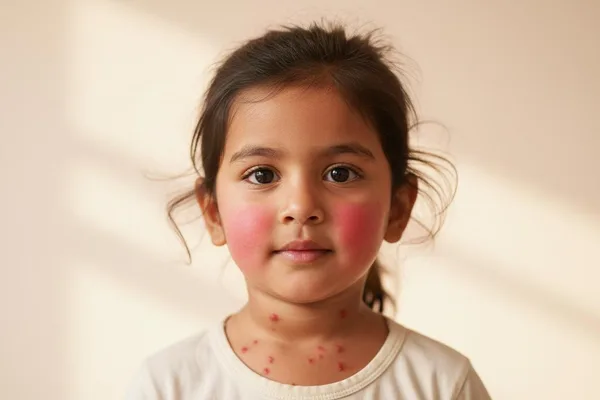
Has your child's cheeks suddenly turned very red and small red spots have appeared all over his body? As a mother or father, it's only natural for you to be a little worried and scared. In most cases, this can be caused by a viral disease called 'Fifth Disease'. When you hear the name, you may wonder what this strange disease is, but in fact, this is a common and not dangerous condition for little ones. So, don't be afraid, okay? Let's talk about this 'Fifth Disease' clearly and precisely today.
What is this Fifth Disease?
Simply put, Fifth Disease is a viral infection that is common in young children, similar to chickenpox and measles . It is caused by a small virus called Parvovirus B19. Although the name may sound a bit scientific, the virus itself is actually very small.
The most distinctive feature of this disease is that the child's cheeks look dark red, as if someone has slapped them . Some people also call it 'slapped cheek disease'. It looks as if someone has hit the cheek. This disease is usually not dangerous and will subside in a few days or weeks. However, if the child is a little uncomfortable, such as itching, it may occur.
Who is most likely to get this disease?
Fifth disease is very common among young children . It is most common in school-aged children between the ages of 5 and 15. Imagine, at school, in classrooms, and on the playground, children hang out, play, and learn together. So, at times like these, this virus can easily spread from one child to another.
However, this is not a disease that only affects young people. It can affect anyone of any age . However, if it affects adults, the symptoms may be a little different, especially joint pain. We'll talk about that a little later.
How does this disease start? What are the early symptoms?
The first few days of fifth disease symptoms feel like a common cold . The rash doesn't appear right away. Your child may have:
- The body temperature rises slightly (like a low fever, maybe around 38 Celsius).
- You may get a headache .
- You may have a runny nose or feel like your nose is blocked .
- Sometimes you may feel a slight soreness or scratchiness in your throat .
- The body may feel a little lifeless and tired .
These symptoms last for two, three, maybe four or five days and then go away. You might think, 'Oh, the cold is gone.' But then, a few days later, that particular rash starts to appear.
'Slapped Cheek' rash, which causes red cheeks
A few days after the initial cold symptoms subside, usually between 4 and 7 days, the child's cheeks suddenly turn very red . It looks as if someone has slapped them on both cheeks. This is the main and most easily recognizable symptom of fifth disease. This redness does not usually occur around the mouth, but can be white under the nose and around the lips.
This 'slapped cheek' appearance is most common in children under the age of 10 .
How the rash spreads throughout the body
After a day or two of redness on the cheeks, this red rash begins to spread to other parts of the child's body . It is usually seen on the chest, back, arms, and legs. It can also appear on the buttocks. These spots are not as red as on the face, but are slightly lighter in color and appear as small spots at first.
This rash may itch a little in some children . Not everyone itches, but if it itches, it can be a little annoying for the child. So if the child is constantly scratching, you should take a look, because scratching can also damage the skin.
Over the course of a few days, these red spots gradually turn white in the center, creating a `lacy net-like` pattern . This is also a characteristic of fifth disease.
How long does the rash last?
This rash usually lasts from one to three weeks . But sometimes it can last a little longer. In some children, this rash may disappear and then reappear, especially if the child is in the sun, in hot water, exercising, or under stress . So it's good to keep that in mind. Don't worry if it reappears, it's normal.
Is this a contagious disease? When is it contagious?
Yes, Fifth Disease is a contagious disease. The virus that causes it, Parvovirus B19, is spread primarily through respiratory droplets. That is, when an infected person coughs or sneezes . It can also be spread by touching objects that have been contaminated with the virus and then touching their nose or mouth.
The most important thing is that the child is most contagious during the cold season (during the days when there is a fever and runny nose) before the rash appears. After the rash appears, the child's transmission of the disease is usually very low, or even stopped.
That means that a child with a rash does not need to be completely isolated from others. However, it is best to keep the child at home until the symptoms subside. It is best to discuss with a doctor before sending the child to school.
How do doctors recognize this?
Often, a doctor can diagnose Fifth Disease by looking at your child's symptoms, especially the 'slapped cheek' rash . The way you describe your child's symptoms will also help the doctor . No other special tests are usually needed.
However, in some special cases, for example, if a pregnant mother develops symptoms, or if someone with certain blood problems (e.g., sickle cell anemia) develops, the doctor may decide to do a blood test to confirm the virus.
What treatments can be done at home?
Since Fifth Disease is a viral disease, there is no specific antiviral medicine for it. It is just like a cold. All we can do is help the child reduce their discomfort (symptomatic relief).
- Give plenty of fluids : Because of the fever, and to prevent dehydration, give plenty of fluids (water, fruit juice, jeevani, porridge).
- Rest : Don't let your child play or struggle, but rather let them rest well. When the body gets rest, it helps it heal faster.
- Reduce fever : If you have a fever, talk to a doctor and give something like paracetamol in the appropriate dosage. Never give aspirin to children without medical advice, right? Because it can cause a dangerous, life-threatening condition called Reye's Syndrome.
- Reduce itching : If the rash is itchy, ask your doctor to apply an anti-itch cream (such as calamine lotion). Also, keep your child's nails short, otherwise scratching can break the skin and cause infection. Wetting the skin with cool water may also help reduce itching.
Most of the time, children recover quickly from this illness without any complications .
When should you definitely see a doctor?
Although fifth disease is usually not dangerous, it is important to see a doctor in some cases. It is important to seek medical advice in the following cases:
- If the child has a high fever (e.g. 38.5 degrees Celsius or higher, if the fever does not subside for several days).
- If the child is very lethargic, refuses to eat or drink , or becomes increasingly sleepy.
- If you have difficulty breathing .
- If you have severe pain or swelling in your joints (this is more common in adults with fifth disease, but can also occur in younger people).
- If the child has a blood disorder like anemia (e.g., sickle cell anemia, thalassemia), or an immunodeficiency . If these people develop fifth disease, they may experience a condition called aplastic crisis. This means that the bone marrow temporarily stops making red blood cells. This can be dangerous.
- If you are pregnant and have symptoms of fifth disease, or if you have been in close contact with someone who has fifth disease (especially before the rash appears) , be sure to see your doctor. Because if you contract this virus during pregnancy (especially in the early months), there is a very small chance that it will affect the fetus (although it does not happen very often, it is important to be aware and seek medical advice).
Remember, if you have any doubts or are even slightly worried about your child, it's never too late to seek advice from a doctor. That's the best thing to do.
Can complications occur?
Complications are rare when a healthy child gets fifth disease. Most children recover without any problems. However, as mentioned earlier, some people, especially those with blood disorders, those with weakened immune systems, and pregnant women, may be at increased risk. Therefore, they should be especially careful and follow medical advice.
In adults, joint pain (arthritis) can sometimes last for several months . This is not as severe in younger people.
How can you protect yourself from this disease?
There is no specific vaccine for fifth disease yet . Also, because the disease is contagious before the rash appears, it is difficult to completely prevent it. However, following general hygiene practices can reduce the spread of the virus to some extent:
- Wash your hands often with soap (especially before eating, after using the bathroom, and after going out). It's best to wash your hands for at least 20 seconds.
- Teach children to cover their mouth and nose with a tissue or their elbow when coughing or sneezing .
- Teach children to avoid touching their eyes, nose, and mouth frequently .
- If your child is sick, limit close contact with others (especially pregnant women and those with weakened immune systems) .
There's nothing to be afraid of, right?
Actually, there is nothing to be too worried about Fifth Disease. It is very common in young children, and they can go back to playing and school within a few days. The most important thing is to recognize the symptoms and give your child the rest and care they need. If you have any doubts or concerns, talk to a doctor. It will also help ease your mind.
So, what are the most important things we need to remember?
Okay, let's briefly review some of the things you need to keep in mind from what we've talked about:
- Fifth Disease is a common viral disease in young children caused by Parvovirus B19 .
- The main symptom is a 'slapped cheek' rash that turns the cheeks dark red . This is followed by a `lacy net-like' rash on other parts of the body.
- Symptoms of a cold (fever, headache, runny nose) may occur before the rash appears.
- This is most contagious when you have cold symptoms. It is less contagious after the rash appears.
- It is usually not dangerous , and children recover quickly. Treatment is aimed at relieving symptoms (such as medication for fever and itching).
- Children with blood disorders (e.g., sickle cell anemia), people with weakened immune systems, and pregnant women may be at risk, so they should especially seek medical advice.
- If you have any doubts or are concerned about your child's condition, see a doctor immediately .
So, I hope you now have a better understanding of Fifth Disease. The most important thing is to not panic and act with awareness. Wishing your child a speedy recovery!
` Fifth disease, parvovirus B19, slapped cheek, childhood diseases, rashes, viral infections, colds




💬 Comments (0)
No comments yet. Be the first to share your thoughts here.
Add Your Comment