

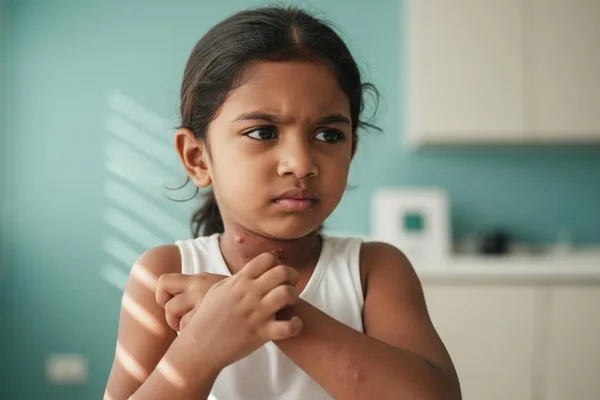
Have you ever noticed that sometimes a small child eats something and then turns red, has a rash, and sometimes has difficulty breathing? Or maybe you've been very scared if something like that happened to your own child. Actually, we call this condition a food allergy. This can sometimes be a little more serious than you think. But don't worry, if we are properly aware of this, we can manage it well.
What is this food allergy? Let's understand it simply.
Okay, think about it this way. We have a group of little security guards inside our bodies. Let's call them the immune system . Their job is to protect us from germs and diseases that enter our bodies. But, when we have a food allergy, something strange happens. These security guards, when they see a normal food that is actually harmless to the body, mistakenly think that it is a big enemy, an invader.
What happens then? Our immune system starts a big fight against that "misidentified" food. As a result of this fight, the symptoms I mentioned earlier, such as rashes and difficulty breathing, come out. We call this an allergic reaction .
The important thing is that even if a person has only a minor allergic reaction to a food in the past, the next time it may be severe enough to be life-threatening . Therefore, if a person has a food allergy, it is necessary to completely stop eating that type of food. Also, it is essential to always keep a medicine called `(Epinephrine)` nearby in case of emergency.
What foods cause the most allergies?
Although a child can be allergic to any food, these are the main foods that cause 90% of allergies in children:
- Milk (most often cow's milk)
- Eggs
- Peanuts
- Soy `(Soy)`
- Wheat
- Nuts that grow on trees (for example, walnuts, cashews)
- Fish
- Shellfish (for example, shrimp, crabs)
- Sesame
These are the main culprits. But I repeat, you can be allergic to any food that is not on this list.
What are the symptoms of a food allergy?
When you have an allergic reaction to a food, your body releases chemicals called histamine. This reaction can be mild or severe. As mentioned earlier, even someone who has had a mild reaction in the past can still have a severe reaction the next time they eat it.
These are the symptoms that can be seen in an allergy:
- Wheezing
- Difficulty breathing
- Cough
- Hoarseness of voice
- Feeling like your throat is constricted
- Stomach ache
- Vomiting
- Diarrhea (vomiting)
- Itchy, watery, or swollen eyes
- Red, itchy bumps on the skin (hives)
- Red spots on the skin
- Body swelling
- Sudden drop in blood pressure, dizziness, or loss of consciousness
Let's also learn about the serious condition called Anaphylaxis.
Sometimes, a food allergy can cause a very severe, even life-threatening reaction called anaphylaxis . This may start with the same mild symptoms as those mentioned earlier. However, the condition can get worse very quickly.
This can cause shortness of breath and loss of consciousness. These symptoms can occur in more than one area of the body. If you do not get an injection of epinephrine, this condition can be fatal. Therefore, this is something that should be taken very seriously.
So what is this food intolerance?
Many people confuse food allergy with food intolerance. There is a big difference between the two.
If you have a food intolerance, you may experience symptoms like:
- Going to Gudus
- Indigestion, digestive problems
- Bloating
- Diarrhea (frequent)
- Headache
- Restlessness
- Feeling hot
However, in case of food intolerance:
- Our immune system is not involved in this . That means there is no battle of the security forces mentioned earlier.
- This can happen if a person cannot digest a substance. For example, some people cannot digest lactose, a type of sugar found in milk.
- Although this is uncomfortable, it is rarely severe enough to be life-threatening .
Do you understand the difference? An allergy involves the immune system, and it can be severe. An intolerance involves mainly the digestive system.
How do you know for sure if you have a food allergy?
If you suspect your child has a food allergy, it's best to see a doctor. The doctor will ask you questions like:
- What symptoms did your child show ?
- How long after eating a particular food did these symptoms start?
- Does anyone in the family have allergies, or conditions like eczema or asthma?
Then, the doctor may refer you to an allergist . The doctor will ask more questions and examine your child. They may also do tests to confirm the allergy, such as:
- Skin Test: This involves placing a few drops of a liquid made from the foods you think you may be allergic to on the child's arm or back, and then pricking the skin with a small needle. If the area turns red and rises slightly (like a mosquito bite) within a few minutes, it means that the child may be sensitive to that food.
- Blood tests: This tests for the presence of antibodies called IgE antibodies, which are produced by the body against specific foods.
For 5 to 7 days before the skin test, your child may need to stop taking certain medications (for example, antihistamines that you can buy at the pharmacy for itching). These medications can affect the test results. So be sure to ask your allergist which medications you should stop taking and for how long.
Sometimes, if the results from these tests are unclear, the allergist may decide to perform a food challenge test .
- This involves giving the child a very small amount of the suspected food and observing for symptoms under the supervision of a doctor. This should be done in an allergist's office, a hospital, or somewhere with emergency medical care, as a severe reaction can occur.
This ``Food Challenge Test'' is used at another time. That is, to see if a child has outgrown a previous allergy.
How are food allergies treated?
A child with a food allergy should always have two doses of epinephrine (adrenaline) with them. This is a medicine to give in case of a sudden, severe reaction.
- Epinephrine is a prescription medicine. It comes in a small, portable device. It's very easy to use. Your doctor will show you how to use it.
- Always keep two doses on hand . Use them if one doesn't work or if your child needs a second dose.
Your doctor may also give you an Allergy Action Plan , a written plan that tells you what to do in case of an allergy, how to recognize the symptoms, and how to treat them. Share this plan with anyone who needs to know. For example, relatives, school officials, and sports coaches. Wherever your child is, everyone who cares for him or her should know where epinephrine is, how to get it easily, and how to give it. Consider having your child wear a medical alert bracelet .
Time is of the essence in an allergic reaction. If your child develops severe symptoms such as difficulty breathing or a sore throat, administer epinephrine within a minute . Also, if symptoms occur in two different areas of the body at the same time (for example, hives and vomiting), administer epinephrine immediately. Then call 911 (an ambulance service) immediately and take your child to the emergency room . Medical supervision is very important. Because sometimes, even when the worst seems to be over, a second wave of severe symptoms can occur.
How can parents keep their children safe?
If your child has a food allergy, it's important to read food labels carefully to avoid allergic reactions. Ingredients and preparation methods can vary. So, it's important to always read the label, even if your child has eaten a food that has not caused any problems in the past .
Most major allergens are clearly labeled. However, less common allergens may be hidden in things like "Natural Flavors" or "Spices."
What may not be listed on a label is the risk of cross-contamination . Cross-contamination is when a food you are not allergic to comes into contact with a food you are allergic to. For example, this can happen if a company grinds different types of food in the same machine.
Some companies put messages like this on their labels: "May contain peanuts," "Processed in a facility that also processes milk," or "Manufactured on equipment that also processes eggs." It's best to avoid products with these warnings.
However, there is no law that requires warnings about ``cross-contamination'' to be placed on the label. Therefore, the best thing to do is to call the manufacturing company and ask if the food is likely to cross-contaminate with substances that your child is allergic to . You may be able to get this information from the company's website. Otherwise, call the company and ask.
When your child eats out, tell anyone who prepares food about the allergy and any foods to avoid. If possible, it's also a good idea to prepare foods that you know are safe for your child yourself.
You can find more information about this online. For example, visit the websites of organizations like the `Food Allergy Research and Education Network (FARE)`.
Finally, a few things to remember (Take-Home Message)
Food allergies are not something to be taken lightly, especially when it comes to the safety of our little ones.
- If in doubt, seek medical advice immediately. Do not self-diagnose.
- If an allergy is confirmed, avoid the allergenic foods completely.
- Always carry two doses of Epinephrine and know exactly how to use it.
- Make it a habit to read labels. Every time, with every meal.
- Be careful about ``(Cross-contamination)``.
- Inform the child's school, daycare center, and all relatives and friends.
- Don't panic, but be vigilant. With the right knowledge and planning, even a child with food allergies can live a happy and safe life.
I hope this article has given you a better understanding of food allergies. If you have any further questions, be sure to talk to your doctor.
` Food allergies, Food allergies, Food Allergy, Allergies in children, Allergy symptoms, Anaphylaxis, Epinephrine, Food labels, Cross-contamination, Immune system




💬 Comments (0)
No comments yet. Be the first to share your thoughts here.
Add Your Comment