
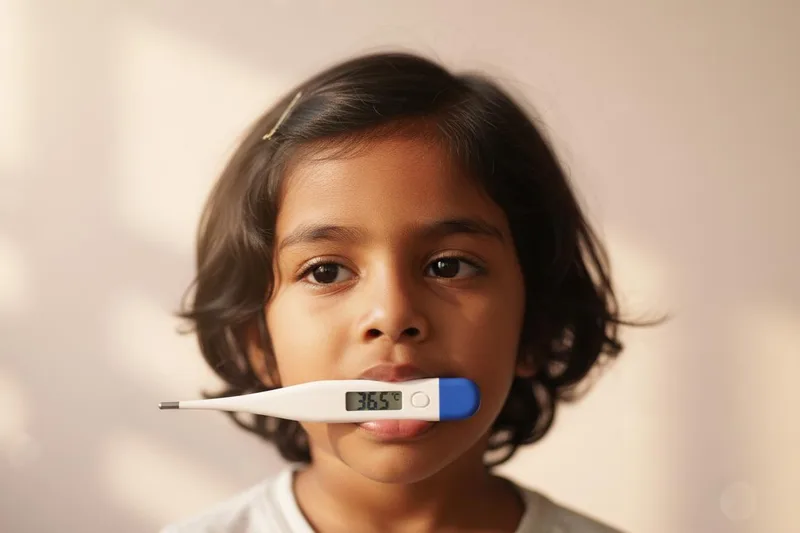
Hello! When your little one has a cold or feels hot, the first thing we do is check their temperature. But sometimes we don't know exactly how to use this thermometer to check their temperature accurately. There are a few things to be careful about, especially when checking their temperature by mouth. So today, let's talk about the most accurate and easiest way to check your child's temperature by mouth at home.
Why do we take a temperature from the mouth? When is this method best?
Now you may be thinking, 'Why do you need to take a temperature through the mouth, doctor? Can't you take a temperature through the armpit?' It's true, there are several ways to take a temperature. You can take a temperature through the armpit, ear, forehead, or even through the rectum of a very young child. However, for a child who is usually about 4-5 years old, who listens to what you say a little, and can just sit still, taking a temperature through the mouth (Oral Temperature) is very easy, and it gives us a fairly accurate value. If a small child does not listen to what you say, or does not want to have a thermometer in their mouth, then we think of another method. But for a child who is a little older and understands, this method is very good.
What kind of thermometer should we use?
This is a very important thing. In the past, there were mercury thermometers with glass tips. Now, you should never use them. Do you know why? If that tip breaks by mistake, the chemical called mercury in it is very dangerous. It is not good for the environment, and it is not good for our bodies.
Now there are digital thermometers . That's what we should use. They are very safe, easy to use, and show the temperature clearly. There are different types of digital thermometers. Some have a flexible tip, which means you can bend the tip of the thermometer. For a small child, one like that might be more suitable.
Remember: Never use a glass mercury thermometer! Always choose a digital thermometer.
What should we do before taking a fever test? (Preparation)
Okay, so now that we've got a good digital thermometer, there are a few things we need to do before we can just put it in our mouth and take our temperature.
1. Let's clean the bamboo skewers.
First, you need to clean the bamboo skewer thoroughly. You can use an alcohol swab or soap and water to clean the tip of the bamboo skewer. Then, rinse it with clean water, wipe it with a clean cloth, and dry it. This is very important, because otherwise, germs can spread.
2. Wash your hands too.
Just like you cleaned the mosquito coil, wash your hands thoroughly with soap. It is very important to stay clean when we touch or care for someone who is sick.
3. Wait a while after eating and drinking.
If your child has just finished eating or drinking something, you should wait at least 20-30 minutes before taking their temperature in the mouth. Do you know why? Imagine that your child ate an ice cream. Then the temperature inside their mouth will decrease a little. Or if they drank hot tea, the temperature inside their mouth will increase a little. Then if we take their temperature, we will get an incorrect value. That is why it is very important to wait a while after eating or drinking.
4. Check for chewing gum or toffee in the mouth.
Before taking the temperature, make sure that there is nothing in the child's mouth, such as chewing gum, toffee, or chocolate. These can also affect the temperature reading.
5. Tell the child what we are going to do.
Especially if it's an older child, simply explain to him what you're going to do. Say something like, 'Son/daughter, should we take a look at the fever in your mouth now? This won't hurt. You just have to hold it in your mouth for a while.' That way, the child won't be afraid and will cooperate.
Okay, now how exactly do you check for fever in the mouth? (Step by Step)
Okay, now that we're all set, let's see how to check for fever in the mouth.
1. Turn on the digital thermometer: There is usually a small button on the thermometer. You can turn it on by pressing it. You may hear a beep or see something on the display.
2. Place the tip of the thermometer under the tongue: Now ask the child to open their mouth. Place the tip of the thermometer (the silvery part) under the child's tongue, to one side of the tongue . Not exactly in the middle of the tongue, but slightly to the side. That is the best place to take the temperature accurately.
3. Tell your child to close their mouth and purse their lips: After placing the thermometer under their tongue, tell them to close their lips tightly. But they should also be told not to chew on the thermometer. If they chew on the thermometer, it may break, or they may not be able to take the temperature correctly.
4. Tell your child to breathe through their nose, not their mouth: When the fever blister is in their mouth, tell them to breathe calmly through their nose, not through their mouth. Tell them not to talk. Just to stay calm is fine.
5. Wait for the beep: Now you have to be patient for a while. Usually, within about a minute, the thermometer will make a sound like 'beep... beep...' . This means that the temperature has been measured. Some thermometers will start to display the temperature.
6. Read the temperature: After the beep, carefully remove the thermometer from your mouth and read the value on the display. That is the child's body temperature.
Simply put: turn on the thermometer -> place it under your tongue -> close your lips (don't chew!) -> breathe in through your nose -> wait for the beep -> read the value. Easy, right?
What is the normal body temperature? How high is a fever?
Okay, we just checked the temperature. Now let's find out if this is normal or a fever.
Normally, a healthy person's oral temperature is between 36.5 and 37.5 degrees Celsius (36.5°C - 37.5°C). In Fahrenheit, it is 97.7°F - 99.5°F.
But this can vary slightly. It can also fluctuate slightly depending on the time of day, the activities we do, and, in women, the menstrual cycle.
We generally consider a fever to be an oral temperature of 38 degrees Celsius (38°C) or higher (100.4°F in Fahrenheit).
- If the temperature is 37.6°C - 37.9°C (99.7°F - 100.2°F) , it may be a low-grade fever . Pay extra attention to your child at this time.
- If it is 38°C (100.4°F) or higher, it is a real fever .
But remember, a fever is not a disease, but a symptom of a disease. It is a sign that something inside the body is fighting an infection or some other cause.
What do you do after checking your temperature?
Once the fever is gone, there are a few more things to do.
1. Clean the bamboo skewer again: As soon as you see the bamboo, clean the bamboo skewer thoroughly as mentioned earlier, dry it, and store it in its appropriate protective case.
2. Write down the temperature and time: On a small piece of paper or in a book, write down your child's temperature and the time you took the temperature. This is very important if you have to go to a doctor. If you take the temperature several times a day, write down the values each time.
3. What to do if you have a fever?
- If the child has a fever, dress them in light clothing.
- Keep the room temperature at a comfortable level. You can turn on a fan slowly.
- Encourage them to drink plenty of fluids, such as water and fruit juice.
- If your child is feeling unwell, you can give a fever-reducing medicine, such as Paracetamol, prescribed by a doctor, in the prescribed dosage. However, do not give any other medicine without medical advice.
- If your child has a very high fever (e.g., over 39°C), is not eating or drinking, has difficulty breathing, has a fit, or is very lethargic or lethargic, see a doctor immediately. If a baby under 3 months old has a fever, it is a serious concern and you should seek medical advice immediately.
What are the possible mistakes when taking a temperature from the mouth and how to avoid them?
Sometimes we unknowingly make small mistakes when taking our temperature. Then we get an incorrect reading. Let's see what those mistakes are and how to avoid them.
- Checking the temperature after eating/drinking: We've talked about this before. Always wait 20-30 minutes before checking the temperature.
- Placing the thermometer under the tongue: The thermometer should be placed under the tongue. If it is placed above the tongue, the temperature will not be measured accurately.
- Not closing the mouth properly: If the child does not close the mouth properly, outside air can enter and change the temperature.
- Biting the bamboo skewer: This can damage the bamboo skewer and cause the value to be entered incorrectly.
- Removing the bamboo skewer before the beep: You must wait until the bamboo skewer has completely finished measuring the temperature.
- Using a thermometer with old batteries: If the batteries in a digital thermometer are weak, it may show incorrect values. So be careful with the batteries as well.
How do you help a slightly disobedient child?
Even at 4-5 years old, some children are a little naughty and don't listen to what you say. It can be a little difficult to tell such a child to keep a fever blister in their mouth.
- Make it a game: Play a little game like, 'Let's see who can keep their mouth shut the longest?'
- Tell a story: While holding the bamboo skewer in your child's mouth, tell him a short story that he likes. This will divert his attention.
- Do it yourself: Put the fever thermometer in your mouth (you don't actually need to see the fever, just show it) and set an example for your child by saying, "Look, this doesn't hurt."
- Don't force it: If your child is very reluctant or crying, don't force them to check their temperature. Doing so will only make them more scared. Try a different method (like the armpit) at that time, or wait a while and try again.
The most important thing is patience. Try to do this by speaking to the child in a loving and kind way, and by calming him down.
Finally, take-home message
So, taking a temperature through the mouth isn't that difficult, right? If done correctly, we can get a clear idea of our child's temperature at home.
- Always use a digital thermometer. Never use a mercury thermometer!
- Clean the bamboo skewer thoroughly before and after using it.
- You should only check your temperature 20-30 minutes after eating or drinking.
- Place the bamboo skewer under the tongue, to one side . Tell the child to close their mouth, not chew, and breathe through their nose.
- Wait patiently until the beep sounds.
- If the temperature is 38°C (100.4°F) or higher, consider it a ``Fever''.
- If the fever is accompanied by other uncomfortable symptoms, or if the child is in a lot of trouble, seek medical advice immediately.
If you keep these points in mind, you too can accurately measure your child's fever. Then it will be easier to take the necessary measures without worrying. Good health to everyone!
` Oral Temperature, Digital Thermometer, Fever Measurement, Children's Fever, Fever, Body Temperature, Tips for Reducing Fever




💬 Comments (0)
No comments yet. Be the first to share your thoughts here.
Add Your Comment