
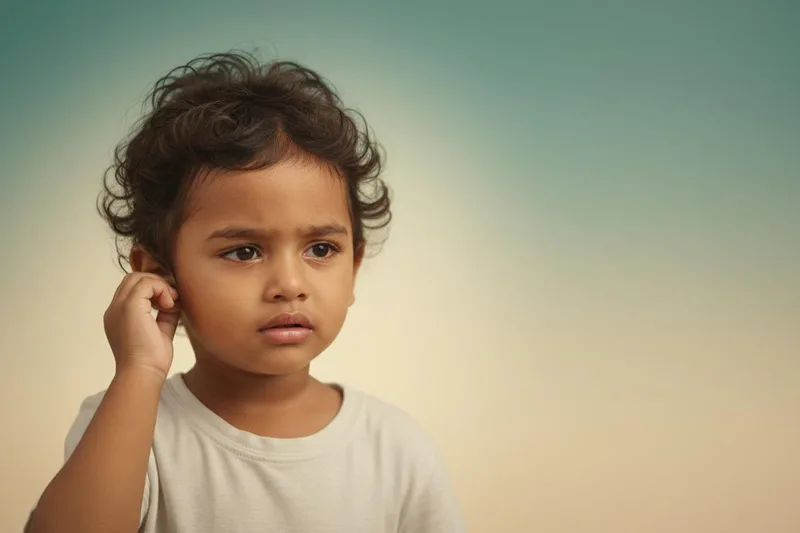
Does your little one often complain about earaches? Or does he cry and hold his ear? Earaches are a common occurrence for little ones. The main cause of this is an infection in the middle ear. Simply put, the middle ear is a small space inside our ear, behind the eardrum. If germs, such as viruses or bacteria, get in here, they get infected and fill with pus. This pus causes pressure on the eardrum, which is why the child experiences ear pain.
What are the symptoms of an ear infection? How do you recognize it?
When a young child has an ear infection (otitis media), the main symptom is severe ear pain . However, you may also notice these symptoms:
- You may get a fever.
- It can be difficult to eat and drink. Sometimes you can't even sleep. Do you know why? When you chew food, suck milk, or lie down, the pressure in the middle ear changes and the pain increases. Imagine a little baby crying as soon as he starts sucking on a bottle of milk, or waking up at night screaming.
- A slightly older child might say, "Mommy, my ear hurts." But a small baby who can't talk might constantly touch or pull at their ear, or they might cry more than usual, in a very agitated and irritable manner.
Sometimes, if the pressure caused by the pus filling the middle ear becomes too high, the eardrum can burst . If that happens, pus starts to come out of the ear. This is the main reason why eardrums burst in young children. A child with a ruptured eardrum may feel dizzy or nauseous. They may also hear a "whooshing..." sound in their ears, or they may feel like something is chirping in their ears.
How do these ear infections develop?
A middle ear infection (Otitis Media) usually occurs when one or both of the Eustachian tubes, which connect our middle ear to the back of our throat, become inflamed. These tubes are what drain mucus and other substances that build up in the middle ear into the throat. It does a very important job, doesn't it?
Imagine you have a cold, a throat infection, or a condition like gastritis, where stomach acid comes up (acid reflux) , or some kind of allergy . These things can cause the Eustachian tubes to swell. What happens then? The way for the mucus to get out is blocked. Then, viruses or bacteria can easily grow inside that trapped mucus and form pus. This pus fills the middle ear and causes that pain.
When a doctor says "an ear infection," they are usually referring to an infection of the middle ear (Otitis Media). This is different from a condition called "Swimmer's Ear" or "Otitis Externa," which occurs when water gets into the ear while swimming.
There is another thing, and that is (Otitis Media with Effusion) . This is when the middle ear fills with a fluid like water without an infection, that is, without pus. This may sometimes not cause any major symptoms. However, some children may feel as if something is filling the ear, or as if the ear is "popping" open.
Why do young children develop this more than others?
You may be wondering, "Why does my little one always have these ear problems?" In fact, young children, especially those between the ages of two and four , are more likely to get ear infections than adults. There are several reasons for this:
- One is that the Eustachian tubes we talked about earlier in young children are a little shorter and more horizontal . So bacteria and viruses can easily get into the middle ear. The other is that these tubes are a little narrower. So they're more likely to get blocked. Got it?
- Another issue is the adenoids in children. These are gland-like structures located behind the nose. If they are large, they can block the opening of the Eustachian tubes. Even then, it becomes difficult for the mucus to drain.
In addition to this, there are other things that increase the risk of a young child developing ear infections. For example:
- Exposing your baby to secondhand smoke is very harmful.
- Bottle feeding , especially when feeding the baby while lying down.
- Hanging out with other children in places like kindergartens , because then there is a greater chance of catching things like colds from each other.
It has also been found that, in general, male children develop ear infections slightly more often than female children.
But remember, ear infections are not spread directly from person to person . However, upper respiratory tract infections, such as colds and flu, can easily spread. Especially when the weather is cold, many people get these illnesses. So a child with an ear infection may also have symptoms of a cold, such as a runny nose, stuffy nose, and cough.
How long will it take for this earache to heal?
Most of the time, middle ear infections (Otitis Media) get better on their own within two to three days without any special treatment . That's a bit of a relief, isn't it?
However, sometimes fluid can remain in the middle ear for a while even after the infection has cleared. If the fluid remains in the middle ear for more than three months , additional treatment may be needed. This is why it is important to stay in touch with a doctor.
How does a doctor accurately diagnose this as a disease?
When you take your child to the doctor, he or she will first give your child a general checkup. Then they will examine the ear. The doctor will use a small instrument called an otoscope . It is like a small flashlight. It allows you to see the eardrum very well. It can check for redness, swelling, or pus behind the eardrum.
So what are the treatments for these ear infections?
When treating an ear infection, doctors consider many factors. They don't just give you a medicine and leave. They consider these things:
- How to tell the type of ear infection and its severity .
- How often does the child get ear infections?
- How long has the infection been present this time?
- The child's age and whether there are other risk factors (for example, if the child is very young, or if there are other illnesses).
- Whether this infection has affected the child's hearing .
There are differences between the treatment of Otitis Media, which we discussed earlier, and the treatment of Otitis Media with Effusion. Not all types of ear infections require antibiotics . This is something that many parents need to understand.
Because most ear infections clear up on their own, doctors often take a "wait-and-see" approach. That is, they give the child pain medication and leave antibiotics alone for a few days to see if the infection improves.
Antibiotics are not routinely recommended for these reasons:
- If the infection is caused by a virus, antibiotics will not help (antibiotics only work on bacteria).
- Antibiotics do not help remove fluid from the middle ear.
- Antibiotics can cause other side effects (e.g., diarrhea).
- It usually doesn't have a significant effect on pain relief within the first 24 hours , and even then it has only a minor effect.
The most important thing is that when antibiotics are used more frequently than necessary, antibiotic-resistant bacteria can develop. If that happens, it can be very difficult to treat a bacterial infection later on.
However, if a doctor decides to give antibiotics, they will usually give a 10-day course. A child over 6 years old who does not have a serious infection may be given a short course of 5-7 days. If there is pus coming out of the infected ear, antibiotic ear drops can also be used.
Some children, for example , those who have frequent ear infections, those who have persistent hearing loss, or those who have a speech delay, may also need ear tube surgery . This involves a minor surgical procedure by an ear, nose, and throat doctor (ENT doctor) to insert small tubes called tympanostomy tubes into the eardrum. This creates a path for fluid to drain from the middle ear. This helps to relieve pressure in the ear.
So, are you always "on the lookout"? Aren't there times when antibiotics are needed urgently?
Yes, there are times when that is the case. Antibiotics may be appropriate for children who have frequent ear infections . Also, younger children (under 6 months) or children who are very sick may need to be given antibiotics from the start.
The "wait-and-see" approach may not be right for every child. It may not be appropriate for children with other health problems, such as:
- Children who have had cochlear implants .
- Children with conditions such as cleft lip and/or cleft palate .
- Children with genetic conditions like Down syndrome .
- Children with immune system disorders .
In special cases like these, the doctor may decide to start treatment sooner.
So, what are the most important things we need to remember about these ear infections?
Okay, so the take-home message from what we've talked about is that there are a few key points to remember:
- Middle ear infections (otitis media) are very common in young children, so don't panic.
- If your child complains of ear pain, is touching his ear, has a fever, or is more agitated than usual, be sure to see a doctor .
- Not all ear infections require antibiotics . Follow your doctor's instructions exactly.
- If the doctor prescribes antibiotics, give them the exact dose and for the exact number of days . Do not stop halfway.
- There are some things you can do to prevent ear infections. Protect your baby from cigarette smoke and keep them away from people who have colds.
- If your child has frequent ear infections or seems to have a hearing problem, talk to your doctor about that as well. You may need to be referred to an ENT specialist .
Remember, if you have even the slightest doubt about your child's health, it's best to talk to a doctor and resolve it.
` Ear Infections, Middle Ear, Otitis Media, Earaches in Children, Eustachian Tube, Earwax, Antibiotics


💬 Comments (0)
No comments yet. Be the first to share your thoughts here.
Add Your Comment