

Every morning when you glance into the bathroom mirror, you are looking directly at your body’s largest and most hardworking organ: your skin. You might wash it, moisturize it, or worry about a minor blemish, but beneath that visible surface lies a dynamic, highly coordinated biological powerhouse. Covering roughly 20 square feet (1.8 to 2.0 square meters) on an average adult and accounting for nearly 15% of your total body weight, human skin is neither a passive plastic wrap nor an inert envelope. It is a resilient, living shield that breathes, defends, insulates, and communicates constantly with your central nervous system to keep you alive and healthy.
⚡ Key Clinical Takeaways.
- Three Distinct Layers: Skin consists of the protective epidermis, the functional support dermis, and the insulating subcutaneous tissue (hypodermis).
- Constant Renewal: Your epidermis regenerates continuously, completing a full cellular turnover about every 28 to 40 days.
- Vital Homeostatic Functions: It acts as a primary microbial barrier, regulates body temperature via sweating and vascular shifts, retains critical fluids, and houses millions of sensory receptors.
- Barrier Integrity Matters: Compromising the skin barrier increases vulnerability to systemic infections, dehydration, and environmental inflammation.
What Exactly Is the Integumentary System?
In medical science, the skin and its accessory structures—such as hair, nails, sweat glands, and oil glands—comprise the integumentary system. Far from being a uniform tissue, a single square inch (6.5 square centimeters) of healthy human skin houses up to 19 million cells, 60,000 melanocytes, 1,000 nerve endings, 20 blood vessels, and dozens of specialized glands. Working in seamless synergy, these cellular elements form an intricate sensory and immunological interface between your delicate internal physiology and an unpredictable external world.
The 6 Vital Physiological Functions of Your Skin.
Why is healthy skin critical to human survival? Without an intact cutaneous barrier, life cannot be sustained for more than a few days due to catastrophic fluid loss and rapid bacterial invasion. Dermatologists categorize the skin’s primary roles into six fundamental mechanisms:
- Immunological Shield (Antimicrobial Defense): The acid mantle (a naturally acidic surface layer with a pH of roughly 4.5 to 5.5) and resident Langerhans cells form an active frontline barrier against pathogenic bacteria, fungi, viruses, and environmental chemicals.
- Thermoregulation (Body Temperature Control): When body temperature rises, the dermis dilates microcapillaries and eccrine sweat glands produce moisture; as sweat evaporates, core heat is pulled away from the body. In cold environments, superficial blood vessels constrict (vasoconstriction) to conserve metabolic warmth.
- Fluid and Electrolyte Retention: The lipid-rich stratum corneum prevents water from evaporating out of your internal tissues (preventing dehydration) while keeping excessive external moisture from soaking into your tissues like a sponge.
- Sensory Perception: Specialized cutaneous mechanoreceptors, thermoreceptors, and nociceptors detect heat, cold, touch, vibration, and mechanical trauma, alerting your brain to environmental dangers before tissue injury occurs.
- Mechanical Cushioning and Shock Absorption: Dense elastic fibers and the underlying adipose layer absorb physical impacts, protecting vital organs, tendons, and bones from direct blunt-force trauma.
- Vitamin D Endocrine Synthesis: When exposed to ultraviolet B (UVB) radiation, 7-dehydrocholesterol within cutaneous cells is converted into cholecalciferol (previtamin D3), which is then processed by the liver and kidneys to maintain skeletal calcium balance and support systemic immunity.
The Tri-Layer Architecture: How Skin Is Built.
To understand both common dermatological conditions and daily skincare, doctors break skin down into three foundational anatomical tiers: the epidermis, the dermis, and the subcutaneous tissue.
1. The Epidermis: The Outermost Protective Shield.
The epidermis is the visible outer barrier. It contains no direct blood vessels and relies entirely on nutrients diffusing from the vascular bed beneath it. Depending on anatomical location, its thickness varies drastically: from a fragile 0.05 mm on the delicate eyelids to over 1.5 mm on high-friction surfaces like the soles of the feet and the palms of the hands.
The epidermis is primarily driven by three specialized cell types:
- Keratinocytes: Representing roughly 90% of epidermal cells, they synthesize keratin, a tough, fibrous structural protein that forms a watertight seal and fortifies skin, hair, and nails against mechanical stress.
- Melanocytes: Located along the basal layer, these cells produce melanin, the pigment that determines cutaneous phototype and absorbs dangerous ultraviolet (UV) radiation to shield nuclear DNA from oncogenic mutation.
- Langerhans Cells: Cutaneous sentinels that capture foreign microbial antigens and present them to T-cells, launching an adaptive immune response against infection.
2. The Dermis: The Metabolic Engine Room.
Directly beneath the basement membrane lies the dermis, a thick, vascularized fibrous network composed primarily of extracellular matrix. It gives skin its tensile strength and pliability through two essential structural proteins:
- Collagen: Provides robust mechanical tensile strength, resisting tearing forces and maintaining structural plumpness.
- Elastin: Provides elastic recoil, allowing the skin to stretch with joint motion and promptly return to its resting position. As intrinsic aging and chronic UV photodamage degrade these fibers, wrinkles and laxity emerge.
The dermis also contains an intricate network of specialized microscopic organs, including:
- Blood Capillaries: Nourish the overlying epidermis and regulate thermal shifts through vasodilation and vasoconstriction.
- Nerve Endings & Receptors: Including Meissner corpuscles, Pacinian corpuscles, and free nerve endings that transmit tactile sensations, pressure, and pain signals.
- Sebaceous Glands: Produce sebum, a complex lipid mixture that naturally waterproofs, lubricates, and conditions the outer stratum corneum. Overproduction can plug pilosebaceous units, contributing to acne vulgaris.
- Eccrine and Apocrine Sweat Glands: Secrete watery fluid for thermoregulation and pheromonal excretion.
- Hair Follicles: Dynamic mini-organs rooted deep within the dermis that generate hair shafts and assist in rapid epidermal re-epithelialization following superficial abrasions.
3. The Subcutaneous Tissue (Hypodermis): The Deep Insulation Bed.
The deepest structural layer, often termed the hypodermis or subcutis, connects the overlying skin to underlying skeletal muscles, fascia, and periosteum. It is primarily composed of well-vascularized lobules of adipose tissue (fat cells) held together by loose connective tissue septa.
This deep tier serves three crucial medical roles: providing mechanical shock absorption against trauma, insulating the core to prevent hypothermia, and storing caloric energy that can be mobilized systemically when nutritional demand arises.
🚨 Critical Red Flags: When to Seek Emergency Medical Care.
While many skin conditions are benign, sudden skin changes can herald life-threatening systemic emergencies. Call 911 (US/Canada), 999 (UK), or your local emergency dispatch right away or present to the nearest Emergency Department (ER / A&E) if you notice:
- Rapidly spreading redness, severe swelling, and high fever: Potential signs of necrotizing fasciitis or aggressive cellulitis.
- Widespread blistering or skin detachment: Sudden peeling after starting a medicine, suggestive of Stevens-Johnson Syndrome (SJS) or Toxic Epidermal Necrolysis (TEN).
- Petechiae or purpura with lethargy and neck stiffness: Non-blanching dark red/purple pinpoint spots that do not fade when pressed under a clear glass (suggestive of meningococcal septicemia).
- Urticaria (hives) accompanied by facial/lip swelling, throat tightness, or difficulty breathing: An active anaphylactic reaction requiring urgent intramuscular epinephrine.
Clinical Comparison: The Three Layers of Human Skin.
| Layer. | Dominant Cell & Tissue Types. | Vascular Supply. | Primary Medical Function. |
|---|---|---|---|
| Epidermis. | Keratinocytes, Melanocytes, Langerhans cells. | Avascular (relies on passive dermal diffusion). | Microbial barrier, waterproofing, UV filtration. |
| Dermis. | Fibroblasts, Collagen, Elastin, Glandular tissue. | Rich capillary networks and arteriovenous plexuses. | Thermoregulation, tactile sensation, structural tensile strength. |
| Subcutaneous Tissue. | Adipocytes (fat cells), fibrous connective septa. | Large perforating blood vessels and lymphatics. | Thermal insulation, blunt trauma shock absorption, energy reserve. |
Evidence-Based Dermatology: Caring for Your Skin Barrier.
Maintaining optimal skin health does not require complicated, aggressive routines. In fact, clinical evidence shows that over-exfoliation and harsh alkaline soaps often strip the lipid mantle, precipitating contact dermatitis, eczema flares, and secondary bacterial colonization.
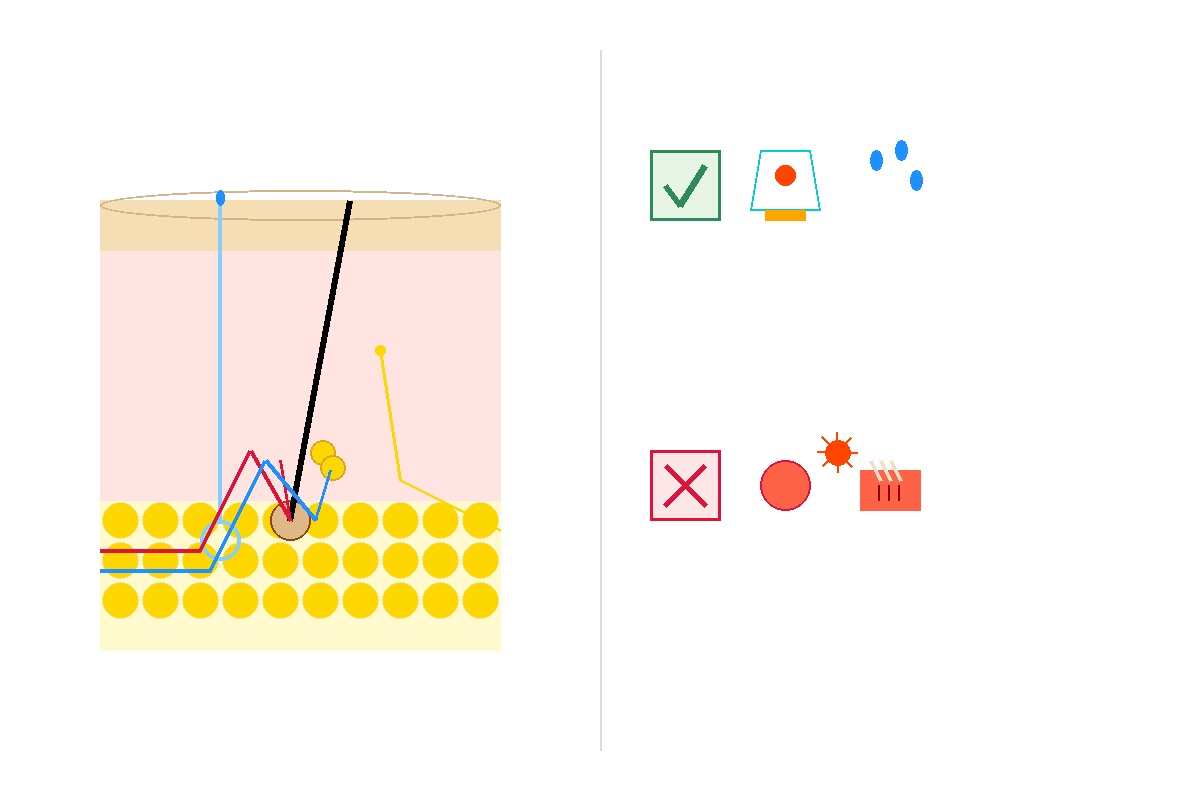
| ✅ Recommended Clinical Practices (Do). | ❌ Harmful Common Mistakes (Don't). |
|---|---|
| Apply Broad-Spectrum Sunscreen: Use SPF 30 or higher daily (reapplying every 2 hours outdoors) to block both UVA and UVB rays. | Don't Skip Sunscreen on Overcast Days: Up to 80% of solar UV radiation penetrates cloud cover, contributing to cumulative photoaging and DNA damage. |
| Hydrate the Lipid Barrier: Apply ceramide- or glycerin-rich emollients right away after bathing while the stratum corneum is damp. | Don't Take Scalding Hot Showers: Excessively hot water dissolves essential natural intercellular lipids, triggering rebound dryness and pruritus. |
| Use pH-Balanced Cleansers: Select gentle, fragrance-free syndet cleansers that preserve the skin’s physiological acid mantle (~pH 5.5). | Don't Scrub with Harsh Alkaline Bar Soaps: High-pH formulations disrupt the cutaneous microbiome and break down defensive antimicrobial peptides. |
| Perform Monthly Self-Checks: Inspect moles using the ABCDE criteria (Asymmetry, Border, Color, Diameter, Evolving) for early melanoma detection. | Don't Pick, Squeeze, or Scratch Lesions: Disrupting the dermis introduces staphylococcal organisms and exponentially increases scarring risks. |
👨⚕️ Doctor's Clinical Note.
"In clinical practice, I often remind patients that the skin acts as an external window into overall health. Chronic cutaneous issues—such as sudden profound dryness, unyielding rashes, delayed wound healing, or unexpected hyperpigmentation—are often the first clinical clues of systemic disorders, including diabetes mellitus, thyroid dysfunction, or autoimmune conditions. Respect your skin, protect it from midday ultraviolet exposure, and never hesitate to schedule an evaluation with a board-certified dermatologist if a mole changes or an unexplained lesion persists longer than two to three weeks."
Peer-Reviewed Medical References & Clinical Guidelines.
- National Health Service (NHS). Skin structure and wound healing: Clinical overview. NHS England. Updated 2024.
- Mayo Clinic Staff. Skin care: 5 tips for healthy skin and maintaining your skin barrier. Mayo Foundation for Medical Education and Research. 2024.
- National Institute of Arthritis and Musculoskeletal and Skin Diseases (NIAMS). Anatomy of the Skin and the Integumentary System. National Institutes of Health (NIH). 2023.
- Centers for Disease Control and Prevention (CDC). Ultraviolet (UV) Radiation and Skin Cancer Prevention Guidelines. U.S. Department of Health and Human Services. 2024.


💬 Comments (0)
No comments yet. Be the first to share your thoughts here.
Add Your Comment