
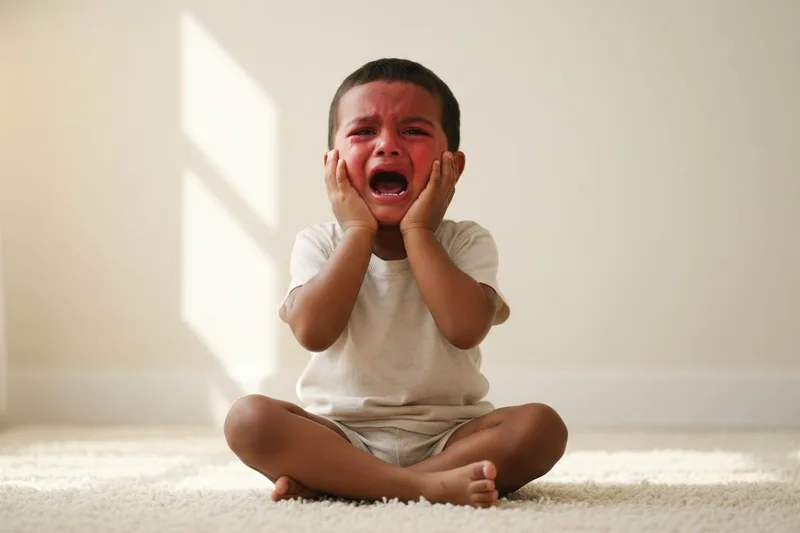
As a mother or father, you may sometimes wonder, 'Why is my child behaving like this?' When your little one suddenly starts crying, screaming, or rolling around on the floor, it can be very frustrating, and sometimes even angry. It's very normal. But instead of looking at these 'troubles' as just a nuisance or a child's bad behavior, what if we saw them as a good opportunity to teach our children something and understand them?
Why do young children struggle like this? What are Temper Tantrums?
Simply put, these temper tantrums , or as we call them in English, are a way for children to release a strong emotion, such as sadness, anger, frustration, or fear, that they have inside. It's like a small volcano. It can't be contained inside and suddenly explodes. These are usually seen in children between the ages of one and three, sometimes four . It doesn't matter whether it's a girl or a boy, both can show similar behaviors at this age.
Some babies roll over frequently, even several times a day. Others do this very rarely, like once a month. However, we all need to first understand that this is a very normal stage of a child's development . That means, don't feel bad thinking that your child is the only one who does this. This is something that every little child in the world experiences to some extent.
Why do children rebel? Let's look at some of the reasons.
Okay, now let's see why these little kids suddenly start acting like this. There's not just one reason for this, there could be many reasons.
Is this normal for their development?
Yes, absolutely. You shouldn't be surprised to hear this. As we've said before, temper tantrums are part of a child's emotional development . They're all part of their journey to understand the world, to identify their feelings, and to learn how to manage them. It's like a little plant growing and its branches are falling apart. They're really trying to say, 'I'm in so much pain right now, I can't take this anymore, help me!'
Small reasons for a revolution
Now let's see what other small, everyday reasons there might be for a young child to start a revolution.
- Fatigue: When they're tired from playing, running around, and learning new things all day, even the smallest things can feel big to them. Just like we get annoyed over small things on a very tired day.
- Hunger: If food is not provided on time, children's patience will decrease even when they are hungry. The saying "The devil dances when he is hungry" is not true.
- An inconvenience: If the clothes you're wearing are tight, or the diaper is wet, or if you're sweating and feeling upset, even a small inconvenience like that can start a big upheaval. Think about it, we do the same, right? Since babies don't know how to express it with words, they tell us by crying.
- Not getting what they want: Sometimes toddlers want a toy, a candy they saw in a store, or a cartoon to watch. If they don't get it right away, they start to get upset. They scream and cry, 'I want that! I want it now!'
- Getting attention: Sometimes, when mom and dad are on the phone or busy with other things, and need to get their attention quickly, little ones can start acting up. When they don't know how to say, "Mommy, look at me!", they try to get that attention by crying.
- Not being able to get others to do what they want: Imagine, your sister is holding the tablet in her hand, and your brother wants it right now. Your sister won't give it to you. Even then, your brother might get angry and have a meltdown. Or, if your mother says 'no' to something, and you can't get her to say 'yes', this can happen.
Learning to cope with the frustration they feel at times like this is a skill they develop over time. This means that it won't happen overnight. We need to be patient and help them with that.
When they can't say exactly what they want...
These outbursts, or temper tantrums , are most common in the second year of a child's life . That is, they are usually seen between the ages of one and a few months and two years. Do you know why this happens at that time? The main reason for this is that their language skills are starting to develop at that time. They understand a few words and can even say a few words. They can use simple words like "mom", "dad", "baby", "food", "water".
However, their vocabulary is not large enough to be able to express everything they think, everything they want, and the emotions they feel (complex emotions like sadness, anger, happiness, and fear) in a complete sentence. Their language skills are still at a very early stage.
Imagine, you are very hungry, but you don't know how to say 'I am hungry, feed me'. Or, if you are very upset about something, but you can't express that sadness in words to anyone, how would you feel? That's how it happens to little ones. They have some difficulty, some need, but they don't know how to communicate it to others, to put it into words. That's when those feelings come out as a twist along with the frustration that builds up in their hearts. This is like their language, that behavior. As their language skills gradually improve, you will be able to see for yourself that this twisting will also gradually decrease.
"I want it, I want to do it myself!" - Big dreams of little ones
Around the age of one and a half or two, toddlers develop a strong desire to do everything on their own (independence) . They want to control their environment. They think things like, 'I'll put on my own shoes', 'I'll eat my own food', 'I want that toy', 'I'll climb the stairs by myself'. This is actually a good sign of their development. They are gradually learning about the world and testing their abilities.
But then, they want things that are bigger than they can actually do. That is, they have higher expectations than their physical and mental abilities. When they think, 'I can do this alone!' and can't do it, or when they think, 'I want that now!' and don't get it, they get very angry and frustrated. That's when that reversal starts again. It's like a ' power struggle ' between themselves and their limitations. They try to win the world, they try to get what they want, but when they can't, they try to win it by crying or by turning around.
What kind of things do kids do when there is a change coming?
Now let's talk about what kind of things and behaviors young children exhibit when they have a temper tantrum . This can vary from person to person. Not all children have the same tantrums. Some tantrums are very minor, while others are quite severe.
- Some people are whining , just pulling and pulling, crying like they're in a coma.
- Others are crying loudly , shedding tears.
- Some people are screaming , loud enough to be heard throughout the entire game, perhaps even from the house next door.
- If it gets worse, they may kick, hit , or even hit their parents, or throw something at them.
- He lies on the ground, rolling around , flailing his arms and legs.
- Some children, this is a bit difficult to watch, and something that really scares parents, is holding their breath (Breath-Holding Spells) . Suddenly they stop breathing, sometimes until their face turns blue. After a while, they start breathing again, and sometimes they lose consciousness. When they see this, mothers are very scared. But this (Breath-Holding Spells) is also a symptom that some children show during a transition, especially when they don't get what they want. This is something we need to talk about separately, because it is a bit special, and sometimes it may be necessary to seek medical advice.
So how should we view this turnaround?
So, after hearing all this, you probably understand that these little kids' tantrums are not something they do because they're bad kids, or they're just trying to make you angry or annoy you.
This is part of their development. It's a way for them to learn about the world, understand their feelings, cope with them, and somehow try to get those feelings out.
Therefore, when a child makes a mistake, we should not just see it as a 'disaster' or a 'trouble', but as a good opportunity for us to teach the child something, to understand him, and to help him deal with his emotions . It is not as easy as it sounds, and it is difficult for us to tolerate it when the child screams or rolls on the floor. However, with this understanding, it will be a little easier for us to face the situation.
Take-Home Message
Okay, so let me summarize some of the most important things for you to remember from what we talked about today:
- Temper tantrums are a very normal part of the development of children between the ages of 1-3 (sometimes 4) . Don't be too afraid or embarrassed about it.
- A child may be acting out because they are tired, hungry, uncomfortable, not getting what they want, wanting attention, or to vent frustration or other negative emotions .
- Especially until their language skills develop , they are more likely to experience these kinds of changes because they cannot express exactly what they want or feel in words.
- Toddlers have a strong desire to do things on their own (independence) and to control their environment (control) . When this exceeds their abilities and those expectations are dashed, upheavals occur.
- When a child has a tantrum, they may exhibit a variety of behaviors, from crying to screaming, rolling on the floor, flailing their limbs, and even holding their breath (breath-holding spells) .
- The most important thing is to not see these changes as something bad in the child, but as an opportunity to help the child, understand them, and teach them to manage their emotions .
So, the next time your little one starts having a tantrum, before you get angry, take a moment to think, 'What is my child trying to tell me? What does he or she want right now?' Understanding that is the biggest step in this challenging, but beautiful journey. If you have any more questions about this, you can talk to your family doctor or a pediatrician.
` Children's Outbursts, Temper Tantrums, Children's Behavior, Parents, Child Development, Breathing, Child Psychology


💬 Comments (0)
No comments yet. Be the first to share your thoughts here.
Add Your Comment