
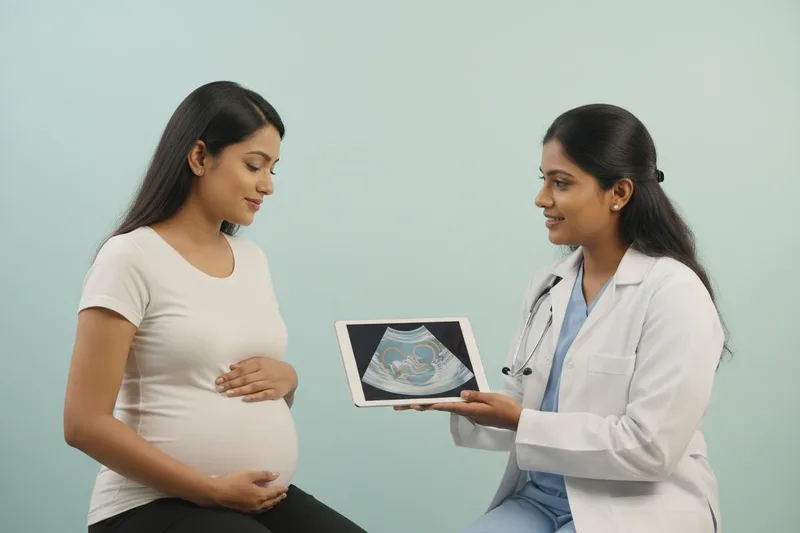
You are expecting a baby, right? During this time, we call `(Prenatal Tests)` the tests that are done to check the health of you and your little one in your womb. These can find out if your baby has any risks, birth defects, or chromosomal abnormalities. Some tests (`screening tests`) indicate that there is a possibility of a problem, while others (`diagnostic tests`) can tell you the exact situation. It is very important for you to know about these tests, because they can give you peace of mind and help you prepare for welcoming the baby. But ultimately, the decision to have these tests or not is yours.
What tests are done when you first see a doctor?
When you first see your doctor, one of the goals is to confirm whether you are pregnant. They will also check for any health risks to you or your unborn baby.
The doctor will do a full physical exam, which includes checking your weight, blood pressure, and a pelvic examination. Your regular Pap smear , if due, will also be done at this time. This checks for changes in the cells of the cervix that could lead to cancer. The vaginal exam also checks for sexually transmitted diseases (STDs) such as Chlamydia and Gonorrhea .
Next, to confirm that you are pregnant, a urine pregnancy test will be taken. It will look for a hormone called hCG (a sign of pregnancy) . Your pee will also be checked for protein, sugar, and signs of infection. Once you are pregnant, your due date will be calculated based on the date of your last menstrual cycle or period. Sometimes an ultrasound scan, or scan, may be done to help with this.
Then comes the most important part. They take some blood from you and do some tests. Let's see what they say.
- Your blood type and `(Rh factor)`: This is very important. Imagine if your blood is `(Rh negative)` and your husband's blood is `(Rh positive),` your body may develop antibodies that could be dangerous to the baby. But don't worry, there are solutions to this. This situation can be prevented with a special medicine injection given around 28 weeks of pregnancy.
- Anemia, which means a low red blood cell count: Many mothers can develop this condition during pregnancy. So it's good to know this in advance.
- Are there any infectious diseases such as `(Hepatitis B)`, `(Syphilis)`, and `(HIV)`: If such diseases are present, if they are identified early, the necessary steps can be taken to protect the baby from them.
- Whether you have immunity to German measles (Rubella) and chickenpox (Varicella or chickenpox): It is important to check whether you have immunity to these diseases, as they can cause problems for the baby if contracted during pregnancy.
- Genetic diseases called `(Cystic Fibrosis)` and `(Spinal Muscular Atrophy)`: These are somewhat rare diseases. But now, in most cases, even if no one in the family has a history of these diseases, doctors still suggest testing for these.
What other tests are done during the first trimester?
After your first visit, your doctor will check your urine, weigh you, and check your blood pressure at every visit until your baby is born (or at least every time). These can help detect problems like gestational diabetes (diabetes that only occurs during pregnancy) and preeclampsia (a dangerously high blood pressure that is very important to catch early).
During your first trimester, you will be offered a few more tests, taking into account factors like your age, health, and family medical history. Let's see what they are.
- First trimester screening: This involves a blood test and an ultrasound scan. This mainly looks at the risk of the baby having a chromosomal abnormality such as Down syndrome or a birth defect such as heart problems. This does not say for sure if there is a problem, but it does indicate if there is a risk.
- Ultrasound: This is a very safe and painless test. It uses sound waves to take images of the baby's shape, position, and growth. It can be done early in pregnancy to date the pregnancy. It can also be done between 11 and 14 weeks, as part of the first trimester screening . Women with high-risk pregnancies may need to have ultrasounds several times during the first trimester.
- Chorionic Villus Sampling (CVS): This is a slightly more complicated test. It involves taking a small sample of cells from the placenta and looking for chromosomal abnormalities, such as Down syndrome . This is usually done between 10 and 13 weeks of pregnancy. This is a diagnostic test , meaning it can tell you with a high degree of certainty whether or not your baby will be born with a specific chromosomal disorder. However, it is not done for everyone, and is done on a case-by-case basis.
- Cell-free DNA testing (Non-invasive prenatal screening or NIPS): This is also a new blood test. It is a very interesting thing, because there is a small amount of the baby's DNA in the mother's blood. These DNA fragments are tested to see if the baby is at risk of having a chromosomal disorder such as Down syndrome . This can be done at any time after 10 weeks of pregnancy. However, this is not a diagnostic test , meaning that if this gives a hint that there is a problem, another test such as CVS is needed to confirm or rule it out. This is often recommended for mothers who are at higher risk, either because they are older or have had a baby with a chromosomal abnormality in the past.
What other tests can you suggest?
Sometimes doctors may suggest additional tests for you. This is because they consider your (and your husband's) personal health history, other medical conditions you have, and risk factors such as family history.
The most important thing is to talk to a genetic counselor if there is a risk that your baby will have hereditary conditions. They will explain this to you in detail. For example, if someone in your family has a genetic condition, you can talk to a doctor about it, meet with a counselor if necessary, and get the necessary tests done.
Additional screening or diagnostic tests may also be recommended for these conditions:
- Thyroid disease
- Toxoplasmosis - This is an infection that can sometimes be transmitted through cat feces, etc. It is something to be careful of during pregnancy.
- Hepatitis C
- Cytomegalovirus (CMV)
- Tay-Sachs disease - This is a very rare genetic disease.
- Fragile X syndrome - This is also a genetic condition that can affect intellectual development.
- Tuberculosis
- Canavan disease - This is also a very rare disease that affects the nervous system.
Finally, is it good to remember this?
You probably understand by now that there are many tests that can be done during pregnancy. But don't be afraid of this. Remember, all of these tests are just *recommended* for you. You have the full right to decide whether to have them or not.
To decide exactly what tests are right for you, and what you need, talk to your doctor or midwife. Make sure you understand why the test is being recommended, what the risks and benefits are, and what the results actually say – and what they *don't* say. Then you can make the right decision without any doubts.
All of this is done to protect you and your unborn baby. Don't hesitate to talk to your doctor about any questions or concerns you may have, okay? We wish you the strength and courage to bring a healthy baby into the world!
` Pregnancy_Tests, First_Trimester, Down_Syndrome, Ultrasound, CVS_Test, NIPS_Test, Pregnancy_Health


💬 Comments (0)
No comments yet. Be the first to share your thoughts here.
Add Your Comment