

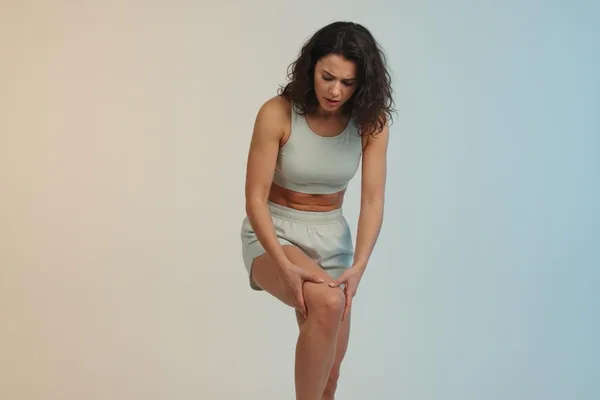
Have you ever felt like your kneecap was popping out of place while you were running, climbing stairs, or just standing up? This can cause your kneecap to hurt, swell, and make it difficult to walk. This can be a very uncomfortable experience at times. So, today we're going to talk about this kneecap popping, a condition called ``Patellar Subluxation''.
What is this kneecap slipping here and there (Patellar Subluxation)?
Simply put, a ``Patellar Subluxation'' is when your kneecap, the part we medically call the ``Patella'', becomes partially displaced from its proper place. This is a ``Patellar Dislocation'', not to be confused with a complete dislocation of the kneecap. In a ``Dislocation'', the kneecap completely comes out of its socket.
Imagine that the kneecap, or patella, between your thigh bone (Femur) and shin bone (Tibia), normally slides up and down in a vertical groove called the trochlear groove. It's like a train going along a track. In a patellar subluxation, the kneecap slips out of this groove for a while and then returns to where it was . Most of the time, the kneecap slips to the outside of the leg, but sometimes it can slip to the inside.
This can be very painful and make it difficult to walk. Repeated patellar subluxation can lead to arthritis, cartilage damage, and overall instability of the knee . This can lead to other knee problems. Even if the patellar dislocation goes back into place, it is important to see a doctor for treatment.
What are the symptoms of a ``Patellar Subluxation''?
When the kneecap pops, you may notice symptoms like these:
- A deformity that is visible from the outside of the knee (sometimes the kneecap can be seen to be tilted to one side).
- Severe knee pain .
- Knee swelling .
- A feeling or hearing of a "click" or "pop" sound coming from the knee.
- A feeling as if the knee is getting stuck, or "locked" .
- Knee instability , as if the knee is "wobbling".
- Difficulty going up and down stairs, or squatting .
- A feeling like the knee is "going numb" or "giving up."
When you have a ``Patellar Subluxation'', your kneecap still moves within the socket to some extent, so you can walk. But it can feel very uncomfortable and unstable. You may also hear a "click" sound when your kneecap moves.
What are the complications or long-term effects of this condition?
This condition, called `Patella Subluxation`, is a condition that can recur frequently . It can also progress to a complete `Dislocation`, where the kneecap completely slips out of place. In addition, this instability of the kneecap can cause damage to the cartilage . Over time, this can lead to osteoarthritis of the knee.
Imagine, there is a young girl named Nisal, who is on the school netball team. One day, while practicing, she suddenly twisted her knee slightly, and with a "click" sound, she felt as if her kneecap had moved to the side. After a while, she felt as if it was back to normal, but her knee started to hurt and swell. She didn't pay much attention to it. But later, her knee started to "go away" all the time, and she couldn't even play. It was only when she showed it to the doctor that she found out that it was a ``Patellar Subluxation'', and that there was some damage to the cartilage.
What are the causes of `(Patellar Subluxation)`?
In most cases, the main reason for the kneecap to pop out like this is injury . For example, a direct blow to the kneecap. This condition is more likely to occur in people who play high-impact sports, such as football . It can also happen if your lower leg is planted firmly on the ground and your knee suddenly twists inward or outward.
In addition, if there is general laxity in the ligaments and tendons in the knee joint (patellar instability) , it can also cause a patellar subluxation.
What are the risk factors for Patellar Subluxation?
Although this condition can affect anyone, it is more common in people with weak leg muscles and tendon laxity . It is also more common in the following people:
- People between the ages of 10 and 20 (especially young athletes).
- Physically active people .
- Women (girls are slightly more likely to develop this condition).
- Athletes or those who frequently engage in sports.
- People who are taller than average .
If you have previously had surgery for a dislocation or partial dislocation of your kneecap, you are more likely to have this condition again.
How do you diagnose a `(Patellar Subluxation)`?
When you see a doctor, they will do a physical examination . They will bend and straighten your leg and feel around your kneecap. They will ask you about your symptoms and what happened before your kneecap dislocated.
The doctor may also perform some special tests (subluxation tests) on your kneecap. They may also do some imaging tests , such as:
- Knee X-ray test.
- MRI scan `(MRI Scan)` test.
- A CT scan is a test.
How is Patellar Subluxation treated?
Your doctor will first try nonsurgical methods to treat this, especially if this is the first time something like this has happened to you. Nonsurgical treatment options include:
- RICE method: This means:
- `Rest`: Resting the knee.
- `Ice`: Applying ice to reduce swelling and pain.
- Compression: A tight bandage around the knee to control swelling.
- Elevation: Keeping the leg elevated to reduce swelling.
- NSAIDs: These are nonsteroidal anti-inflammatory drugs (NSAIDs), which are painkillers and anti-inflammatory drugs. For example, ibuprofen (Advil®).
- Immobilization: Depending on the severity of the injury, a knee brace or cast may be used to keep the knee immobile.
- Walking/mobility aids: You may be asked to use crutches, a cane, or a walker to reduce the load on your knees. You may also be asked to use a functional knee brace, such as a J-brace, or a patella-stabilizing sleeve.
- Orthotics (special shoes): You may be advised to use specially designed shoes or insoles to reduce pressure on the kneecap.
- Physical Therapy: This is very important to strengthen and stretch the muscles around the knee, as well as improve balance (proprioception).
If your symptoms do not improve after several months, or if you have had more than one patellar subluxation, your doctor may recommend surgery . Surgical options include:
- Lateral Release: This involves cutting the part of the knee called the ``Lateral Retinaculum'' and correcting the position of the kneecap (``Patella Positioning''). This is usually done in conjunction with other reconstructive procedures.
- Medial Patellofemoral Ligament (MPFL) Repair: A surgery to repair and strengthen the ligaments that help keep the kneecap in place.
- MPFL Reconstruction: This is an arthroscopic surgery, which means it is performed through small incisions using a camera. In this, a portion of your own hamstring muscle is taken from the back of your thigh and the medial patellofemoral ligament is reconstructed.
- Osteotomy: This involves cutting your shin bone (Tibia) at certain angles and realigning the shin bone, kneecap, thigh bone, and connective tissues.
When should I see a doctor?
If you think you may have a ``Patellar Subluxation'', meaning you have symptoms like these, you should definitely see a doctor:
- Pain and swelling .
- Inability to bear weight on the ground with the feet .
- A "clicking" sound or a "buckling" feeling in the knee.
- The kneecap may appear or feel as if it is protruding from the socket .
Remember, even if you think your kneecap has moved back into place, it's still important to see a doctor. If not treated properly, this can become more frequent and lead to bigger problems later on.
What questions should I ask the doctor?
When you go to see a doctor, you can ask questions like these:
- What treatment options do you recommend?
- Will I need surgery?
- What are the chances of me having this condition again?
- What can I do to prevent my kneecap from popping out like this again?
How long does it take to heal from a ``Patellar Subluxation''?
The time it takes to recover from this condition depends on several factors:
- Is this your first subluxation, or is it a recurrence ?
- The severity of your condition .
- What type of treatment did you receive ?
If this is your first subluxation, it is not too serious, and you do not need surgery, you should be fully recovered within four to six weeks . Your doctor will often recommend physical therapy. Your physical therapist can give you a specific time frame.
If you have had more than one subluxation, a major injury, or surgery, your recovery time will be longer . You should be able to resume light activities within six to eight weeks. However, it may take a year or longer before you can resume sports.
How can I prevent Patellar Subluxation?
Most patellar subluxations are caused by injuries, so we can't prevent all of them. But there are things you can do to keep the connective tissue around your kneecap strong. Here are some things you can do to prevent your kneecap from popping out:
- Engage in physical activities that strengthen every muscle in your legs .
- Wearing knee pads when playing contact sports.
- If you have previously injured your knee, wearing a knee brace can help prevent re-injury.
- If your doctor has prescribed physical therapy for you, follow those instructions exactly .
Take-Home Message
Patellar subluxation can be a very annoying and painful condition. It can make your kneecap feel unstable. You may be able to put your kneecap back in place, but you should definitely see a doctor . Because, over time, these types of subluxations can lead to complete dislocations. Your doctor can help you prevent this from happening. He or she can recommend the best treatment options to strengthen your knee and get you back on track. So, if you have a knee problem, don't ignore it, it's wise to seek medical advice right away!
` patellar subluxation, kneecap dislocation, knee pain, knee instability, knee disorders, physical therapy, knee surgery




💬 Comments (0)
No comments yet. Be the first to share your thoughts here.
Add Your Comment