
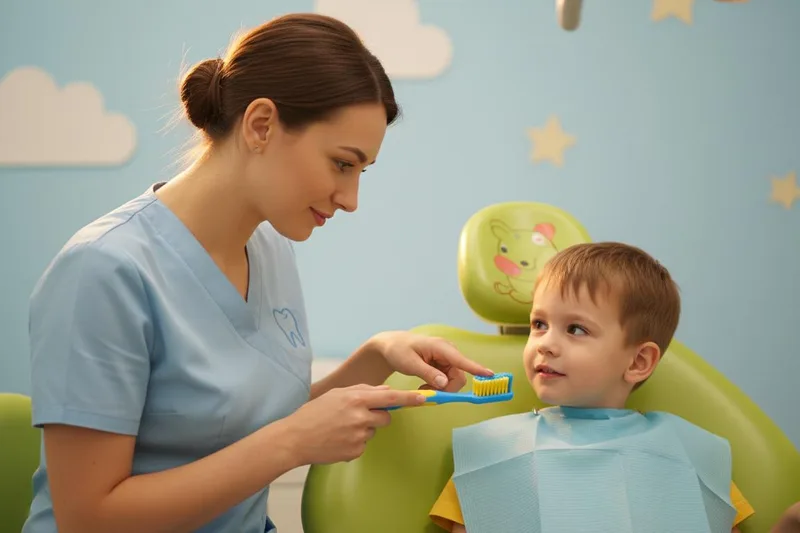
Your little one is very lazy to brush his teeth, isn't he? No matter how much you say "worms eat teeth" when he eats chocolate or toffee, he only remembers that moment. Sometimes you might think, "Oh, these baby teeth are going to fall out anyway, so why bother?" But that's not really the case. The dental health of young children is much, much more important than we think. To be precise, it is the foundation of their future beautiful smile. So there are doctors who are specially trained for this important job and work with children in mind. Today we are talking about those specialist doctors, that is, pediatric dentists.
Who is a Pediatric Dentist?
Simply put, a pediatric dentist is a doctor who specializes in the teeth, gums, and oral health of infants, toddlers, and young children . They are sometimes called ``Pedodontists''.
Imagine, if we take a small child to a doctor who is a regular doctor, he might be scared, right? The surroundings and all the equipment are new to him. But where a pediatric dentist works, that is, his clinic, is designed to suit small children. When the child goes inside, it doesn't feel like he has come to a doctor, but like he has come to a good place to play. By painting beautiful colorful pictures on the walls, and placing toys, books, and puzzles, these doctors try to alleviate the child's fears and put him at ease.
Also, these doctors teach the child how to brush their teeth and keep their mouth clean in a way that makes them happy. Those are habits that will help them throughout their lives.
What is the difference from a regular dentist?
This is a question that many parents have. "Is it okay to take my baby to the same dentist as me?" Actually, a pediatric dentist is someone who has received more specialized training.
After completing a general dentistry degree, you need to study for an additional two to three years to become a pediatric dentist. During this time, you learn not only about teeth, but also about how a child's mind and body develop, and how to manage them.
Here are some of the areas in which special training is provided.
| Special training section | To explain simply... |
|---|---|
| Child Psychology | The doctor knows how your child thinks and feels. He has a good understanding of how to calm a child down, win their heart, and treat them when they are afraid or reluctant. |
| Childhood Growth and Development | A child's jawbone, facial bones, and teeth develop differently as they age. Because these doctors have in-depth knowledge of these changes, they can identify potential problems in the future. |
| Relaxation Techniques | Some children are very afraid of doctors. These doctors are trained in special techniques to put such children at ease and not be afraid. |
| Children with Special Needs | Treating children with special physical or mental needs requires special patience and knowledge. Pediatric dentists have received special training for this. |
What services are available from a pediatric dentist?
A pediatric dentist can do almost everything you can to help your child's oral health. Let's take a look at some of the key services.
| Service / Treatment | What happens with this? |
|---|---|
| Dental Exams and Checkups | The child's teeth and gums are checked regularly to see if they are healthy and if there are any problems. |
| Teeth Cleanings | We use special equipment to clean small particles, such as dirt and glue, that are difficult to remove with a toothbrush. We also teach the child how to brush their teeth properly. |
| Dental fillings | The most common problem for children is tooth decay. When such cavities develop, they are cleaned and filled with a special material (composite resin) that matches the color of the tooth. |
| Fluoride Treatments | Fluoride is a mineral that strengthens the outer covering (enamel) of the teeth. This treatment greatly reduces the risk of tooth decay. It's like putting a protective shield on the tooth. |
| Applying sealants | Our teeth have deep grooves on the surface of their upper teeth. Food can get stuck in them and cause tooth decay. Sealants are a protective coating that closes those grooves. |
| Crowns | If a tooth is badly decayed and damaged beyond repair, a crown is placed over it to protect it. These are made of stainless steel or a material that matches the color of the tooth. |
| Tooth extractions | Some teeth may need to be extracted when a tooth is too decayed to be restored, or when there is not enough space to fix the teeth (put in braces). |
| Dental X-rays | X-rays are used to check for things that are not visible to the naked eye, such as the condition of permanent teeth growing under the gums and the health of the jawbone. This can help identify problems early. |
| Emergency Treatment | Imagine that your child falls while playing and breaks a tooth, or even loses it completely. These doctors can provide immediate treatment in such an emergency. |
When should you take your baby to the doctor for the first time?
This is the most important thing. Many parents think that they should take their child to the doctor only after all the teeth have come in, or when a tooth starts to hurt. That is a big mistake .
The rule is: As soon as your child's first tooth erupts, or at the latest when they are one year old, they should be taken for their first dental checkup.
You might be thinking, "Why would I go to the doctor just to see a little tooth or two?" But a pediatric dentist doesn't just look at teeth. He or she will check a lot of things, such as how your child's jawbone is growing, the health of their gums, and the condition of other teeth that are developing inside their gums. When you check early, it's easier to prevent problems before they happen.
Are baby teeth important? Why should we care about them?
Let's forget the saying "baby teeth fall out anyway." Baby teeth can be even more important than permanent teeth. Let's see why:
- Eat well: Healthy baby teeth are essential for your child to get the nutrition they need and chew their food well. If their teeth hurt, they may refuse to eat.
- Speak clearly: We pronounce some letters by placing our tongue on our teeth. If a child has no teeth or has dental problems, it may be difficult for them to speak clearly.
- Make way for permanent teeth: This is the most important thing. A permanent tooth grows under every baby tooth. A baby tooth is like a "space holder." If a baby tooth is pulled out too early, the teeth on either side can fall into that space. Then, the permanent tooth that comes in underneath can fall out or get stuck.
- A beautiful smile and self-confidence: A pair of healthy teeth is something that boosts a child's self-confidence.
Also remember that some baby teeth remain in a child's mouth until they are 12-13 years old . So it is very important to protect those teeth.
What can you ask the doctor?
As a parent, you probably have a lot of questions about your child's teeth. Don't be afraid to ask. Your doctor is there to answer all of them. Here are some questions you can ask:
- How should I properly care for my baby's teeth at home? (Things like how to choose the right toothbrush and toothpaste).
- How can you teach him how to brush his teeth and floss in a way that makes it seem like a game?
- Does my child's thumb sucking/pacifier use affect their teeth? When should I stop these habits?
- If your child is afraid of the doctor , what do you do to alleviate that fear?
- How often should I come for a dental checkup?
- Can I find out now if my child will need braces in the future? (This is called an `orthodontic consultation`).
- Do you offer sedation dentistry (treatments that help children who are very scared to sleep) here?
- If my child plays sports, should he wear a mouthguard to protect his teeth?
Ask any questions like this and clear your doubts. It's your responsibility.
Take-Home Message
- Be sure to see a pediatric dentist as soon as your child's first tooth appears or when they are one year old .
- Pediatric dentists are specialists who have received special training in the oral health of children and who understand the minds of children.
- Baby teeth are not just a few teeth that fall out. They are the foundation for a child's future set of teeth and overall health.
- Good oral health habits developed at a young age become a valuable asset for a child throughout their life.
- Never be afraid to ask your doctor any questions or doubts you may have.




💬 Comments (0)
No comments yet. Be the first to share your thoughts here.
Add Your Comment