

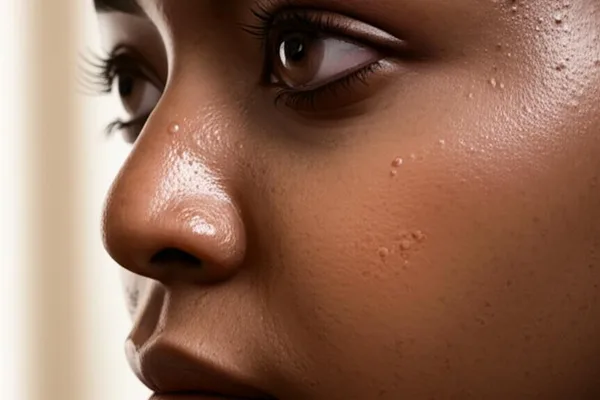
Our skin is the largest organ in our body. And our appearance, our identity, are greatly affected by our skin color. As Sri Lankans, our skin color is diverse, and it is part of our beauty. But did you know that when our skin color is a little darker, that is, when we have more melanin pigment, we are more likely to develop certain skin diseases and conditions? Perhaps you have experienced these things too. After a pimple heals, does it leave a dark scar that lasts for months? Or does the hair on both sides of the forehead thin out when you comb your hair one way or another? These are some of the problems that we are going to talk about today, which commonly affect people with dark skin.
What skin diseases most commonly affect dark skin?
Anyone can develop any skin condition. However, studies have found that people with darker skin tones like ours are more likely to develop certain conditions, or they may appear differently on our skin. This can be due to genetic factors, but also to our cultural habits, such as how we style our hair.
These are the main ones we see most often:
- Pigmentary Disorders: These are changes in skin color. These include dark spots caused by things like acne and scratches, known as `Post-Inflammatory hyperpigmentation (PIH),` and `Melasma,` a condition that occurs on the face.
- Hair Disorders: The most common of these are `Traction Alopecia`, which is caused by pulling the hair too hard and combing it, and `Central Centrifugal Cicatricial Alopecia (CCCA),` which causes hair loss in the center of the scalp and scarring.
- Keloids: This is a condition where a larger, raised scar forms at the site of a wound after it has healed. This condition is more common in people with darker skin tones.
Now let's look at each of these situations in a little more detail.
Let's talk about acne scars and spots (Post-Inflammatory Hyperpigmentation - PIH)
This is a familiar problem for many people. Simply put, PIH is a dark spot or scar that remains on your skin after a condition like an allergy, acne, a cut, eczema, or psoriasis has healed. It's as if your skin "remembers" the event.
These spots can range in color from light brown to dark brown, and sometimes even blue-gray. While they can occur on any skin tone, they are more visible on darker skin tones like ours and sometimes take longer to heal.
Most importantly: Remember, sun exposure is a major factor in making PIH scars worse, darker, and delaying the healing process.
What can be done about these PIH spots?
PIH is a really difficult condition to treat. But don't worry, there are treatments available.
- Topical preparations: There are some creams that can be purchased at the pharmacy, as well as strong medicated creams that a doctor can prescribe.
- Chemical Peels: A treatment that uses special chemicals to remove the top layer of skin, revealing new skin.
- Laser Treatments : These should only be done under the supervision of a qualified physician.
Before undergoing any of these treatments, it is essential to talk to your doctor to choose what is best for your skin.
How can you prevent PIH from occurring?
"Prevention is better than cure," they say. That applies to PIH as well.
1. Treat the underlying cause: If you have a problem like acne or eczema, treat it properly first. Avoid things like popping or scratching the pimples.
2. Sun Protection: This is the most important thing. It is a big mistake to think that we who have dark skin do not need `sunscreen` because we do not get sunburned. `Sunscreen` is essential to prevent `PIH` and to heal existing spots. Use a `sunscreen` with at least `SPF` 30` or higher , `Broad-Spectrum`, every day. It is also very important to reduce going out in strong sunlight and wear a hat.
Specific conditions that can cause hair loss
Just like skin problems, there are several hair-related conditions that specifically affect those of us with darker skin tones.
| Condition | Main features | Cause and remedies |
|---|---|---|
| Traction Alopecia | Thinning hair on both sides of the forehead and along the hairline. | Cause: Hair pulled tightly for a long time (tight ponytail, tight braids). Remedy: Switch to hairstyles that give the hair a 'rest' and don't pull. If detected early, hair can regrow. If left untreated, permanent hair loss can occur. |
| Central Centrifugal Cicatricial Alopecia (CCCA) | Hair loss starting from the crown and spreading outwards. The scalp may be itchy and painful. | Cause: The cause is not known for sure. This is a condition that causes permanent scarring . Treatment: The condition can be controlled with early medical attention and treatment. There are treatments available, including topical and injectable medications, as well as oral medications. |
The condition called ``CCCA`` can be very distressing, as it causes permanent hair loss. Therefore, if you experience unusual hair loss along with itching and pain on the scalp, see a doctor immediately .
Dark skin and skin cancer: A misconception we know about
This is a very important point. One of the biggest misconceptions in society is that "people with dark skin don't get skin cancer."
This is completely wrong. True, our skin has more melanin pigment, which provides some protection from the sun. Therefore, we are less likely to develop skin cancer than people with fair skin. However, lower risk does not mean no risk.
The most dangerous thing is that, due to this misconception, if skin cancer develops among our people, it is often detected when the disease is already very advanced and severe . Therefore, it is difficult to treat.
So always pay attention to your skin. If you notice anything new, such as a birthmark that changes shape or color, or a wound that doesn't heal, or if you have any doubts about it, seek medical advice.
What should you do to protect your skin?
Finally, it's important to be aware of your skin's health. If a skin problem doesn't improve with home remedies, don't ignore it.
It is very important to see a qualified doctor early and get treatment . Because the longer you wait to get treatment, the harder it is to cure conditions like `PIH`, conditions like `CCCA` can lead to permanent hair loss, and skin cancer can even be life-threatening. Your skin is your property, so take care of it with love.
Take-Home Message
- Having dark skin means you are more prone to certain skin conditions (spots, hair loss).
- The best way to prevent and treat post-acne or post-acne hyperpigmentation (PIH) is to use sunscreen daily .
- Pulling your hair too hard and combing it can cause hair loss on both sides of your forehead (`Traction Alopecia`). Be careful with your hairstyle.
- Even people with dark skin can develop skin cancer. Although the risk is low, don't ignore it. Be aware of any unusual changes in your skin.
- Seeking early treatment from a doctor for any skin problem can prevent the condition from worsening and permanent damage.




💬 Comments (0)
No comments yet. Be the first to share your thoughts here.
Add Your Comment