Let's learn simply about the treatment for fluid around the heart (Pericardiocentesis)

Let's learn simply about the treatment for fluid around the heart (Pericardiocentesis)

Have you ever heard someone say, "There's fluid around the heart"? Maybe you or someone you know has had this condition, and a doctor has talked about a treatment for it. It's normal to feel a little scared and nervous when you hear this. But don't worry. Today we're going to talk about a special treatment for this condition, which can sometimes save lives. It's called `Pericardiocentesis`. Let's talk about this simply, in a way that everyone can understand.

Simply put, what is Pericardiocentesis?

Imagine that our heart is inside a small sac. This sac is medically called the pericardium. Its job is to protect the heart and keep it in its proper place inside the body. Normally, there is a very small amount of fluid between this sac and the heart, which helps to reduce the amount of friction the heart has when it beats.

However, due to some diseases, fluid (water) starts to build up inside the pericardium unnecessarily . We call this condition `Pericardial effusion`. When this fluid builds up, that fluid puts a lot of pressure on the heart. Due to this pressure, the heart cannot beat, contract, or expand properly. This is a very dangerous and life-threatening emergency. This is called `Cardiac tamponade`.

So, pericardiocentesis is, quite simply, a procedure in which this unwanted amount of fluid that has accumulated around the heart is removed from the body using a needle. This immediately reduces the pressure on the heart and allows the heart to function freely again.

Who needs this treatment?

This treatment is needed for people who have fluid around the heart, called pericardial effusion. Sometimes it is done as an emergency treatment, especially in life-threatening situations like cardiac tamponade. Other times, even if it is not an emergency, it is also used to find out why this fluid is accumulating. The fluid that is removed can be sent for tests to find out the cause.

There can be several reasons why fluid accumulates around the heart. Let's look at the main ones.

Reason Description
Cancer conditions Cancer that has spread elsewhere in the body or cancer related to the heart.
Heart attack Especially in the event of a complication such as a ruptured heart wall due to a heart attack.
Infections Tuberculosis , a bacterial or viral infection (can also occur after COVID-19 infection or in people with HIV ).
Immune system diseases Diseases such as lupus and rheumatoid arthritis.
Other medical conditions Heart or kidney failure, hypothyroidism .
Side effects of treatment Due to certain medications or radiation therapy .
Cases without known cause Sometimes no specific cause can be found.

What happens before this treatment?

Once your doctor has diagnosed you with Pericardial effusion or Cardiac tamponade, they will determine whether or not to perform this treatment based on its severity.

Unless it's an emergency, your doctor will schedule an appointment for you. Usually, you'll be asked to fast for about 8 hours before your appointment. However, you'll be allowed to drink fluids, such as water, up to 2 hours before.

Before starting treatment, the medical team will do the following:

  • Saline infusion: A small tube (intravenous - IV line) is inserted into a vein in your arm. This can be used to give medications or fluids directly into your body, if needed.
  • Skin preparation: The area where the needle will be inserted is shaved and the area is thoroughly cleaned with an antiseptic solution. This can help prevent infection.
  • Vital signs monitoring: Sensors are attached to your body to measure your blood pressure, breathing, heart rate, and blood oxygen levels . You will also be connected to an ``ECG (Electrocardiogram)'' machine to monitor the electrical activity of your heart.
  • Providing supplemental oxygen: If necessary, oxygen can be given through a small tube placed in the nose or through a mouth mask.

What happens during treatment?

This is done by a team of doctors, nurses, and other technical personnel.

Imaging guidance

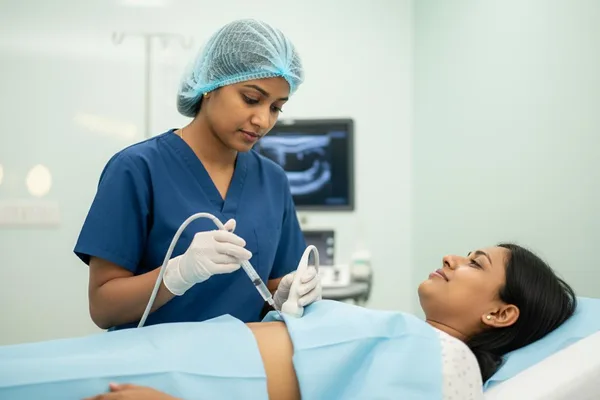
Before inserting the needle, the doctor uses a scan, such as an ultrasound (echocardiogram), to find the safest and easiest place to look for fluid around the heart. This scan allows the needle to be inserted under the guidance of a doctor, reducing the risk of damaging the heart or other organs. Sometimes a type of X-ray called fluoroscopy is also used.

In a very urgent, life-threatening situation, this can be done without the help of a scan like this. But that is a very rare occurrence.

Inserting the needle

You won't be put to sleep. Instead, a local anesthetic will be injected into the area where the needle is inserted, numbing the area. So you won't feel any pain, but you may feel a slight tingling sensation.

There are several places where the needle can be inserted.

  • Most often: Under the large bone in the middle of the chest (sternum).
  • Other methods: Front or obliquely, between the ribs of the chest.

The doctor, while looking at the scan, very carefully inserts the needle into the fluid-filled space around the heart, avoiding the heart. Then, using a syringe, the fluid is slowly withdrawn.

Depending on the amount of fluid, this process can take 10 to 20 minutes. If there is a lot of fluid, a small tube (catheter) can be inserted instead of a needle and left in place for a day or two to slowly drain all the fluid.

When the work is finished, the needle or tube is removed and a small plaster or bandage is applied to the area.

What happens after treatment?

After treatment, the doctor may do the following:

  • The sample of fluid removed is sent to a laboratory to determine why the fluid accumulated.
  • Another ultrasound (echocardiogram) scan is done to see if all the fluid has been removed.
  • You will need to stay in the hospital for one or two days. During this time, the medical staff will constantly monitor your condition.

Many people begin to feel great relief as soon as the fluid is removed. Symptoms such as shortness of breath and chest pain quickly subside.

What are the benefits and risks of this treatment?

Like any medical treatment, this one has both benefits and risks.

Main advantages

  • Life-saving: In an emergency situation like cardiac tamponade, this can save lives by instantly reducing the pressure on the heart.
  • Helping with diagnosis: Examining the fluid, finding the root cause, and providing the right treatment.
  • Simpler than surgery: This is a faster, less complicated procedure than major surgery.

Possible risks (Complications)

Since it is done with the help of a scan, the risk is very low. However, because the needle passes very close to vital organs like the heart and lungs, complications can occur in a small percentage of cases.

  • Heart damage: If the needle hits the heart, it can cause bleeding, irregular heartbeat (arrhythmia), or heart attack. These are very serious and may require emergency surgery.
  • Lung damage: If a lung is punctured, it can collapse.
  • Damage to other organs: The diaphragm, liver, stomach, or large blood vessels may be damaged.
  • Infection: Germs can enter the area where the needle was inserted. If this infection spreads throughout the body, it can cause a life-threatening condition called `sepsis`.

But remember, these risks are very rare. The benefits of having this treatment are always much greater than not having it, especially in an emergency.

How long does it take to recover and when should I see a doctor again?

You will usually be able to go home within a day or two. The time it takes to fully recover depends on the severity of your condition, the cause of the fluid buildup, and any other treatments you are receiving. Your doctor will tell you when you can resume your daily activities.

If you develop any symptoms after returning home, you should go to a hospital or emergency room (ETU) immediately.

Symptoms that require immediate medical attention
Symptoms of Cardiac Tamponade

  • Chest pain
  • Difficulty breathing or rapid breathing
  • Feeling dizzy or lightheaded
  • Palpitations (feeling like your heart is beating fast)

Symptoms of an infection (Infection/Sepsis)

  • Swelling and redness where the needle was inserted
  • Feeling unusually warm when the area is touched
  • Fever or chills
  • Confusion, memory loss

For some people, this type of fluid buildup can recur. If this happens, your doctor may refer you to a surgeon for a more permanent solution, such as a pericardial window.

Take-Home Message

  • Pericardiocentesis is an important, often life-saving procedure that removes unwanted fluid that has accumulated around your heart.
  • This is done through a scan, and you won't feel much pain because it's numb.
  • When compared to the benefits, the potential risks are very low.
  • If you develop symptoms such as chest pain, difficulty breathing, or fever after treatment, notify your doctor immediately or go to a hospital.
  • If you have any further questions, fears, or doubts about this treatment, discuss them openly with your doctor. They will explain everything to you.

Pericardiocentesis, fluid around the heart, heart attack, Cardiac tamponade, Pericardial effusion, heart health, chest pain

⚠️ Important: The medical articles and information on Nirogi Lanka are for general awareness only, and are by no means a substitute for professional medical advice, diagnosis, or treatment. For any medical problem you have, consult a qualified physician immediately.

💬 Comments (0)

No comments yet. Be the first to share your thoughts here.

Add Your Comment

Please calculate: 7 + 2 =
Let's learn simply about the treatment for fluid around the heart (Pericardiocentesis)
SurgeriesJuly 7, 2026

Let's learn simply about the treatment for fluid around the heart (Pericardiocentesis)

Have you ever heard someone say, "There's fluid around the heart"? Maybe you or someone you know has had this condition, and a doctor has talked about a treatment for it. It's normal to feel a little scared and nervous when you hear this. But don't worry. Today we're going to talk about a special treatment for this condition, which can sometimes save lives. It's called `Pericardiocentesis`. Let's talk about this simply, in a way that everyone can understand.

Simply put, what is Pericardiocentesis?

Imagine that our heart is inside a small sac. This sac is medically called the pericardium. Its job is to protect the heart and keep it in its proper place inside the body. Normally, there is a very small amount of fluid between this sac and the heart, which helps to reduce the amount of friction the heart has when it beats.

However, due to some diseases, fluid (water) starts to build up inside the pericardium unnecessarily . We call this condition `Pericardial effusion`. When this fluid builds up, that fluid puts a lot of pressure on the heart. Due to this pressure, the heart cannot beat, contract, or expand properly. This is a very dangerous and life-threatening emergency. This is called `Cardiac tamponade`.

So, pericardiocentesis is, quite simply, a procedure in which this unwanted amount of fluid that has accumulated around the heart is removed from the body using a needle. This immediately reduces the pressure on the heart and allows the heart to function freely again.

Who needs this treatment?

This treatment is needed for people who have fluid around the heart, called pericardial effusion. Sometimes it is done as an emergency treatment, especially in life-threatening situations like cardiac tamponade. Other times, even if it is not an emergency, it is also used to find out why this fluid is accumulating. The fluid that is removed can be sent for tests to find out the cause.

There can be several reasons why fluid accumulates around the heart. Let's look at the main ones.

Reason Description
Cancer conditions Cancer that has spread elsewhere in the body or cancer related to the heart.
Heart attack Especially in the event of a complication such as a ruptured heart wall due to a heart attack.
Infections Tuberculosis , a bacterial or viral infection (can also occur after COVID-19 infection or in people with HIV ).
Immune system diseases Diseases such as lupus and rheumatoid arthritis.
Other medical conditions Heart or kidney failure, hypothyroidism .
Side effects of treatment Due to certain medications or radiation therapy .
Cases without known cause Sometimes no specific cause can be found.

What happens before this treatment?

Once your doctor has diagnosed you with Pericardial effusion or Cardiac tamponade, they will determine whether or not to perform this treatment based on its severity.

Unless it's an emergency, your doctor will schedule an appointment for you. Usually, you'll be asked to fast for about 8 hours before your appointment. However, you'll be allowed to drink fluids, such as water, up to 2 hours before.

Before starting treatment, the medical team will do the following:

  • Saline infusion: A small tube (intravenous - IV line) is inserted into a vein in your arm. This can be used to give medications or fluids directly into your body, if needed.
  • Skin preparation: The area where the needle will be inserted is shaved and the area is thoroughly cleaned with an antiseptic solution. This can help prevent infection.
  • Vital signs monitoring: Sensors are attached to your body to measure your blood pressure, breathing, heart rate, and blood oxygen levels . You will also be connected to an ``ECG (Electrocardiogram)'' machine to monitor the electrical activity of your heart.
  • Providing supplemental oxygen: If necessary, oxygen can be given through a small tube placed in the nose or through a mouth mask.

What happens during treatment?

This is done by a team of doctors, nurses, and other technical personnel.

Imaging guidance

Before inserting the needle, the doctor uses a scan, such as an ultrasound (echocardiogram), to find the safest and easiest place to look for fluid around the heart. This scan allows the needle to be inserted under the guidance of a doctor, reducing the risk of damaging the heart or other organs. Sometimes a type of X-ray called fluoroscopy is also used.

In a very urgent, life-threatening situation, this can be done without the help of a scan like this. But that is a very rare occurrence.

Inserting the needle

You won't be put to sleep. Instead, a local anesthetic will be injected into the area where the needle is inserted, numbing the area. So you won't feel any pain, but you may feel a slight tingling sensation.

There are several places where the needle can be inserted.

  • Most often: Under the large bone in the middle of the chest (sternum).
  • Other methods: Front or obliquely, between the ribs of the chest.

The doctor, while looking at the scan, very carefully inserts the needle into the fluid-filled space around the heart, avoiding the heart. Then, using a syringe, the fluid is slowly withdrawn.

Depending on the amount of fluid, this process can take 10 to 20 minutes. If there is a lot of fluid, a small tube (catheter) can be inserted instead of a needle and left in place for a day or two to slowly drain all the fluid.

When the work is finished, the needle or tube is removed and a small plaster or bandage is applied to the area.

What happens after treatment?

After treatment, the doctor may do the following:

  • The sample of fluid removed is sent to a laboratory to determine why the fluid accumulated.
  • Another ultrasound (echocardiogram) scan is done to see if all the fluid has been removed.
  • You will need to stay in the hospital for one or two days. During this time, the medical staff will constantly monitor your condition.

Many people begin to feel great relief as soon as the fluid is removed. Symptoms such as shortness of breath and chest pain quickly subside.

What are the benefits and risks of this treatment?

Like any medical treatment, this one has both benefits and risks.

Main advantages

  • Life-saving: In an emergency situation like cardiac tamponade, this can save lives by instantly reducing the pressure on the heart.
  • Helping with diagnosis: Examining the fluid, finding the root cause, and providing the right treatment.
  • Simpler than surgery: This is a faster, less complicated procedure than major surgery.

Possible risks (Complications)

Since it is done with the help of a scan, the risk is very low. However, because the needle passes very close to vital organs like the heart and lungs, complications can occur in a small percentage of cases.

  • Heart damage: If the needle hits the heart, it can cause bleeding, irregular heartbeat (arrhythmia), or heart attack. These are very serious and may require emergency surgery.
  • Lung damage: If a lung is punctured, it can collapse.
  • Damage to other organs: The diaphragm, liver, stomach, or large blood vessels may be damaged.
  • Infection: Germs can enter the area where the needle was inserted. If this infection spreads throughout the body, it can cause a life-threatening condition called `sepsis`.

But remember, these risks are very rare. The benefits of having this treatment are always much greater than not having it, especially in an emergency.

How long does it take to recover and when should I see a doctor again?

You will usually be able to go home within a day or two. The time it takes to fully recover depends on the severity of your condition, the cause of the fluid buildup, and any other treatments you are receiving. Your doctor will tell you when you can resume your daily activities.

If you develop any symptoms after returning home, you should go to a hospital or emergency room (ETU) immediately.

Symptoms that require immediate medical attention
Symptoms of Cardiac Tamponade

  • Chest pain
  • Difficulty breathing or rapid breathing
  • Feeling dizzy or lightheaded
  • Palpitations (feeling like your heart is beating fast)

Symptoms of an infection (Infection/Sepsis)

  • Swelling and redness where the needle was inserted
  • Feeling unusually warm when the area is touched
  • Fever or chills
  • Confusion, memory loss

For some people, this type of fluid buildup can recur. If this happens, your doctor may refer you to a surgeon for a more permanent solution, such as a pericardial window.

Take-Home Message

  • Pericardiocentesis is an important, often life-saving procedure that removes unwanted fluid that has accumulated around your heart.
  • This is done through a scan, and you won't feel much pain because it's numb.
  • When compared to the benefits, the potential risks are very low.
  • If you develop symptoms such as chest pain, difficulty breathing, or fever after treatment, notify your doctor immediately or go to a hospital.
  • If you have any further questions, fears, or doubts about this treatment, discuss them openly with your doctor. They will explain everything to you.

Pericardiocentesis, fluid around the heart, heart attack, Cardiac tamponade, Pericardial effusion, heart health, chest pain

⚠️ Important: The medical articles and information on Nirogi Lanka are for general awareness only, and are by no means a substitute for professional medical advice, diagnosis, or treatment. For any medical problem you have, consult a qualified physician immediately.

💬 Comments (0)

No comments yet. Be the first to share your thoughts here.

Add Your Comment

Please calculate: 7 + 2 =