
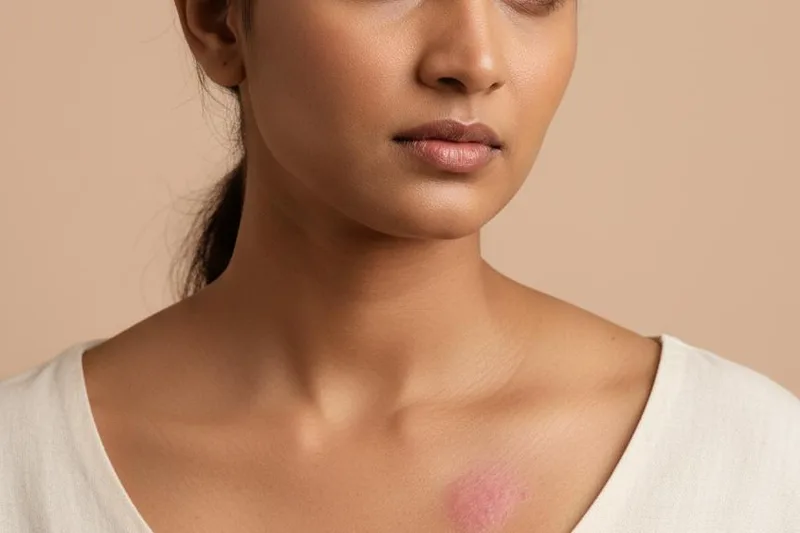
Have you suddenly developed a pink, slightly scaly rash on your body, especially on your chest, stomach, or back? Did it appear within a week or two and then spread to many smaller spots? Then you may have a skin condition called Pityriasis Rosea. Don't be scared when you hear this name. This is a very common condition, and it's usually not dangerous. Let's talk about it simply, in a way that you can understand.
What is Pityriasis Rosea?
Simply put, Pityriasis Rosea is a skin condition that causes pink, raised, scaly patches to appear on your skin. These are most commonly seen on your torso (chest, stomach, back), arms, and legs. Despite the name "Rosea," these patches don't all look pink. They can also appear red, gray, brown, or purple, depending on your skin tone.
This disease also has a funny name - "Christmas tree rash." This is because when these small spots spread across the body, they look like the branches of a Christmas tree bending down.
Who is most likely to get this?
Pityriasis Rosea can affect anyone, but some people are more likely to develop it.
- For those between the ages of 10 and 35 .
- Women are about 50% more likely to develop this condition than men.
Some people say that they were under a lot of stress before they got these spots. However, it has not yet been scientifically proven that stress causes them. It is usually less common in people over the age of 60. However, if they do, the symptoms may last a little longer.
What are the symptoms? Let's learn about them step by step...
The symptoms of this disease usually do not appear all at once. They appear in several stages.
| Stage | What Happens |
|---|---|
| First stage (early symptoms) | Some people may experience a mild illness such as fever, headache, and sore throat for a few days before these spots appear. This does not happen to everyone. |
| The arrival of the 'Herald Patch' | First, a round or oval-shaped spot, about 1-6 centimeters in size, appears in one place on the body. This is the initial sign of the disease. We also call this the 'Herald Patch' or 'mother patch'. |
| The spread of 'Daughter Patches' | The large spot appears in about a week or two, and many smaller spots (about 1-2 cm) start to spread, especially on the trunk. These are called 'daughter patches'. |
| Itching | About 50% of people with this disease, or about one in two, scratch these spots. The itching can be quite intense for some. |
| Dark skin appearance | In people with darker skin, these spots may appear more raised (papular) than normal. |
These spots do not cause pain. However, if you scratch them too much, they can damage the skin and cause infection , which can cause pain.
Why does this happen? Is it contagious from person to person?
The exact cause of this condition has not yet been found, but doctors believe that it may be caused by certain types of herpes viruses (`(HHV-6)`, `(HHV-7)`, `(HHV-8)`).
The most important thing is that this herpes virus has nothing to do with genital herpes or the herpes virus that causes cold sores. Therefore, it is not a sexually transmitted disease (STD). And it is not spread from person to person through skin-to-skin contact. So don't be unduly afraid of this.
Pityriasis Rosea or Ringworm?
Some people confuse these two conditions with ringworm because they look very similar. Both are raised, scaly patches on the skin. Ringworm is a fungal infection . Pityriasis Rosea is a condition that is thought to be caused by a virus. Your doctor can tell the difference between the two.
Is it dangerous if it occurs during pregnancy?
This is a very important point. If you are pregnant and you develop these spots, do not delay and inform your doctor immediately.
Some studies have shown that Pityriasis Rosea during early pregnancy may increase the risk of miscarriage and neonatal hypotonia. Therefore, it is imperative to seek medical advice.
How does the doctor recognize this?
A doctor can usually diagnose Pityriasis Rosea by examining your skin, especially by seeing the first 'Herald Patch'.
But sometimes it can be confused with other skin diseases. For example:
- Eczema
- Psoriasis
- Ringworm
- Ringworm (Tinea versicolor)
Therefore, if the doctor has any doubts, he may refer you for a biopsy, which involves taking a small piece of skin and examining it, or a blood test, to make sure that there are no other medical conditions.
What are the treatments? Are there things I can do at home?
The good news is that for most people, these spots disappear completely within 6-8 weeks without any treatment.
However, if the itching is very severe, your doctor may prescribe some treatments to reduce the discomfort.
- Antivirals: Medicines that help fight viruses.
- Phototherapy: A treatment using specific ultraviolet (UVB) light. However, people with darker skin tones may develop permanent hyperpigmentation after this, so it is important to discuss this with your doctor.
- Prednisone tablets: These are corticosteroid tablets. They reduce inflammation and itching of the skin.
Things you can do at home to relieve itching
It's important to talk to your doctor before trying these home remedies. You may be allergic to some of the ingredients.
- Antihistamines: Allergy pills help reduce itching.
- Calamine lotion: Reduces itching and discomfort, and relieves skin dryness.
- Hydrocortisone creams: Creams that reduce itching and inflammation.
- Oatmeal: Oatmeal is a great natural remedy for itching. Grind some oats in a blender until smooth. Then mix it with a little water to make a paste and apply it to the affected areas. Leave it on for about 10 minutes and then wipe it off with a clean cloth.
What are the best times to see a doctor?
Although this is usually not dangerous, you should definitely see a doctor in the following cases:
- If you develop new symptoms.
- If symptoms do not improve despite treatment.
- If the spots last more than 10 weeks.
- If the spots look infected (e.g. red, swollen, oozing pus).
- If you are pregnant and spots like this appear (this is very important).
Take-Home Message
- Pityriasis Rosea is a common, usually non-dangerous skin condition.
- This is not spread from person to person and is not a sexually transmitted disease.
- It usually heals completely in 6-8 weeks without any treatment.
- If the itching is severe, you can get treatment for it.
- Most importantly, if you have spots like this, see a doctor to make sure it's just Pityriasis Rosea.
- If you are pregnant, notify a doctor immediately if you develop any rash like this.


💬 Comments (0)
No comments yet. Be the first to share your thoughts here.
Add Your Comment