

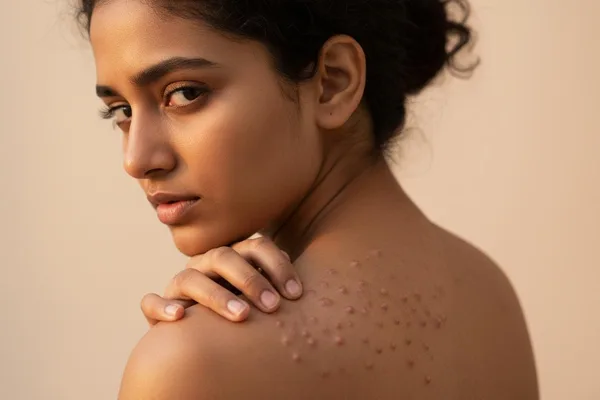
Do you have small, similar-looking bumps on your skin, especially on your chest, back, shoulders, and maybe even your forehead, and they're incredibly itchy? Sometimes you might think that these are just regular acne. However, they may not be acne at all, but rather a skin condition that's a little different, but can be seen in many people. Today, we're going to talk about a condition called `Malassezia Folliculitis` or `Pityrosporum Folliculitis`, which shows similar symptoms. Don't worry, we'll talk about this simply and in a way that you can understand.
What is Malassezia Folliculitis?
Simply put, `Malassezia folliculitis` is a fungal infection of the hair follicles, the small openings where hair comes out of our skin. Just think, we all have a type of yeast called `Malassezia`, a small fungus, living on our skin. It's like a little guest on our skin, and it's usually harmless. But, sometimes, for some reason, if this `Malassezia` yeast grows too much, that is, too fast, and invades our hair follicles, then this skin problem called `Malassezia folliculitis` occurs. Some people also call this ``Pityrosporum Folliculitis'', because ``Pityrosporum'' is another name for the yeast ``Malassezia''.
Who gets this the most?
So, let's see who is most likely to develop this condition called `Malassezia folliculitis`.
- This can often be seen in young children who are entering puberty , whether it's your daughter or son. It's probably because the skin becomes a little oilier during that time, along with hormonal changes.
- In addition, people who sweat a lot are more likely to develop this condition. Some people have a tendency to sweat even at the slightest thing, which in medicine we call `hyperhidrosis`. People like that can also develop this condition.
- Similarly, this is also common in those living in regions with hot and humid climates. Just think, it's not surprising that this is seen quite often in a country like Sri Lanka with a climate like ours, right? Because in such an environment, the yeast we mentioned can grow well.
What are the risk factors that affect this?
Okay, so let's learn about some other risk factors that can contribute to the development of `Malassezia folliculitis.' See if these things apply to you too:
- If you are young, especially if you are male (this seems to occur a little more in males).
- If you have diabetes mellitus . When you have diabetes, your immune system is weak, making it easier for germs to cause infections.
- If you have very oily skin, oily skin is a good environment for yeast to grow.
- If you have a weakness in your immune system . That is, if your body's defense system that fights diseases is weak.
- If you frequently develop conditions like seborrheic dermatitis or dandruff , the yeast `Malassezia` is also associated with these conditions.
- If you are a person who sweats a lot (we have said this before).
- If you take antibiotics ( for bacterial infections) or steroids (for asthma, arthritis, etc.) for a long time, these medications can sometimes kill the good bacteria on your skin, giving yeast a chance to grow.
How common is this condition?
Actually, ``Pityrosporum folliculitis`` is a common skin disease (dermatitis) . But it's hard to say exactly how common it is. The reason is that sometimes it doesn't even need treatment, or some people mistakenly think it's acne . Therefore, it may not be correctly diagnosed.
Which part of the body is most affected by this?
These blisters are usually seen:
- On the face (especially the forehead area)
- On the scalp (often near the hairline, that is, where the hair begins)
- In the shoulders
- On the upper part of the arms
- In the chest
- On the back
These areas are more sweaty and oily, so it's easier for yeast to grow.
What is the difference between this and acne? This is very important!
This is where many people get confused. Because both the blisters caused by `Malassezia folliculitis` and the common acne blisters can appear on the face and upper body. However , the causes, appearance, and feel of the two are different .
- Malassezia/Pityrosporum folliculitis:
- Cause: This is caused by a fungal infection in the hair follicles . That is, an overgrowth of the yeast `Malassezia`.
- Appearance: Blisters are usually uniform in size and shape . This means that many of the blisters look the same, with small, red bumps, sometimes with a small white dot on top.
- What it feels like: It's very itchy! This is the main symptom. Some people may even feel a burning sensation.
- Acne:
- Cause: This is caused by blockage of the skin's oil-producing glands (sebaceous glands) and hair follicles . Bacteria are also involved.
- Appearance: Blisters can come in many shapes and sizes . For example, you may see different types of acne at the same time, such as small whiteheads (`whiteheads`), blackheads (`blackheads`), large red, swollen pimples (`pimples`), and pus-filled blisters (`pustules`).
- How it feels: Acne usually doesn't itch as badly as Malassezia folliculitis. It can sometimes be a little painful, especially if it's a large, inflamed pimple.
So you probably understand, if you have "pimple-like blisters and are itching a lot," there's a good chance it's Malassezia folliculitis.
Is this a contagious disease?
Yes, `Pityrosporum folliculitis` can be somewhat contagious . That means it can be transmitted from one person to another. How does that happen?
- By using the same razors.
- From commonly used places like hot tubs.
- Although less likely, it can also be spread from person to person through skin-to-skin contact . However, this is not very common.
Therefore, it is better not to share things like razors with others.
How do doctors diagnose this?
If you have these symptoms, it's best to see a doctor. The doctor will first do a physical examination of your skin . They will ask about the appearance of the blisters, where they have spread, and any symptoms you are experiencing (such as itching). They may also refer you to a dermatologist .
To confirm whether you have Malassezia folliculitis, your doctor may do something like this:
- Skin scraping: This involves taking a small, painless scraping of skin cells from the area where the blisters are. The cells are then examined under a microscope to see if there is an excess of the yeast Malassezia.
- Skin biopsy: Sometimes, if the diagnosis is unclear, a very small piece of skin may be taken and sent to a laboratory for testing. This is not done for everyone, but only if necessary.
How can this be cured? (Treatment)
The good news is that there are effective treatments for this condition, called Malassezia folliculitis. Doctors usually prescribe antifungals for this condition.
- Topical Antifungals:
- First, antifungal creams, gels, or shampoos may be prescribed to reduce the amount of yeast on the skin. For example, you may be told to use a shampoo containing ketoconazole or selenium sulfide when you wash your body. These should be applied directly to the blisters.
- Oral Antifungals:
- However, if the condition is more severe , meaning the blisters are widespread, or if they persist and do not respond to topical medications , your doctor may prescribe systemic antifungal pills . For example, fluconazole (brand name Diflucan®), itraconazole, or ketoconazole (which is now less commonly used due to its effects on the liver). These medications should be taken exactly as directed by your doctor.
- Photodynamic Therapy (PDT):
- In severe cases, some doctors may also recommend a treatment called photodynamic therapy , which uses special light.
Are there things you can do at home?
Yes, some simple things can help.
- Anti-dandruff shampoo: Washing the affected area with a shampoo containing selenium sulfide or ketoconazole can help reduce the amount of yeast. Apply the shampoo and leave it on for 5-10 minutes before rinsing.
- Over-the-counter antifungal creams (OTC antifungals): Some creams used to treat fungal infections like athlete's foot may also help, but it's best to seek medical advice.
What about natural treatments?
Some studies suggest that tea tree oil, a type of herbal oil, may help with Malassezia folliculitis. Tea tree oil has antifungal properties. However, when using it, it should be diluted with something like coconut oil rather than directly applied to the skin, as it can cause skin irritation in some people. However, it is wise to talk to your doctor before using anything like this.
Are there any side effects to these treatments?
Skin-soaked medications usually don't cause major side effects. Sometimes, a little burning and dryness may occur.
However, oral antifungal medications can cause side effects in some people. The most common ones include:
- Abdominal pain
- Diarrhea
- Nausea and vomiting
- Some medications can affect the liver, which is why it is recommended to take these medications under the supervision of a doctor.
If you feel anything unusual, tell your doctor immediately.
How can this be prevented from happening? (Prevention)
Malassezia yeast thrives when your skin is warm, sweaty, and moist . So, here are some things you can do to help prevent this condition from developing or reduce its recurrence:
- Avoid using greasy skin care products and sunscreens . Choose products that are labeled "non-comedogenic" (will not clog hair follicles).
- Wear clothes that allow your skin to breathe and absorb sweat . Cotton is best. Tight clothing made of synthetic fabrics like nylon can trap sweat and encourage yeast growth.
- Wash your skin thoroughly at least once a day . Don't forget to shower or wash your body quickly, especially after exercising or sweating.
- Don't wear sweaty clothes . Change out of them and put on clean clothes as soon as you're done exercising.
- For some people, using a doctor-recommended antifungal shampoo once or twice a week can help prevent it from coming back.
If I have `Malassezia folliculitis`, what should I expect?
You can expect symptoms (itching, blisters) to subside within a few weeks of starting proper treatment . The blisters will gradually fade.
However, for some people, the condition called `Malassezia folliculitis` can last for years . Often, the symptoms will subside significantly during treatment, only to reappear after a short time after treatment is stopped . This can be a bit annoying.
Therefore, to prevent symptoms from recurring, your doctor may recommend that you continue to use certain creams, shampoos, or oral medications at a low dose as maintenance therapy .
When should I see a doctor?
It is essential for you to see a doctor if:
- You think you have acne, but acne treatments (e.g., over-the-counter creams) don't help, especially if there are blisters along with itching .
- If the skin blisters are widespread and the itching is severe .
- If there is no shortage of care at home.
- If this situation occurs frequently .
Remember, `Malassezia folliculitis` is a condition caused by an overgrowth of a yeast called `Malassezia` on the skin and infecting hair follicles. This causes itchy, similar-looking bumps on the face, scalp, and upper body. Doctors treat it with topical antifungal creams, shampoos, and, if necessary, oral antifungal medications.
So what should we remember from this story? (Take-Home Message)
Okay, let's summarize and remember some important points from what we've talked about:
- If you have small, similar-looking bumps on your body, especially on your chest, back, shoulders, and forehead, and you're itching a lot , it's not just regular acne, it's likely Malassezia Folliculitis .
- The main reason for this is that a yeast (fungus) called ``Malassezia'', which is normally present on our skin, grows excessively and infects the hair follicles .
- Sweating, oily skin, certain medications (especially antibiotics, steroids), weak immunity, and hot, humid environments are the main factors that contribute to the worsening of this condition.
- If your acne is not getting better with over-the-counter acne medications and home remedies, you should definitely see a doctor . This is treated with a different class of medication called antifungals.
- Taking care of personal hygiene , washing your body promptly after sweating, wearing breathable, sweat-absorbing cotton clothing, and avoiding oily cosmetics can help prevent and control this condition.
- Although this is a bit of a bothersome condition, there is nothing to worry about . With the right medical treatment and your dedication, it can be well controlled and cured .
So, if you have these symptoms, don't be shy or delay, seek medical advice. Take care of your skin health!
` Malassezia folliculitis, Pityrosporum folliculitis, fungal acne, skin yeast infection, itchy bumps on skin, skin fungus, Pityrosporum folliculitis, Malassezia folliculitis, skin blisters, skin itching, acne-like blisters




💬 Comments (0)
No comments yet. Be the first to share your thoughts here.
Add Your Comment