

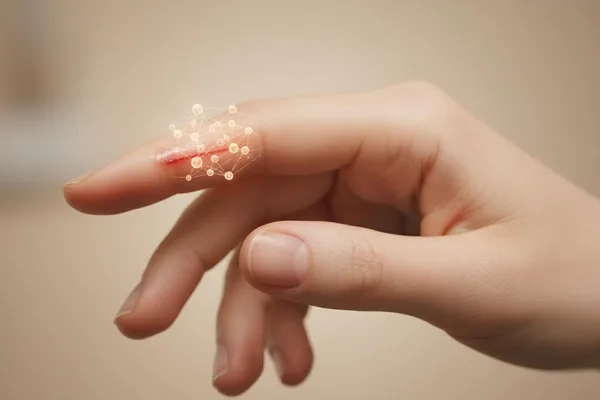
When you cut your finger, the bleeding just stops after a while, right? Or when you sprain your knee while playing, a blood clot forms over the wound and seals it. Have you ever wondered who does this amazing thing? This is actually part of a very amazing defense system in our body. It is responsible for some of the smallest, but very important cells in our blood. We medically call these platelets, or platelets . Some people also call them `(Thrombocytes)`. So today, let's talk about these little heroes.
Simply put, what are platelets?
Think of it like a little Band-Aid that naturally forms inside your body. That's what platelets are. They're not actually whole cells, they're little pieces that break off from larger cells called megakaryocytes in our bone marrow. They're very small and colorless. But they do a lot of work.
If you take a drop of your blood, there are tens of thousands of these platelets in it. To keep our bodies healthy, the number of these platelets needs to be in perfect balance.
- Low platelet count (Thrombocytopenia): If you get a cut, the bleeding may not stop and you may bleed a lot. This can be dangerous.
- If platelets increase (Thrombocytosis): This can cause blood clots to form unnecessarily, which can become lodged in blood vessels. This can lead to serious conditions like heart attack or stroke.
This means that only if there are the right number of platelets can bleeding stop when injured, and also prevent the formation of unnecessary blood clots.
The main function of platelets is to stop bleeding.
The main and most important function of platelets is to stop bleeding when there is damage to one of our blood vessels, that is, a wound. We call this process ``Hemostasis``. This is something that happens in a very strange way, in several steps. Imagine a water pipe that has a hole. These platelets do a job like the plaster that we put to close it.
Here's how it happens:
1. Adhesion: As soon as a blood vessel is cut, platelets, which travel throughout the body with the blood, rush to the site of the damage and stick to the broken wall. It's like seeing a hole and going to grab it.
2. Activation: Those stuck platelets become "activated." That is, they change shape. They change from a plate-like shape to a spider-like shape with threads sticking out. These legs can grip the walls of the wound and other platelets better. Also, these activated platelets release chemicals. These chemicals send a signal to other platelets, saying, "There's a problem here, come quickly!"
3. Aggregation: Once that signal is received, thousands more platelets arrive at the site and form a clump. This clump temporarily closes the wound. We call this a "Platelet Plug."
This is like filling sacks of soil with soil when a dam breaks on a river. It's a temporary solution.
Then, as these platelets clump together, another complex process begins. It's called the ``Coagulation Cascade.'' In this, other proteins in the blood (clotting factors) combine to form a strong mesh called fibrin . This fibrin mesh further strengthens the platelets, forming a firm, strong blood clot. That's when the bleeding stops completely.
Where are these platelets located in our body?
Platelets can be found mainly in three places in our body.
- Bone Marrow: This is the "factory" for platelets. Our blood cells are made in the bone marrow, which is inside our bones. Platelets are broken down into small pieces by large cells called ``Megakaryocytes'' here and released into the blood.
- Blood: Once in the bloodstream, these platelets travel throughout the body through blood vessels. Because they are light, they stay close to the walls of the blood vessels. So if there is an injury, they can quickly reach the site.
- Spleen: This is the "storage" and "recycling center" for platelets. About a third of the platelets produced in our body are stored and kept in the spleen. It also removes and recycles old and damaged platelets.
How many platelets should a healthy person have in their blood?
A healthy adult has between 150,000 and 450,000 platelets per microliter (a very small drop of blood) of blood. It is very important that this number is within these limits.
The lifespan of a platelet is very short. A platelet is destroyed in 7 to 10 days. Therefore, our bone marrow has to constantly add new platelets to the bloodstream. This is a continuous process.
What are the main diseases associated with platelets?
Most diseases related to platelets can be divided into two types: low platelet count or high platelet count.
| Medical condition | Simple meaning and effect |
|---|---|
| Thrombocytopenia | This is a decrease in platelet count . This condition can occur when you have a disease like dengue. This condition occurs either when the body produces fewer platelets or when the platelets that are produced are destroyed too quickly. The main risk here is excessive bleeding, even from a minor injury. |
| Thrombocytosis | This is an increase in platelets . This condition occurs when too many platelets are produced due to a problem in the bone marrow. The main risk here is the formation of unnecessary blood clots inside the body. If these blood clots block blood vessels leading to the heart, brain, or lungs, it can be life-threatening. |
What are the signs that there is a problem with platelets?
If you have an imbalance in the number of platelets in your body, you may experience the following symptoms. If you continue to have one or more of these, it is very important to see your doctor immediately .
| Symptom | Description |
|---|---|
| Bruising for no reason | If you develop blue or purple bruises on your body without hitting anything, sometimes small red dots (petechiae) may also appear under the skin. |
| Frequent nose and gum bleeding | If your gums often bleed when you brush your teeth, or if you have frequent nosebleeds. |
| Blood in stool or urine | Black or bloody stools, red or pink urine. |
| Heavy menstrual bleeding in women | Bleeding during menstruation for longer than usual or heavier than usual. |
| Excessive bleeding from a minor injury | If even the smallest wound takes a long time to stop bleeding. |
| Numbness, swelling in the limbs | A symptom that can occur when platelets increase. This can occur when blood clots obstruct blood flow. |
| Severe headache, dizziness, weakness | These are also serious symptoms that can occur due to blood clots forming in the veins supplying blood to the brain due to an increase in platelets. |
How do you check the health of platelets?
If your doctor has any doubts about your platelets, they can do several tests to confirm it.
- Complete Blood Count (CBC): In Sri Lanka, we often call this a Full Blood Count (FBC). This involves taking a sample of your blood and measuring the exact number of red cells, white cells, and platelets in it.
- Peripheral Blood Smear (PBS): This involves smearing a small amount of blood on a glass slide and looking at it under a microscope. This allows the platelets to be seen in abnormal shape and size.
- Blood Clotting Tests: Tests that check how quickly your blood clots. These can give an idea of the function of your platelets.
- Bone Marrow Biopsy: In some cases, a small sample of bone marrow is taken from the hip bone under anesthesia to check for problems with the bone marrow, where platelets are produced.
What are the treatments for such conditions?
Treatment depends on whether your platelet count is low or high, and the cause.
Very important: It's good to be aware of the following treatments, but never start or stop any medication without your doctor's advice.
- Medications: If you have high platelets, you may be given medications that reduce their production. If the low platelet count is due to an immune system problem, other medications may be given to treat it.
- Aspirin: To reduce the risk of blood clots in people with high platelet counts, your doctor may recommend taking a low-dose aspirin daily.
- Platelet Transfusions: If the platelet count is very low and there is a high risk of bleeding, platelets taken from a healthy person are given to the body through blood.
- Splenectomy: In some conditions, the spleen captures and destroys too many platelets. In such cases, if other treatments are not successful, surgery may be needed to remove the spleen.
What can we do to keep platelets healthy?
If you already have a platelet-related condition, it's important to follow your doctor's instructions exactly. In addition, these things generally help keep our platelets healthy.
- Limit alcohol consumption. Excessive alcohol consumption can affect bone marrow function and reduce platelet production.
- Avoid smoking. Smoking can damage blood vessels and increase the tendency of platelets to stick together.
- Stay away from toxic chemicals. Exposure to some chemicals, such as pesticides, can damage the bone marrow.
- Protect yourself from injury. If your platelet count is low, you should take special care to protect yourself from falls and bruises.
Take-Home Message
- Platelets are tiny cells in our blood that stop bleeding when we get injured.
- Both a decrease in the number of platelets (thrombocytopenia) and an increase in the number of platelets (thrombocytosis) are problematic conditions.
- Don't ignore symptoms like unexplained bruising, frequent nosebleeds, or bleeding gums. These could be signs of a platelet problem.
- If you have symptoms like these, don't just assume, see your doctor immediately for advice.
- Never use any medication you feel like without medical advice.




💬 Comments (0)
No comments yet. Be the first to share your thoughts here.
Add Your Comment