
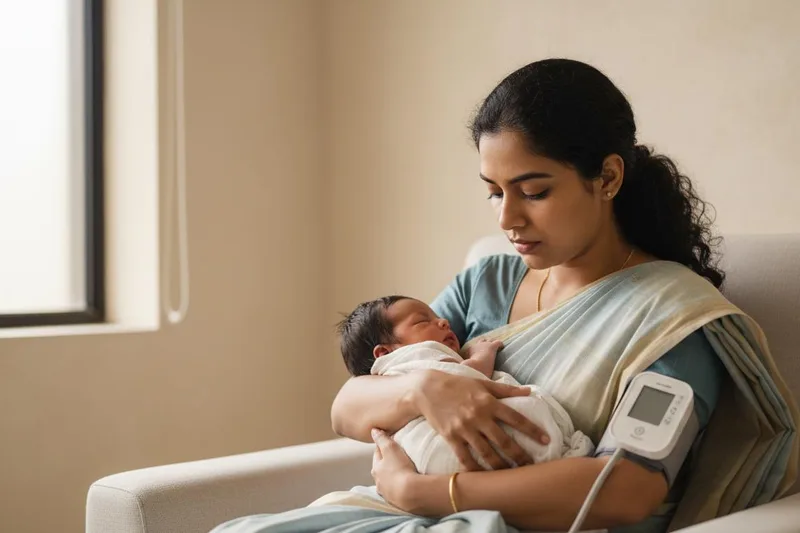
The joy of welcoming a new baby home is indescribable, isn't it? While everyone's attention is focused on your baby and son, it's important for you as a new mother to take care of your own health. After all, childbirth is a big process, and it takes some time for your body to recover. During this time, we can sometimes experience unexpected, but very serious health conditions. That's Postpartum Preeclampsia.
Simply put, what is postpartum preeclampsia?
Postpartum preeclampsia is a serious, but somewhat rare, condition of high blood pressure that occurs in mothers after giving birth. It usually occurs within the first 48 hours of delivery. However, it can sometimes develop as late as six weeks after delivery. It is dangerous because it can lead to serious complications such as stroke and seizures if not diagnosed and treated early.
Now you might be thinking, isn't this the same as preeclampsia? No, these two are a little different. Preeclampsia is a condition that occurs during pregnancy. But postpartum preeclampsia only occurs after the baby is born. What's surprising is that even a mother who has never had preeclampsia in her life and who has had no problems during pregnancy can develop this condition.
The most important thing is to seek medical advice immediately if you experience any of these symptoms. The sooner you are diagnosed and treated, the greater your chances of making a full recovery.
Who is at higher risk for this condition?
Although this condition can develop in anyone, certain factors may increase your risk. It is important to talk to your doctor about this.
| Risk Factor | Simple explanation |
|---|---|
| Obesity | If your body weight is much higher than normal. |
| High blood pressure during pregnancy | If your blood pressure was high while you were expecting your baby. |
| Family or personal history | If you or someone in your family (mother, sister) has previously had preeclampsia or postpartum preeclampsia. |
| Age | If you are under 20 years old or over 40 years old. |
| Twins | If you are expecting twins or more children. |
| Other medical conditions | If you have conditions such as diabetes (Type 1 or Type 2 Diabetes) or autoimmune diseases (e.g. Lupus). |
How do we recognize this? What are the symptoms?
With the fatigue of your body after having a baby, you may think that some symptoms are normal and miss them. So, pay close attention to these signs.
| Symptom | How does this feel? |
|---|---|
| High blood pressure | Blood pressure is 140/90 mmHg or higher. This is difficult for you to detect at home. |
| Severe headache | It's not like a normal headache, it's an unbearable, severe pain. Even taking painkillers may not help. |
| Vision changes | Your eyes may appear blurry, you may have difficulty looking at light, and you may feel like there are dots or lines floating before your eyes. |
| Body swelling | Swelling, especially of the face, hands, legs, and feet. |
| Stomach pain | Pain in the upper abdomen, usually under the ribs on the right side. |
| Nausea and vomiting | Nausea and vomiting without an obvious cause. |
| Decreased urination | Significant decrease in the amount of urine excreted per day. |
| Difficulty breathing | Difficulty breathing, feeling of heaviness in the chest. |
If you have any of these symptoms after having a baby, don't just assume, "This is probably just normal exertion." Call your doctor immediately, or go to the Emergency Department (ETU) at your nearest hospital.
Why is this happening? What is the reason?
In fact, doctors still don't know the exact cause of postpartum preeclampsia. But they do know that the risk factors we discussed earlier play a role. That's why it's important to attend your prenatal care and postpartum check-ups regularly. Share your full medical history with your doctor. Don't hesitate to tell them anything unusual, no matter how small.
How can the doctor confirm this?
When you go to the hospital, if the doctor suspects this condition, they will run several tests.
- Blood pressure measurement: The first thing to do is check your blood pressure.
- Blood tests: A sample of your blood will be taken to check your platelet count and how well your liver and kidneys are functioning.
- Urinalysis: A urine sample is taken and tested for protein. In this condition, protein may be present in the urine. This is called proteinuria .
- Brain scan: If you have had a seizure , you may have a CT or MRI scan to see if there is any brain damage.
How is it treated?
Because this is a serious condition, you will be treated in the hospital. There are several main treatment options.
- Blood pressure medications: Medications are given to bring your high blood pressure down to a safe level.
- Anti- seizure medications: The biggest risk in this condition is seizures . To prevent this, medications such as magnesium sulfate are given intravenously.
- Anticoagulants: Since there is a risk of blood clots forming in the blood vessels, blood thinners may be given to reduce this risk.
If you are a breastfeeding mother, be sure to tell your doctor and nurses. They will then confirm whether the medication you are giving is safe for your baby and plan your treatment accordingly.
What serious things can happen if left untreated?
Don't be afraid to read this section. This is to educate you. Because only when you understand how serious this condition is will you not ignore the symptoms.
- Permanent damage to major organs such as the brain, liver, and kidneys.
- Seizures .
- Pulmonary edema .
- Stroke .
- Formation of blood clots in blood vessels.
- The occurrence of a very serious, life-threatening condition called HELLP syndrome .
- Although rare, death is even possible.
This is why we repeatedly say that if you have any doubts about your symptoms, see a doctor immediately.
How long will it take to heal? Can it grow back?
It may take a few days or weeks for your blood pressure to return to a safe level with medication. Once your pressure is under control, your risk of other complications decreases.
It's not easy to recover from an illness like this while taking care of a child. You will have to stay in the hospital for a few more days. Get as much rest as possible during this time. Pay attention to your health. Don't hesitate to ask your husband for help at home. Even after you go home from the hospital, go to the clinic every day that the doctor tells you to come.
If you have had postpartum preeclampsia once, you are at risk of developing this condition (preeclampsia or postpartum preeclampsia) in your next pregnancy. Therefore, if you become pregnant again, it is very important to tell your doctor so that they can monitor you more closely throughout your pregnancy.
Take-Home Message
- Postpartum preeclampsia is a serious condition involving high blood pressure that develops after childbirth. It can develop even in people who have never had high blood pressure before.
- Keep in mind the main symptoms of severe headache, blurred vision, swelling of the face, hands, and feet, stomach pain, and difficulty breathing .
- Don't ignore these symptoms as "normal postpartum fatigue." These are warning signs.
- If you experience any of these symptoms, call your doctor immediately . If you have difficulty breathing or have a seizure , go to the hospital's Emergency Department (ETU) immediately.
- Although this condition cannot be prevented, it can be completely cured if diagnosed early and treated properly. Your life and health are very important to you, as well as your baby.


💬 Comments (0)
No comments yet. Be the first to share your thoughts here.
Add Your Comment