

Have you ever heard the doctors say, "We're going to pronate the patient" when one of your relatives or friends is in the ICU (intensive care unit)? Or you may remember the word 'proning' being used frequently during the COVID-19 pandemic. While this may be new to many, it is actually a very important and long-standing technique that doctors use to save the lives of patients with severe respiratory distress. So, today we will talk about it all in a very simple way, in a way that you can understand.
Simply put, what is 'Proning'?
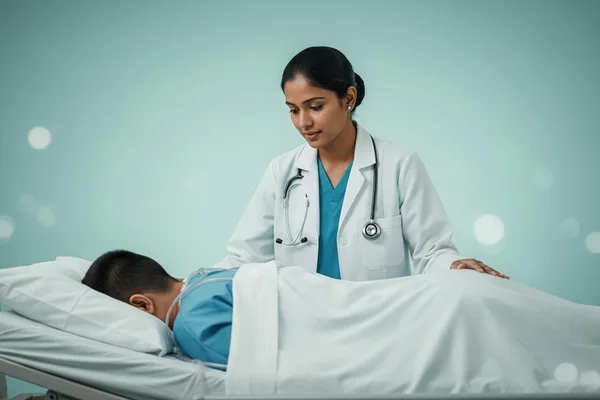
Proning is a very simple thing. It is turning a patient who is in a supine position in bed into a prone position. It is like turning over on our stomach to sleep. But this is not something we do casually, it is something that is done very carefully and deliberately by the medical staff in a hospital.
This is often done for patients with severe respiratory distress , especially those on mechanical ventilation. This increases the amount of oxygen that reaches the patient's body.
Although it became popular during the COVID-19 pandemic, this is nothing new. Doctors have been using this method for decades. Research has even shown that early pronation in patients with severe respiratory illness who are on a ventilator can significantly reduce mortality .
What kind of medical conditions is this method used for?
The proning method is mainly used to help patients with severe respiratory illnesses where the body is not getting enough oxygen (hypoxia). The most common of these conditions is Acute Respiratory Distress Syndrome (ARDS).
Simply put, ARDS is the accumulation of fluid in the tiny air sacs inside our lungs, the alveoli. Think of it like a sponge that absorbs water and closes the gaps. When these air sacs fill with fluid, there is no room for air to breathe. This is a very serious condition. ARDS can occur as a severe case of diseases like pneumonia and COVID-19.
Why does oxygenation improve when you turn your stomach?
This is the most important thing. How does oxygen level increase when you turn over on your stomach? There are two main reasons for this. The reason is that our body is not symmetrical.
1. Reduced weight and pressure on the lungs (Improved Ventilation)
Because of our body shape, we have more lung tissue on our back than on our chest. When we sleep on our back, the weight of our heart and other abdominal organs falls directly on top of our lungs. Also, fluid that accumulates in the lungs, such as in conditions like ARDS, can cause gravity to put pressure on the air sacs on the back. This reduces the lungs' ability to fully fill with air.
Imagine having a weight on your chest and having difficulty breathing. The same thing happens to your lungs.
However, when the patient is turned on his stomach (prone position), the weight of the heart and other organs does not fall on the lungs, but on the chest bones. Also, the fluid in the lungs collects in a small, front lung area. This frees up the large lung area on the back. Then , air can enter that area well, allowing the lungs to expand to their maximum capacity.
2. Improved gas exchange efficiency in the lungs
In conditions like ARDS, there is a mismatch between the amount of air entering the lungs (ventilation) and the amount of oxygen being absorbed into the blood (perfusion). In a healthy person, these two processes are well-coordinated.
In any position we are in, the back of our lungs receives more blood flow than the front. Now imagine what happens when a patient is turned onto their stomach.
- According to the first point, the outer lung chambers are well open and filled with air.
- The second thing is that the part of the back that fills with air also has the best blood supply.
Simply put, where there is the most oxygen, blood flow is also good. It's like delivering goods exactly where they need to be. This makes the breathing process much more efficient.
| The patient's position | What happens to the lungs? |
|---|---|
| Supine | The lungs are compressed due to the weight of the heart and organs. It is difficult for air to reach the back parts of the lungs. |
| Prone | The lungs are freed up as the weight of the organs moves to the chest. The large back lung chambers open up well and fill with air. |
How do you `prone` a patient in a hospital?
This is something that is planned and done very carefully. It's not like you just turn someone over all at once. It involves a team of doctors, nurses, and respiratory therapists working together. This is what usually happens:
- First, all the tubes and wires connected to the patient (for example, saline tubes, ventilator tubes, ECG wires) are carefully arranged so that they do not come loose or become tangled.
- The respiratory therapist securely holds the endotracheal tube in the patient's head and mouth.
- Then the rest of the team prepares the patient by placing a sheet under the patient, placing pillows and another sheet on top of the patient.
- Then, everyone together, at the same time, according to a given signal, turns the patient to one side of the bed, then to the other side.
- In the meantime, we recheck that all the pipes and wires are in place.
- Finally, the patient is turned completely onto his stomach and placed comfortably on the pillows that were previously placed. Pillows are also placed for the head and neck to create a comfortable position.
This can vary slightly from hospital to hospital, and sometimes special equipment is used for this purpose.
How long should I keep it like this?
Some patients' oxygen levels begin to improve in as little as an hour. However, to ensure lasting improvement, doctors typically keep the patient in the proning position for 12 to 18 hours at a time . If the patient's condition improves, they keep the patient in this position for at least 16 hours a day, and then switch back to the supine position for the rest of the time.
What are the risks and benefits of proning?
Like any medical procedure, proning carries some risks, but the benefits far outweigh those risks.
| Benefits | Risks |
|---|---|
| Significantly improves blood oxygen levels. | Accidental dislodgement of the endotracheal tube when turning the patient. |
| Makes it easier to expel mucus-like secretions from the lungs. | Dislodged venous catheter that delivers saline. |
| Opens blood vessels in the lungs and improves heart function. | Having problems with blood pressure or heartbeat. |
| Increases the ability to quickly remove from the ventilator. | Airway obstruction. |
| It has been proven to reduce mortality in patients with severe ARDS. | Possibility of developing pressure sores on the skin. |
To minimize these risks, doctors and nursing staff work together as a team in a very planned manner. This risk is much lower, especially in hospitals that have experience in this.
What is `Awake Proning`?
You may have heard of this too. Awake proning is the process of instructing a conscious patient who is not connected to a ventilator to turn themselves onto their stomach. This is done in less severe cases, with the aim of preventing the need for a ventilator.
But this is very important. This is not something you can do on your own. You should only do it if your doctor has carefully examined the patient's condition and recommends it. Even then, the medical staff will help you learn how to safely transition into that position.
Seeing a loved one in a hospital, especially an intensive care unit, in a critical condition is a very scary and distressing experience. With all the wires, tubes, and beeping machines, it can be overwhelming. We may not understand some of the things doctors do. Proning is just one of the important tools doctors use to save a patient's life. While not every treatment is 100% effective, research has shown that proning is a great way to save the lives of patients with severe respiratory illnesses and speed up their recovery.
Take-Home Message
- Proning is the process of turning a patient with severe respiratory illness onto their stomach to increase oxygen levels in the body.
- This is mainly used for severe conditions like ARDS, especially in patients on a ventilator.
- It works by reducing pressure on the lungs and providing good blood supply to the area where air enters.
- Proning is a very planned and careful procedure performed in a hospital by a trained medical team.
- Despite some risks, proning has been proven to help significantly reduce the mortality rate of patients in severe cases.
- Never attempt "Awake Proning" at home or in the hospital without medical advice. Always consult your doctor.




💬 Comments (0)
No comments yet. Be the first to share your thoughts here.
Add Your Comment