

Do you have severe stomach pain and diarrhea several times a day? Perhaps you also feel nauseous along with a fever? Especially, did these symptoms appear after you recently took antibiotics for some illness? If so, this is something that may be important to you. Today we will talk about a condition called 'Pseudomembranous Colitis'. Don't worry, if you are properly informed about this, you can get treatment and recover quickly.
What is Pseudomembranous Colitis?
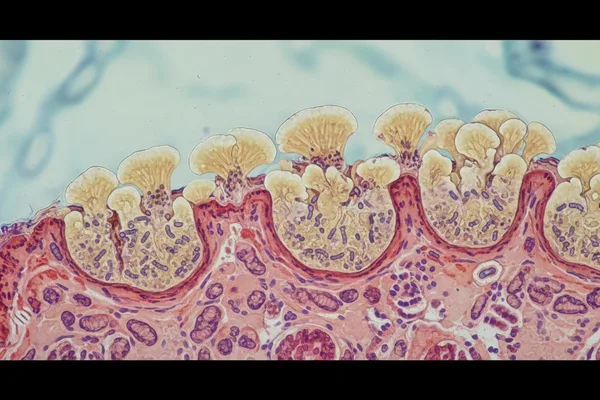
Simply put, 'Pseudomembranous Colitis' is a severe inflammatory condition that occurs in our large intestine, or colon. In this, for some reason (it could be bacteria, a toxin, or another disease), the inner wall of your large intestine, or the mucous membrane (`mucosa`), becomes damaged. This damage causes yellowish-white, thick, crusty plaques to form in the damaged areas. Doctors call these 'pseudomembranes'.
What are 'pseudomembranes'?
Pseudomembranes are what form when cells in the lining of the large intestine, such as the lining of the large intestine, die. Think of it this way: when there is an injury, our immune system sends white blood cells to the site. Similarly, here too, dead cell fragments combine with white blood cells (especially neutrophils) to form pseudomembranes. These are about 2 centimeters wide, yellowish-white, and slightly raised layers on the surface.
What are the symptoms of this condition?
A person with pseudomembranous colitis may experience symptoms such as:
- Severe abdominal pain.
- Diarrhea. This can occur several times a day, sometimes as a liquid.
- Fever.
- Nausea.
- Sometimes, you may see blood or pus coming out of your stool, but this doesn't happen to everyone.
What causes Pseudomembranous Colitis?
The main and most common cause of this is infection with the bacteria `C. diff` (Clostridioides difficile). The toxins produced by this bacteria damage the lining of the large intestine. About 10% of `C. diff` infections can progress to a more serious condition called `pseudomembranous colitis.` In fact, 90% of these cases are caused by the `C. diff` bacteria. However, other inflammatory bowel conditions can also cause this type of damage.
How does the C. difficile bacteria affect this?
The bacteria C. difficile produces toxins that destroy the cells lining our large intestine. This infection can spread more quickly and severely than you might think.
Most often, a C. diff infection occurs after you take antibiotics for another illness. Think about it, when you take antibiotics, the other "good" bacteria in your gut that help you get better are killed. However, most antibiotics can't kill the C. diff bacteria. So, when those good bacteria are gone, the C. diff bacteria have no competition, grow rapidly, and spread unchecked, causing these problems.
What antibiotics are most effective in this condition?
In fact, any antibiotic that kills the good bacteria in our intestines and does not affect the C. diff bacteria can cause a C. diff infection and the resulting pseudomembranous colitis. However, some antibiotics are thought to pose a higher risk. Some of them are:
- Clindamycin
- Cephalosporin class of drugs
- Penicillin group of drugs
- Fluoroquinolones
- Aztreonam
- Carbapenems
Important: This is not to say that these antibiotics are bad. If a doctor prescribes them, they should be used as needed. However, using antibiotics unnecessarily can lead to risks like these.
Are there other reasons?
Pseudomembranous colitis can also occur when inflammation of the colon caused by other causes, other than C. diff. Here are a few examples:
- Staphylococcus aureus infection
- E. coli infection `(E. coli infection)`
- Cytomegalovirus infection
- Microscopic colitis
- Behçet's disease
- Ischemic colitis (inflammation caused by decreased blood supply to the colon)
- Anti-cancer drugs `(Chemotherapy drugs)`
- Cocaine use
- Vasculitis (inflammation of blood vessels)
- Heavy metal poisoning
In such cases, the disease is more severe or complicated than a normal colitis. Sometimes, the blood flow to the inner wall of the colon is reduced (ischemia), tissue death (necrosis) occurs, and pseudomembranes develop. Also, pre-existing diseases such as Inflammatory Bowel Disease (IBD) can also make the colon more susceptible to this condition.
Who is at higher risk of developing this condition?
You are more likely to develop pseudomembranous colitis if you:
- If you are hospitalized.
- If you have recently used antibiotics.
- If you have recently undergone surgery.
- If someone stays in a nursing home.
- If you are over 65 years old.
- If you have an autoimmune disease.
- If your immune system is weak.
- If you have already had a C. diff infection.
What are the possible complications of Pseudomembranous Colitis?
If this condition becomes severe and difficult to control, some dangerous complications can occur. So it's important to be aware of this as well.
- Dehydration and electrolyte losses: In severe pseudomembranous colitis, diarrhea can occur up to 10-15 times a day. This can lead to dehydration and electrolyte losses. This can lead to dangerous conditions such as low blood volume, low blood pressure, and kidney failure.
- Fluid leakage: Fluid can leak from the damaged wall of the large intestine into the abdominal cavity, causing the abdomen to swell. This is called ascites. Proteins such as albumin can also be lost from the large intestine. When albumin is low, fluid leaks out of the blood vessels, causing swelling in the limbs (edema).
- Toxic megacolon: A severe, uncontrolled inflammation of the colon that can cause the colon to swell excessively and stop working. Initially, the muscles in the colon stop contracting, blocking the passage of stool. As the colon continues to swell, its walls can rupture, allowing the contents to leak into the abdominal cavity. This is called peritonitis. This can be life-threatening.
- Gastrointestinal perforation: A hole in the wall of the large intestine can occur without toxic megacolon. This can happen if ulcers develop in the large intestine and go through the wall, or if there is significant tissue death (necrosis) in the large intestine wall. When bacteria in the large intestine leak into the abdominal cavity (peritonitis), they can spread into the bloodstream (septicemia).
- Sepsis: Sepsis is a condition caused by the accumulation of bacteria in the blood (septicemia). Sepsis is a severe, life-threatening infection that spreads throughout the body. This can lead to septic shock, multiple organ failure, and even death.
These complications can be scary to hear about. But remember, they don't happen to everyone. Early diagnosis and proper treatment can prevent these serious conditions.
How to diagnose this disease?
A doctor will first ask you about your symptoms and your health history. Then, they may order various tests to find the cause of your symptoms. For example, they may order blood tests, imaging tests such as scans, and poop tests. These tests look for infection, inflammation, and other risk factors.
Your stool test will specifically check for a C. diff infection. If it is found, treatment will begin immediately. If you have no complications and are responding well to treatment, there may be no specific reason to look inside your large intestine for pseudomembranes.
Sometimes, imaging tests (such as a CT scan) can show signs of pseudomembranous colitis. If the colon wall is thickened (similar to a "thumbprint sign" or "accordion sign"), the doctor may decide to do further tests.
Next, to look deeper, you need to do a test that looks inside the large intestine. It's called a colonoscopy. In this, a tube with a camera is used to look inside the large intestine. If you see the so-called 'pseudomembrane', a small piece of tissue (a biopsy) is taken from it and sent to a laboratory to confirm the disease.
What are the treatments?
Treatment depends on the cause of this disease.
- If it's a bacterial infection like C. diff, you'll need to give specific antibiotics that work for it.
- If this condition is caused or worsened by another medication you are taking, that medication may need to be stopped or changed.
- In some cases, medications may be prescribed to reduce inflammation in the large intestine.
Some people only need supportive care. For example, intravenous fluids (IV fluids) to help with fluid retention, or IV nutrition to help the colon rest. Others may need to be treated for complications, possibly in an intensive care unit. Some people with very severe colitis or complications may need to have a colectomy (surgery to remove the damaged part of the colon).
What are the main medications given if it is caused by `C. diff`?
If the cause of pseudomembranous colitis is a C. diff infection, there are several medications available to treat it. Your doctor will choose the one that is best for you. The medications given for C. diff infection are:
- Metronidazole
- Vancomycin
- Fidaxomicin
Can Pseudomembranous Colitis be prevented?
The most important way to prevent this disease is to control the spread of C. diff bacteria in high-risk communities (especially hospitals and nursing homes). People in these settings are more likely to become infected and develop severe symptoms such as pseudomembranous colitis.
Therefore, healthcare workers in these types of institutions take special steps to control C. diff infection:
- Isolation: People infected with C. diff are placed in a separate room, or in a room shared only with other infected people. Disposable gloves are used when entering the room.
- Handwashing: Washing your hands frequently with soap and warm water is the best way to protect yourself from C. diff. This bacteria is resistant to hand sanitizers. It is especially important to wash your hands before handling food.
- Disinfection: Regular disinfectants cannot kill C. diff. However, chlorine-based products can. It is important to thoroughly disinfect all surfaces that the infected person has come into contact with.
Can this disease be completely cured? What is the mortality rate?
Yes, pseudomembranous colitis can be completely cured with treatment. In most cases, symptoms will go away quickly. However, some people may need more treatment and longer periods of time than others. If you have a persistent, difficult-to-control C. diff infection, you may need to undergo a minor surgery to treat it. In some cases, surgery may be necessary.
In terms of mortality, only 2% of patients with pseudomembranous colitis die. However, in people with long-term care and weakened immune systems, this rate can be as high as 15%. If the previously mentioned complication called toxic megacolon occurs, the mortality rate can rise to 35%. That is why prompt treatment is important.
When should you see a doctor?
If you have any of these symptoms, seek medical advice immediately:
- Severe stomach pain or bloating.
- If you have diarrhea more than five times a day.
- If there is blood in the stool.
- If you haven't had a bowel movement for three days.
- If you haven't urinated for a day, or if your urine is dark in color.
- If you have a fever of more than 39 degrees Celsius (102 degrees Fahrenheit) for three days.
Finally, things to remember
Bacterial infections that cause colitis are common, and most of the time they are not serious. Not everyone who gets C. diff will develop pseudomembranous colitis. However, if you do, it can be a bit scary. Knowing that your colon is being damaged from the inside can be scary, with symptoms like pain and bleeding.
If you have these symptoms, you need special medical attention. But remember, with proper treatment, your colon can heal. The lining of our colon, like the lining of our colon, heals well when the damage stops. If you feel like your colitis symptoms are not getting better, talk to a doctor. He or she can help you find the cause of your condition, do what you can to stop it, and give your colon the rest it needs. The most important thing is to not panic and seek medical advice quickly.
` Pseudomembranous Colitis, C. diff, diarrhea, stomach ache, colitis, antibiotics




💬 Comments (0)
No comments yet. Be the first to share your thoughts here.
Add Your Comment