
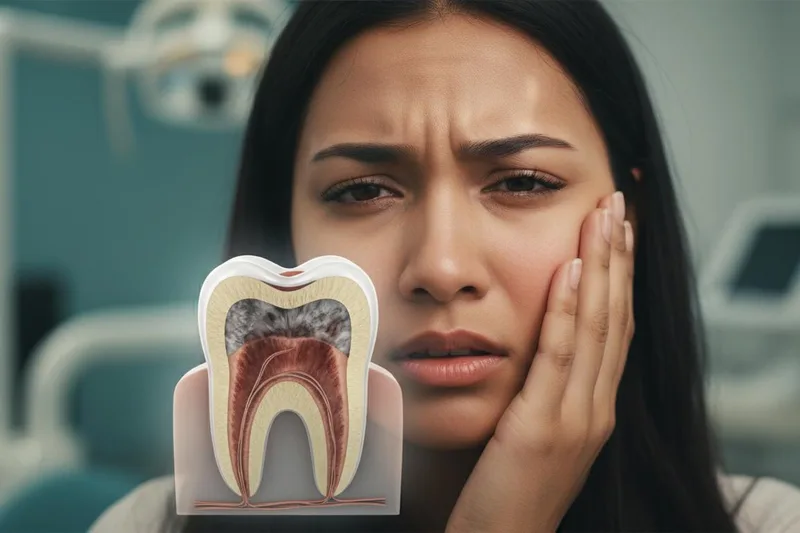
Have you ever suffered from a severe toothache? Sometimes it starts as a minor toothache and then becomes unbearable. In such cases, the important part inside your tooth, the pulp, may have been damaged. Today we are going to talk about this condition called pulp necrosis , or as doctors call it.
What exactly is Pulp Necrosis?
Simply put, pulp necrosis is the death of the vital tissue inside your tooth, the pulp . Think about it, a tooth is not just a rock. The hard white part at the top of the tooth is called enamel . Underneath this enamel is the pulp. This runs all the way down to the root of the tooth. Inside this pulp are blood vessels , nerves, and many other types of cells that help keep the tooth healthy. Like the roots of a tree, this pulp nourishes the tooth and keeps it alive. So when this part dies, the problem begins.
How does this condition (Pulp Necrosis) develop?
This is because the tooth pulp doesn't die all at once. It happens in stages.
Imagine that you have a cavity in your tooth, or what we call a cavity, or a small crack in your tooth. What happens is that bacteria in your mouth easily find a way to get into the pulp. When these bacteria get inside, the pulp starts to swell and turn red. We call this inflammation , or as dentists call it , pulpitis .
Teeth have an amazing ability to heal themselves from this condition (Pulpitis). However, if we ignore it and do not treat it, (Pulpitis) will gradually worsen and eventually the pulp of the tooth will die, which is called (Pulp Necrosis). There are three main stages of this:
1. Reversible Pulpitis: At this point, the pulp of the tooth has been damaged, but it is not yet dead. If a dentist can clean, fill, and seal the cavity, the tooth can be restored to its normal condition. This usually causes a sharp pain when eating, drinking, or eating something cold or sweet, but it quickly goes away. There is no sensitivity to hot things.
2. Irreversible Pulpitis: Here, the inflammation has become more severe. The tooth is no longer able to heal on its own. The pain is more severe. It may be a dull ache, a throbbing pain, or a sharp pain. It may last for half a minute (30 seconds) or more when exposed to cold, hot, or sweet things.
3. Pulp Necrosis: This is the final stage. The pulp tissue is completely dead. The strange thing here is that sometimes you may not feel any sensation to cold, heat, or sweet tastes because the nerves in the tooth are dead. However, you may feel pain if the dentist taps the tooth.
The most important thing: If this infection is left untreated, it can spread beyond the tooth root, to your jawbone, neck, and even your chest. If that happens, it can be a very dangerous situation, remember.
How common is this condition (Pulp Necrosis)?
Pulp Necrosis is a condition that is more common than you might think. But it is difficult to say exactly how many people develop it. However, we can get a rough idea by looking at the number of root canal treatments . Because, most of the time, root canal treatment is done as a treatment for pulp necrosis. According to the American Association of Endodontists, about 15 million root canal treatments are performed every year! This number is also significant in Sri Lanka.
What are the symptoms of this? How do we recognize it?
The main symptoms of pulpitis and pulp necrosis are toothache and sensitivity . However, the nature of the pain and sensitivity you feel may vary depending on the condition mentioned above.
- In reversible pulpitis:
- Drinking something cold or eating something sweet can cause a brief, sharp pain , but it quickly goes away.
- Usually, I'm not very sensitive to hot things.
- In case of irreversible pulpitis:
- This can be a low-grade ache , a throbbing pain , or a sharp pain .
- The pain can last for 30 seconds or more after you put something cold, hot, or sweet in your mouth. Sometimes it hurts even when you just sit still.
- When the pulp of the tooth dies (Pulp Necrosis):
- Because the tooth nerve is dead here, you may not feel any sensitivity to cold, heat, or sweet tastes .
- However, if the doctor taps the tooth, you may feel some pain.
- Sometimes the color of the tooth can change and even become a little darker.
- The gums around the tooth may swell and develop into an abscess.
What are the main causes of this condition (Pulp Necrosis)?
The main cause of this is cavities , or tooth decay. Most of us will develop a cavity at some point in our lives. If these are not detected and treated early, they can allow bacteria to enter the tooth pulp.
There are several other reasons:
- Cracked tooth: Just as a crack in a house wall allows insects to crawl in, a crack in a tooth can allow bacteria to enter the tooth pulp. These cracks are sometimes invisible to the naked eye.
- Dental procedures: When the same tooth is treated multiple times, or if a treatment is unsuccessful, the tooth is more likely to suffer from Pulp Necrosis.
- Trauma: If a tooth is hit hard, for example during sports or in an accident, the pulp can be exposed. Otherwise, the blood supply to the pulp can be cut off, causing the tissue to die.
- Worn tooth enamel: Some people brush their teeth too hard. Or there are those who have the habit of grinding their teeth at night (Bruxism) . Due to things like this, the protective covering on the tooth, that is, the enamel, wears away. Then, bacteria easily penetrate the tooth from those worn areas.
How is this condition (Pulp Necrosis) diagnosed?
If you have a toothache or sensitivity, you should first see a dentist. If he or she suspects that your tooth pulp is infected, he or she may refer you to an endodontist, a dentist who specializes in treating problems related to the pulp of your tooth .
Dentists and endodontists use several tests to diagnose this condition (pulp necrosis):
- Electric pulp testing: In this, a small device sends a very fine electrical pulse to your tooth. If you can feel it, the pulp is still alive. If pulp necrosis has occurred, you will not feel the electrical pulse.
- Heat or cold test: In this test, something hot or cold is applied to your teeth. The doctor will also ask about any sensitivity you feel when you eat or drink.
- Tooth tapping: The doctor will gently tap your tooth with a small instrument to see if you feel any pain.
- X-rays: X-rays of your teeth allow your doctor to see the structure of your teeth and jawbone. These images can show any cavities, cavities, or infected pulp.
How is it treated? What are the options?
The most important thing to know is that once the pulp tissue dies, it cannot be revived . Therefore, the doctor has to remove the dead tissue. If he doesn't, the infection can spread further and cause more damage.
There are mainly two treatment options:
1. Root Canal Treatment: This treatment can be performed by both general dentists and endodontists. This involves removing the dead tooth pulp, cleaning the root canal inside the tooth thoroughly, and then filling and sealing the empty root canal with a special material. After a few weeks for the tooth to heal, the doctor will usually place a crown , a cap that covers the tooth. This will strengthen the tooth.
2. Tooth removal / Extraction: This involves the complete removal of the tooth. After a tooth is extracted, talk to your doctor about the options for replacing the missing tooth with an artificial tooth, such as a dental implant or a dental bridge .
Sometimes, if you're taking a long time to heal, your doctor may prescribe antibiotics to stop the infection from spreading. But remember, antibiotics are not the main treatment for this. They're just a temporary solution.
What are the possible complications of pulp necrosis?
Complications occur when the infection in the pulp of the tooth spreads. If this infection reaches the tip of the root of the tooth, an abscess can form there. This is very painful.
There are several other dangerous complications:
- (Ludwig's Angina): This is a severe infection that spreads to the soft tissues under the tongue and into the neck. It can even cause difficulty breathing.
- Mediastinitis: This is an infection that spreads to the space around the organs in the chest. This can also be life-threatening.
- Osteomyelitis of the jaw: In this, the infection spreads to the jawbone itself.
These complications are very serious, which is why it is important to seek treatment as soon as a dental problem occurs.
How do we prevent this condition (Pulp Necrosis)?
The best solution is to prevent cavities and keep your teeth healthy. You can do the following:
- Brush your teeth twice a day. It is best to use a toothpaste that contains fluoride.
- Floss between your teeth every day. This removes food particles from places where a toothbrush can't reach.
- Visit a dentist at regular intervals to have your teeth checked and cleaned. It is generally a good idea to go at least once every 6 months.
- If you notice any symptoms, such as new tooth pain or sensitivity, do not ignore it and tell your doctor immediately.
- If you grind your teeth at night (teeth grinding / bruxism) , consider using a night guard . You can ask your doctor about this.
What can we expect in the future in the case of Pulp Necrosis?
If you recognize this condition early and get proper treatment, your outlook is very good. Even a tooth that has undergone root canal treatment can last for many years if taken care of properly.
However, if the infection spreads to your jawbone, neck, or chest, it can be serious. In the past, these conditions were life-threatening. However, with improved antibiotics, advanced X-ray and scanning technology, and surgical techniques, the chances of recovery from these conditions have increased significantly.
When should I see a dentist?
If you have any toothache , or if your tooth feels sensitive to cold, hot, or sweet tastes , don't ignore it and see a dentist right away . Early detection and treatment of conditions like pulpitis and pulp necrosis can stop the infection from spreading and reduce the risk of serious complications.
Finally, things to remember (Take-Home Message)
Okay, so I hope you now have a better understanding of what we talked about today (Pulp Necrosis).
Simply put, pulp necrosis is the death of the living tissue inside your tooth, the pulp. The main cause of this is untreated cavities and injuries to the tooth.
Remember:
- If you have a toothache or sensitivity, don't ignore it . See a doctor immediately.
- Treatment may include root canal therapy or tooth extraction .
- Prompt treatment is essential , as dangerous complications can occur if the infection spreads.
- The best way to prevent this is to take good care of your teeth . Brush your teeth twice a day, floss, and go for regular dental checkups.
Your teeth are your most valuable asset. So take care of them. If you have any other questions, be sure to talk to your dentist. Healthy smiles to everyone!
` Pulp Necrosis, Toothache, Root Canal Treatment, Root Canal, Dental Health, Tooth Infection


💬 Comments (0)
No comments yet. Be the first to share your thoughts here.
Add Your Comment