
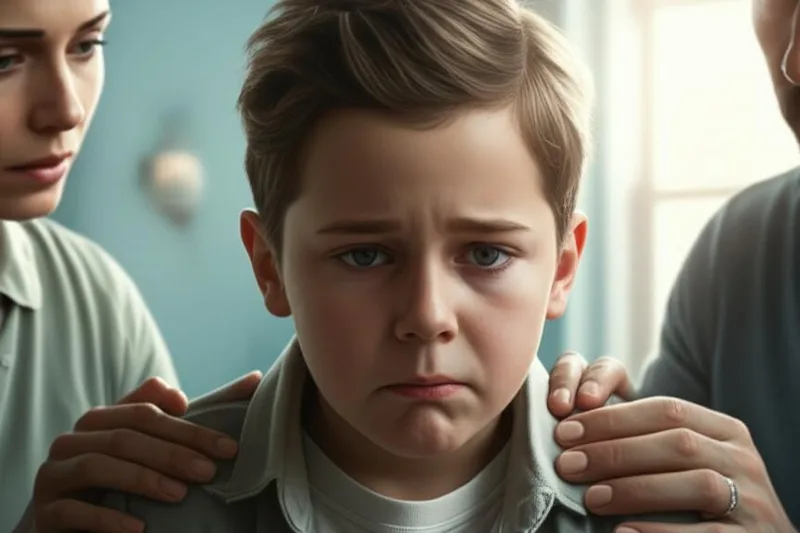
Imagine, your little baby is smiling, running and playing. You are happily watching every step of his development. Just when you think everything is fine, suddenly his gait changes, he starts falling frequently. Seeing something like that would scare any mother or father, right? This is about a few families who never gave up hope despite facing such a heartbreaking experience. Their stories teach us a lot.
"Will's" Story: The Day Everything Changed
Will is a very mischievous, active, and outgoing little boy. According to his mother, Casey, every milestone in his development happened right on time. When Will was about two years old, he was walking and playing well, but for no apparent reason, he began to fall frequently. One day, he suddenly fell.
From that day on, Will's health began to deteriorate rapidly. After many tests, the doctors finally discovered that Will had a very rare disease. The disease was called `Leigh syndrome` .
Simply put, every cell in our body has little power plants called mitochondria that provide energy. In this rare disease called Leigh syndrome, these energy-generating centers don't work properly due to a genetic mutation. Will had a mutation in one of those genes, called SURF1. This condition belongs to a larger group of diseases called mitochondrial diseases.
Casey recalls that time with great emotion. "It was a very difficult time in our lives. While one of my children couldn't walk, my other child was learning to walk." Imagine how that mother must have felt.
A battle beyond parenthood
When this happened to their child, Casey and her husband, Doug, didn't just sit back and watch. They began researching everything there was to know about the disease. As Casey says, "When you hear about a rare disease like this, it feels like your whole life is falling apart in front of you... and then you have to learn everything there is to know about your child's disease. It's like going to medical school and taking a whole new course."
When they realized how little information and resources were available about the disease, they joined forces with other families with children with the same condition and started the "Cure Mito Foundation." The goal of this foundation was to help find a treatment or cure for Leigh syndrome.
"A family of a child with a rare disease, in addition to taking care of the child, we are the main advocates for them, being nurses at night, raising millions of dollars. We don't even know if these things will work. But, we try." - Casey Wollaben
Look at the challenges parents like these face and the enormous role they play.
| Challenges faced by parents of a child with a rare disease | The different roles they play |
|---|---|
| Lack of accurate information and resources about the disease. | Researcher: Learning about the disease on your own. |
| High financial costs for treatment and support services. | Fundraiser: Seeking money for research. |
| Severe emotional stress and social isolation. | Advocate: Advocate for the rights and interests of the child. |
| Specialized medical care that is needed 24 hours a day. | Nurse: Providing medical care to the child at home. |
"Sophia" who turned pain into strength
The story of a mother named Sophia Silber is also related to this. She is also on the board of directors of the `Cure Mito` Foundation. Six years ago, her little daughter Miriam, a few weeks after birth, passed away from `Leigh syndrome`. The shock of that sudden, unexpected death was so great that Sophia says that the event divided their lives into two parts: `before` and `after`. "Every word, every minute of that time is forever in our hearts," she says.
But she didn't stop there. She used her professional knowledge (clinical trial data analysis) to create a patient registry that would collect information about patients with this disease around the world. She has volunteered thousands of hours for this.
Why is a patient registry like this important?
Imagine, because these diseases are so rare, no single doctor will encounter a large number of patients like this. So the best information about how the disease develops, its course, and how symptoms change lies with the patients and their families. When this information is gathered in one place, it becomes an invaluable resource for researchers looking for new drugs. It paves the way for new treatments.
Legacy of Hope
Let's go back to Will's story. Today, Will is 11 years old. Although he can't walk, talk, or eat by mouth, his condition is stable. Most importantly, his mental abilities are still very good. His mother says that he is most interested in science. During a recent video call, he smiled and gave a thumbs up to confirm this.
The Cure Mito Foundation, started by Will's parents, is now funding gene therapy and drug repurposing research to see if other existing drugs can be used to treat the disease.
That means that what we do in Will's name could save the life of another child with this disease in the future. That's the legacy he leaves behind. These stories tell us that no matter how difficult the situation, if we come together and work with hope, we can make a big difference. The fight these parents are fighting for their child is creating a future for thousands of other children.
Take-Home Message
- Being diagnosed with a rare disease is not the end of life. Knowledge, unity, and hope are your greatest strengths.
- If you notice any unusual, unexplained changes in your child's development or behavior, don't ignore it. Seek advice from a qualified doctor immediately.
- Our support and understanding are very important to families living with these conditions. Don't marginalize them, but be their strength.
- The experiences and information of patients and their families are an invaluable resource for research to find new treatments.


💬 Comments (0)
No comments yet. Be the first to share your thoughts here.
Add Your Comment