
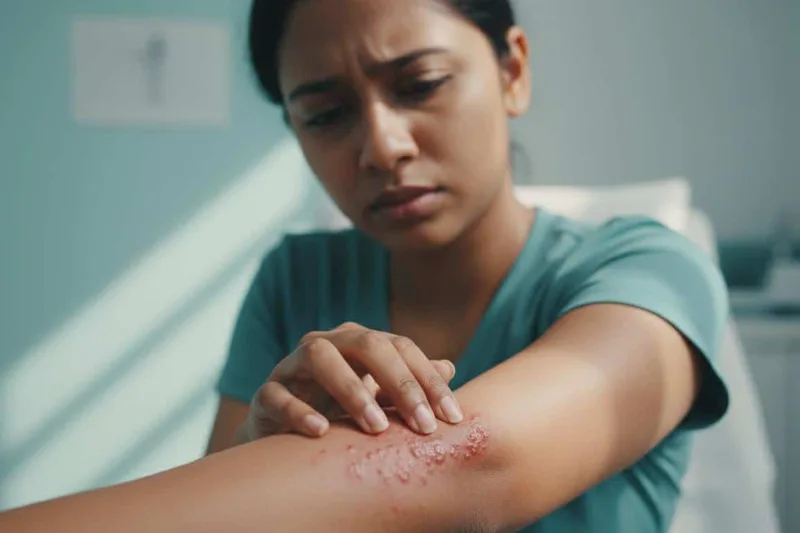
Have you ever noticed that your skin, or that of someone you know, suddenly turns red, breaks out into small blisters, and sometimes itches unbearably? Or sometimes it hurts? These are the things we simply call a skin rash . This is actually a very common thing that happens to many people. So before you panic, let's talk about this in a little more detail.
What exactly is a skin rash? How common is it?
Simply put, a skin rash is when our skin becomes red, swollen, and sometimes has small blisters or bumps. Some types of skin rashes are very dry and itchy. Others can even hurt. There are many reasons for this. For example, various types of viruses , bacteria , things we are allergic to (allergens ), or skin conditions like eczema .
Think about it, have you ever had a minor skin rash or itch? Almost everyone has had a minor skin rash at some point in their life. So it's very common. It's normal for the skin to become red, itchy, and itchy for a while.
Who is most likely to get this (skin rash)?
Actually, there is no age limit for this. Anyone from small babies to elderly grandparents can get skin cancer.
- For young babies: Diaper Rash (a rash caused by nappies) and Cradle Cap (a crust on the scalp ) are common in them.
- Young children: They are more likely to develop rashes caused by viral infections, such as Atopic Dermatitis (also a type of eczema) and Fifth Disease .
- For young children and adults: Over time, the skin becomes sensitive to certain allergens or irritants, which can lead to conditions such as contact dermatitis (inflammation of the skin caused by contact with something).
What are the main types of skin rashes?
There are not just one or two types of skin tags, there are many. Let's take a look at the main ones:
(Contact Dermatitis) - Inflammation of the skin caused by contact
This is when your skin reacts to something that your body doesn't like, that is, something you are allergic to. For example, some people can be allergic to perfumes, preservatives, nickel (this is often found in artificial jewelry), or certain poisonous plants (for example , Poison Ivy) . Also, the soaps, laundry detergents, various chemicals, and household cleaning products we use can sometimes be harmful to the skin and cause this kind of damage.
(Eczema) - Eczema (atopic dermatitis)
This is also called Atopic Dermatitis . It often starts in childhood, but it can sometimes get better as the child grows older. It may also be a genetic condition. People with asthma or other allergies are more likely to develop eczema.
(Hives) - Urticaria
This is also called Urticaria . This is when the skin becomes red, swollen, and itchy, like welts. You can get hives as an allergic reaction to things in the air or when you get an insect bite. It can also be caused by sudden changes in temperature or some bacterial infections.
(Psoriasis)
This is a skin disease that can last a lifetime. It causes thickening of the skin, scaly patches. These patches are most often seen on the elbows, knees, lower back, scalp, and genital areas. Psoriasis can also be hereditary.
Viral Rashes
A common symptom of some viral diseases is a rash. For example, chickenpox , measles , and molluscum contagiosum can cause rash.
Why do we get this (Skin Rash)? What are the causes?
As we've discussed before, there can be a number of reasons why skin lesions develop. The main ones are:
- Allergens in the environment: Some people may be allergic to things like pollen, dust, and animal dander.
- Bacterial infections: For example, things like strep throat can sometimes cause skin lesions.
- Skin conditions such as eczema.
- Irritants: Harsh soaps, chemicals, etc.
- Viral infections (Viruses).
What are the symptoms of a skin rash?
The symptoms of a skin rash vary depending on the cause and type. These rashes can occur in just one area of the body, or they can spread throughout the body. Symptoms of a skin rash include:
- Dry skin.
- Bubbles .
- Skin spots .
- A burning or stinging sensation on the skin.
- Peeling or flaking of the skin.
- Hives- like rash.
- Skin inflammation or swelling .
- Starting to itch .
- Feeling pain .
- Redness of the skin.
How does a doctor accurately diagnose this (skin rash)?
Because there are so many causes of skin lesions, it can sometimes be difficult to identify exactly what they are. Your doctor will first examine your lesions, ask about your symptoms, and take a look at your medical history. In addition, they may also do tests such as:
- Biopsy: In this procedure, the doctor takes a small sample of your skin or other tissue and tests it for viruses or bacteria.
- Allergy Test: These tests can help identify allergens . Skin Prick Test and Patch Test are two main types of tests. Prick Testing helps diagnose conditions like Urticaria , while Patch Testing helps diagnose Contact Dermatitis . In these tests, the doctor exposes your skin to a small amount of the allergen and sees if you have a reaction. You may be tested for just one allergen or for multiple allergens at once. If your skin becomes red, swollen, or itchy, it means you are allergic to that substance.
- Blood Tests: Some skin conditions are caused by antibodies in your blood. These can be detected through blood tests. Some rashes can also be a symptom of another systemic illness. In that case, blood tests may also be done to see if other organ systems are affected.
How do you treat a skin rash?
Skin lesions are treated depending on the cause. Sometimes, it can take several weeks for the lesions to heal. The main treatments for skin lesions are:
- Allergy medications: Oral antihistamines reduce itching.
- Anti-inflammatory creams: Creams containing hydrocortisone (e.g. Cortizone®) relieve inflammation and itching.
- Immunosuppressants: If the skin rash is caused by eczema or an immune system response, medications are given to reduce that response. This can reduce inflammation (irritation).
- Oatmeal baths: Soaking in warm water with colloidal oatmeal (available at pharmacies, e.g. Aveeno®) can help soothe dry, itchy skin.
- Steroids: If symptoms persist, your doctor may prescribe a topical steroid cream or an oral steroid , such as prednisone . Steroids reduce inflammation and itching.
- Topical immunomodulators: These medications work by changing how your body's immune system responds to allergens. These medications, which are available by prescription, include Tacrolimus ointment - Protopic® and Pimecrolimus skin cream - Elidel® .
What are the possible complications of skin rash?
Skin tags are a very annoying and sometimes unsightly condition, but they often resolve with treatment. Serious problems are rare. However, they can cause:
- Anaphylaxis: A severe allergic reaction can cause a life-threatening condition called anaphylaxis, which can include skin rashes and swelling. Angioedema , which can cause airway obstruction, can also occur. A person experiencing anaphylaxis should be given an epinephrine injection (EpiPen®) immediately to control this allergic reaction.
Important: If you have ever had a rash that feels like your throat or mouth is swelling, be sure to talk to your doctor about whether you need to carry an EpiPen® .
- Infection: When you scratch a pimple, the skin is broken and germs can enter. This increases the risk of bacterial skin infections.
How can I prevent this (skin rash) from developing?
By following these steps, you can reduce your risk of developing skin damage:
- Avoid things you are allergic to or know are harmful to you (e.g., allergens , irritants ) as much as possible.
- Do not share personal items or clothing with someone who has a contagious virus.
- Use mild, fragrance-free, hypoallergenic soaps, cleansers, and moisturizers.
- If you touch something you know you are allergic to or something that is harmful to your skin, wash your hands thoroughly immediately .
What is the prognosis of someone with a skin rash?
Depending on the cause, some skin lesions can be completely cured with treatment. However, lesions caused by skin conditions such as eczema and psoriasis can be long-term and recurring. They require ongoing treatment and care. Treatment can relieve pain, inflammation, and itching.
When should I see a doctor?
If you have any of these symptoms, you should see a doctor immediately and seek emergency treatment :
- If you experience severe difficulty breathing along with the rash (this may be a sign of anaphylaxis ).
- If the damage suddenly appears.
- If the lesions have spread throughout the body .
- If the plague spreads very quickly .
- If there is a fever along with the rash.
- If there are blisters or open wounds .
- If the wound looks infected (red, warm, swollen, and has yellow pus).
What should I ask the doctor?
If you have a skin rash, you can talk to your doctor about these things:
- Why do I have skin lesions like this?
- When will these wounds heal?
- Should I get an allergy test?
- What are the best treatments for these skin lesions?
- What can I do to prevent skin lesions?
- What are the best treatments for itchy, painful sores?
- What are some good over-the-counter cleansers and moisturizers?
- Should I be concerned about symptoms of complications?
Finally, things to remember (Take-Home Message)
How much a skin rash affects your life depends on what's causing it. While it's hard to avoid things like viruses and bacteria, you can avoid things you know are allergic to or harmful. Whatever the cause, most skin rashes, while annoying, can be treated.
Some skin conditions, such as psoriasis, can last a lifetime and require more attention. Your doctor can help you determine the exact cause of your skin problems. You can also talk to him/her about how to reduce your exposure to triggers. Your doctor can also develop a treatment plan that is tailored to your symptoms and the type of skin problem you have. So, if you have a skin problem, don't hesitate to seek medical advice.
` Skin diseases, skin diseases, allergies, eczema, psoriasis, skin itching, skin treatment


💬 Comments (0)
No comments yet. Be the first to share your thoughts here.
Add Your Comment