
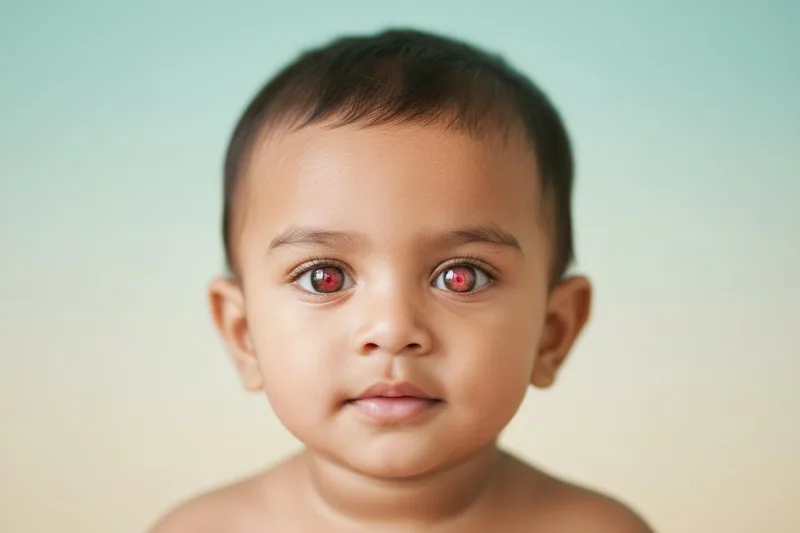
Have you ever taken a photo of your baby or other small child with the flash on? You may have noticed that sometimes the baby's eyes glow red. Some people get a little worried when they see this, thinking, 'Why are these eyes red? Is there something wrong?' But most of the time, this is nothing to worry about. Today, we're going to talk about this so-called 'red reflex'. Let's find out exactly what it is, why it happens, and whether it's a problem or not.
What exactly is 'Red Reflex'?
Simply put, the 'Red Reflex' is the red color seen through the iris when light hits the back of the eye and is reflected back. Pediatricians will definitely check for this 'red reflex' when you take your little one to the monthly clinic, or when you go to see a doctor to check their development. Also, as we mentioned earlier, this is something that is often seen when taking photos with the flash on.
However, although this is called the 'red reflex', even in a healthy person, it does not always appear red. Therefore, some medical experts also suggest using the name 'Fundus Reflex' for this. 'Fundus' is the medical term for the part of the eye that is at the back of the eye. So in this article, we may use that name in some places.
Why does this look red? Or how does this happen?
This is very simple. Imagine, a light falls on your eye. That light goes inside the eye, hits the tissues at the back of the eye, that is, the ``fundus'', and is reflected back. That reflected light is what we see through the black ring of our eye. It is like light reflecting off a mirror.
Does this look red to everyone's eyes?
Here's an important question. Many people think that everyone should see this as red. But the truth is, the color of this 'fundus reflex' can vary from person to person. The main reason for that is skin color. As the skin color becomes darker, the tissue behind the eye inside the eye may also become a little darker. Then the color of the reflected light also changes.
Simply put, a healthy 'fundus reflex' can appear in a variety of colors, such as:
- For those with light skin: Most often, it appears in the red to orange range.
- For people of Asian descent, or those with medium skin tones: It can appear orange to yellow.
- For black people, or those with very dark skin: This can appear dark, sometimes even greenish or blue.
So, don't worry if your baby's eyes are a different color than red in a photo. It's likely normal.
How can we see this 'fundus reflex'?
Nowadays, the easiest way to see this is to take a photo with a flashlight in a dark place. Because our eyes need to see clearly in the dark, the iris of the eye gets bigger. Then the light from the flash used to take the photo goes through the enlarged iris and into the eye, and is reflected back. This happens before the iris shrinks back down.
Photographers call this the 'red eye effect'. Professional photographers try to remove this from their photos. Many smartphone photo apps these days even have methods for removing this 'red eye'.
When should we be concerned about the 'Red Reflex'?
This is the most important point. The 'fundus reflex' is a very important test that can be used to determine the health of the eyes of young children, especially newborns. Because it can detect some vision impairments, certain eye conditions, and sometimes even serious diseases early.
If there is a problem, there are several main ways to look at the 'fundus reflex' in a different way:
- Leukocoria: This means “white eye.” In this condition, the fundus reflex appears light, yellow, or white. This is because light is being reflected through something other than the fundus inside the eye. Very rarely, this can be a sign of a type of eye cancer called retinoblastoma. It can affect one or both eyes. It affects about 1 in 15,000 newborns.
- Weakened reflection on one side: The 'fundus reflex' should be the same in both eyes and be clear. Sometimes, depending on the angle of view or the lighting, one side may be slightly less visible. However, if the reflection in one eye consistently looks different from the other, it is a matter of concern.
- Lack of a fundus reflex in one eye: If the fundus reflex is visible in one eye, but not in the other eye at all, this may also be a sign of a problem.
Should you be worried if you see a change in a photo?
The most important thing to remember here is that the 'fundus reflex' is something that trained doctors look at using special equipment, such as an 'ophthalmoscope'. Although we can see this in photos, it is not a good idea to panic just because you see a difference in one photo.
There are several reasons for that:
- Structure of the Eye: The transparent part at the front of our eye, the 'cornea', can also reflect light. That reflection can sometimes appear as a light color. But it is not a reflection coming from inside the eye.
- Viewing angle: The way the 'fundus reflex' appears changes depending on the angle we view it from. So, even if there is a difference in one photo, it is not something to worry about unless it is consistently visible in several photos.
- Distance: Doctors observe this 'fundus reflex' from a distance of between 1.5 and 3 feet (0.45 - 0.9 meters). It is not as clear from further away. If there is a visible image from a great distance, it is probably a reflection from the front of the eye.
What should I do if I see something strange in my baby's 'red reflex'?
If you notice something unusual in your baby's (or a child you care for) fundus reflex, it's normal to feel scared, worried, or anxious. But remember, don't panic just because you see one photo. There can be many reasons why a fundus reflex might look unusual in a photo.
However, if you consistently see the same change in multiple photos, or if you have any concerns, it's best to call your child's pediatrician, explain what you've noticed, and schedule an appointment to have your child examined. The doctor can check your child's fundus reflex to determine if there's anything to be concerned about.
This test only takes a few minutes. In most cases, no dilation is needed, and it is not painful. If the doctor feels that something needs further attention, he or she will refer you to an eye care specialist.
Are there any smartphone apps that can view 'Red Reflex'?
The answer to this is both yes and no. There have been apps that could be used for this kind of thing in the past, but they were mostly for research purposes. You may still be able to find some, but there are currently no apps that have been approved by government authorities for medical purposes. New apps are coming out all the time, but it's not a good idea to rely on them alone.
If you ever have a question about your child's eye health, be sure to see a pediatrician or other qualified doctor. Apps can sometimes help diagnose certain things, but never use apps as a substitute for seeing a trained, qualified doctor.
Take-Home Message
Okay, so let's remind ourselves of some of the most important facts about the 'Red Reflex' or 'Fundus Reflex' that we talked about.
- This refers to the appearance that occurs when light falls on the eye, is reflected from the back of the eye, and is visible through the black iris of the eye.
- This test is very important for early detection of serious eye conditions in children, especially young children, such as rare eye cancer (Retinoblastoma).
- If you have any concerns about the color of light reflected from your child's eyes, or anything unusual about their appearance, don't panic and see a pediatrician.
- A simple eye exam and 'Fundus Reflex' test can identify any problems early and clear up any doubts you may have. Remember, early detection is the best!
So, I hope you have a good understanding of the 'Red Reflex'. I hope this information is useful to you!
` Red reflex, fundus reflex, red eyes, baby eyes, eye health, leukocoria, retinoblastoma


💬 Comments (0)
No comments yet. Be the first to share your thoughts here.
Add Your Comment