
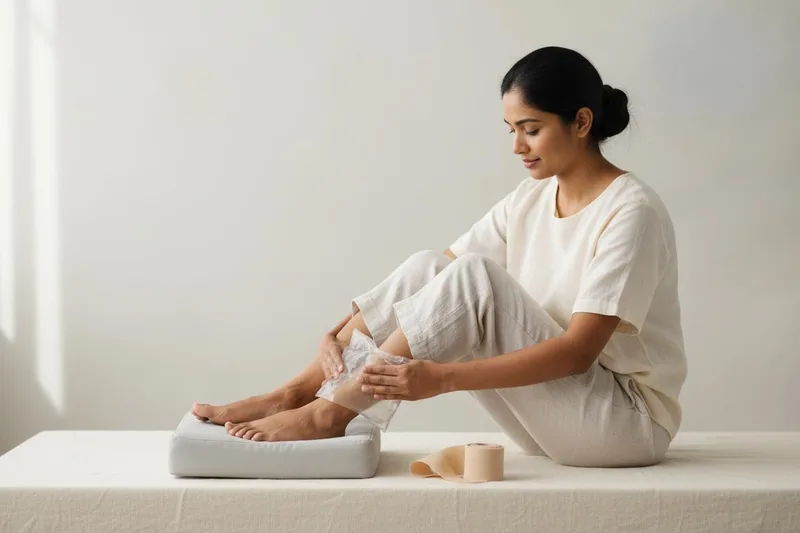
We've all sprained our ankles, pulled a muscle, or injured our limbs at least once in our lives, right? These things can happen while playing cricket, going down stairs, or even just walking down the street. RICE is a very simple first aid method that many people use to quickly reduce the pain and swelling that you feel at times like these, and it's also recommended by doctors. Let's see how to do it exactly, and what new facts you need to know about it?
What exactly is the RICE method?
Simply put, RICE is a set of four steps used to provide immediate relief from injuries to soft tissues such as our muscles, tendons, and ligaments. It is an acronym formed by combining the first letters of four English words.
This method is typically used for injuries like these:
- Sprains: A strain on a ligament in a joint.
- Strains: A pulled muscle or tendon.
- Contusions: Bruises caused by hitting something.
These are often sports-related injuries. It can also be used for repetitive strain injuries, which are injuries that occur from repeated motion. Sometimes, even in the case of a serious injury like a fracture, the RICE method can help control pain and swelling until medical attention is available.
What do the four letters in RICE stand for?
Okay, now let's see what the four steps are that are spelled out in these four letters RICE.
| Letter and meaning | What you need to do is simple. |
|---|---|
| R - Rest | Rest the injured arm or leg. Avoid putting any weight on the part that is moving the most. |
| I - Ice (Icing) | Apply ice to the injured area. You can use ice cubes or an ice pack for this. |
| C - Compression (applying pressure) | To control swelling, gently wrap the wound with something like a crepe bandage. |
| E - Elevation | Keep the injured arm or leg as high as possible above the heart. This can be done by placing a pillow on top. |
Let's look at these steps in a little more detail.
- Rest: Resting is a natural response of our body when we are injured. This is when the body has the opportunity to start the healing process. If you put weight on the injured leg again, it will delay the healing process and may even make the injury worse. Therefore, it is essential to rest for at least the first two to three days .
- Ice: This is called ``cryotherapy''. Applying ice causes the blood vessels in the area to constrict, reducing blood flow. This reduces swelling and pain. But never put ice directly on the skin . Wrap it in a thin cloth. Leave it on for about 10-15 minutes at a time, and repeat every two hours.
- Compression: We use a compression bandage for this. This applies gentle pressure around the wound to control swelling (edema). Do not wrap the bandage tightly. This can cut off blood flow and cause numbness. If your fingers start to feel blue or numb, loosen the bandage a little.
- Elevation: Keep your injured leg or arm elevated on two or three pillows, preferably above the level of your heart . This will help reduce the amount of blood flowing to the injured area due to gravity. This will help reduce swelling and any pain that may be felt.
Is the RICE method really good? What are the new ideas?
Although we've used the RICE method for years, there have been some mixed opinions about it recently. Some doctors say that inflammation is part of the body's natural healing process when you have an injury. They believe that controlling this swelling with ice and bandages can actually delay the healing process.
Therefore, doctors today recommend the RICE method with certain conditions. That is, you should use it, but be aware of its limitations.
New things to remember:
- Rest: It's not a good idea to completely rest for days. You should rest for the first couple of days and then slowly start moving the injured area until you don't feel any pain .
- Ice: Ice is best applied within the first 8 hours of an injury . It will help control pain and bleeding if there is any. However, prolonged use of ice can hinder the healing process.
- Compression: A bandage is not necessary for a minor wound, but if there is significant swelling or bleeding , it can help control it.
- Elevation: This won't hurt. If there's a lot of swelling, it can help reduce it.
This is why some doctors are suggesting newer methods such as MICE (Motion, Ice, Compression, Elevation) instead of RICE. All of them suggest that controlled movement helps in healing, rather than complete rest.
When should we definitely see a doctor?
Even if you can apply first aid at home using the RICE method, in some cases, you should definitely seek medical advice, as the internal injury may be more serious than it appears on the outside.
| If you have these symptoms, see a doctor immediately! | |
|---|---|
| Severe pain | The pain is so severe that even ordinary painkillers cannot control it. |
| Difficulty putting weight on/moving | If you cannot put weight on the injured leg, or if you cannot move your arm. |
| Shape change | If the injury site appears to have a protruding bone or is abnormally deformed. |
| Severe swelling and redness | If the area around the wound is excessively swollen, red, and feels hot to the touch. |
| Neurological symptoms | Numbness, tingling, or loss of sensation at or below the injury site. |
If you have these symptoms, do not stay home and immediately see a doctor or go to the nearest hospital's Emergency Treatment Unit (ETU) .
Are there alternatives to the RICE method? (MEAT and PEACE & LOVE)
Yes. After the first 72 hours of an injury, several protocols other than RICE are now recommended to help the healing process. Two of the main ones are MEAT and PEACE & LOVE.
MEAT method
- M - Movement: Gentle movements increase blood flow to the injured area and speed up healing.
- E - Exercise: Under the guidance of a physiotherapist, specific exercises are performed to strengthen the injured area.
- A - Analgesia: Use of painkillers to allow for healthy movement, if needed during the healing period.
- T - Therapy: Other long-term treatments, such as physical therapy, that are necessary for full recovery.
PEACE & LOVE method
This is a long two-part procedure.
PEACE (for immediate care):
- P - Protection: Protecting the wound.
- E - Elevation: Elevation to reduce swelling.
- A - Avoid anti-inflammatories: Avoid taking medications such as ``NSAIDs'' to allow the natural healing process to take place.
- C - Compression: Applying a bandage to control swelling.
- E - Education: Becoming aware of your role in the healing process.
LOVE (for the healing period):
- L - Load: Slowly begin to apply weight to the injured area.
- O - Optimism: Thinking positively about recovery.
- V - Vascularization (increasing blood supply): Increasing blood flow to the wound through exercise.
- E - Exercise: Exercise to regain strength and flexibility.
Take-Home Message
- RICE is a first aid method that can quickly reduce pain and swelling in the event of a soft tissue injury (sprains, muscle strains).
- This method is most effective within the first 24-48 hours after the injury.
- Don't overdo it when applying ice or wrapping a bandage. This can delay the healing process.
- If you have warning signs like severe pain, deformity, or numbness, don't stay home and see a doctor.
- In the case of any injury, it is best to consult your doctor for an accurate diagnosis and treatment plan.


💬 Comments (0)
No comments yet. Be the first to share your thoughts here.
Add Your Comment