
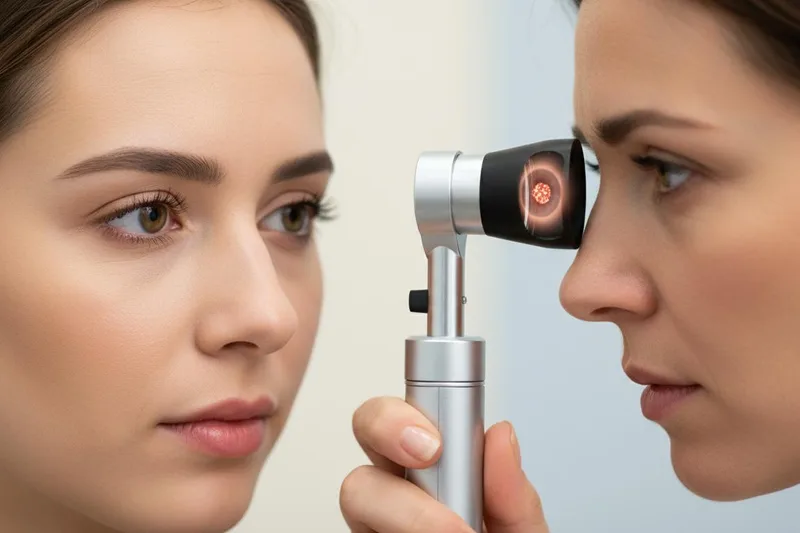
Have you ever had an eye check-up and the doctor looked inside your eye with a special instrument and said, "I see a little spot inside my eye"? It's normal to feel a little scared when you hear that. But don't worry. These spots, or 'Roth Spots', are signs that we don't usually see from the outside, but can be very important information about our health. So let's talk about this simply and politely today.
What exactly are Roth Spots?
Simply put, Roth spots are small hemorrhages that occur in the sensitive membrane inside our eyes called the retina. Think of our eyes as a camera. On the back wall of that camera is this membrane called the retina. This is where the images of the things we see are recorded.
There is a very fine network of blood vessels spread throughout the retina like a spider's web. If for some reason a small drop of blood leaks out of one of these blood vessels, that is what the doctor sees as a Roth spot.
The important thing is, you can't see these spots when you look in the mirror . And no one else can see them when they just look at your eyes. To see them, you need a special device, such as a slit lamp or an ophthalmoscope, which an ophthalmologist uses.
Usually, these spots do not affect your vision. However, very rarely, if these spots occur in the center of the retina, the part called the macula, which helps us see straight ahead, you may notice a slight change in your vision.
How do these spots look?
When the doctor looks through that instrument, a healthy retina usually appears as an orange-yellow color. A Roth spot stands out against this background in a dark color. It's a dark red, maroon-colored spot. There's a small white dot right in the middle of this spot.
The science behind this is very simple. The dark part is the blood that has leaked out of the vein. The white dot in the middle is a sign that the bleeding site has closed and is beginning to heal due to our body's natural blood clotting process (hemostasis). It's like putting a plaster on a small wound, which is what the body does from the inside.
Why do these Roth Spots occur?
In the past, in the 1800s, scientists first thought that Roth spots were caused by a condition called ``Infective Endocarditis.'' This is an infection that occurs inside the heart, especially the heart valves. This infection can be caused by things like bacteria and viruses.
Imagine that small infected blood clots formed due to this infection in the heart travel throughout the body with the blood. As they travel, this blood clot can get stuck in a very fine blood vessel inside the eye. Then that blood vessel bursts, bleeding, and then a Roth spot forms.
However, new research has found that `Infective Endocarditis` is not the only cause of Roth spots. In fact, it only accounts for a small percentage of cases, about 5%. Roth spots can be a sign of a much wider range of medical conditions.
Let's look at some of those reasons in the table below.
| Possible cause category | Examples |
|---|---|
| Blood disorders | Anemia, Thrombocytopenia |
| Cancers | Conditions such as Leukemia and Multiple Myeloma |
| Autoimmune diseases | Diseases such as Lupus (SLE), Behçet's disease |
| Diseases of the heart and circulatory system | High blood pressure (Hypertension) |
| Infections | HIV, Toxoplasmosis, Leishmaniasis, severe bacterial infections of the tooth roots |
| Metabolic conditions | Diabetes (Type 2 Diabetes) |
| Complications during pregnancy | Conditions like Preeclampsia and Eclampsia |
| Oxygen deficiency (Anoxia) | Carbon monoxide poisoning, being at high altitudes (above 12,000 feet) |
| Injuries | Head injuries (Concussions, Traumatic Brain Injuries - TBIs), eye injuries, Shaken baby syndrome |
How is this treated?
The important thing here is that there is no way to directly treat Roth spots because it is not a disease, but only a symptom of a disease.
Therefore, the treatment is not for the Roth spot itself, but for the underlying condition that caused it . For example, if the spot is caused by uncontrolled diabetes, the doctor will treat the diabetes to control it. If it is caused by high blood pressure, it will be treated. If it is caused by an infection, antibiotics will be given for that infection.
Your doctor will determine the best treatment for this. When the underlying cause is properly treated, these spots will gradually disappear.
What happens if left untreated?
Roth spots are like a warning sign. While the spot itself may not cause much harm, the underlying condition that causes them can often be serious and dangerous .
Imagine, if your eye doctor sees a spot like this, he will refer you to a primary care provider. Then, that doctor will conduct the necessary tests (such as blood tests, scans) to find out what the real cause of these spots is. Once the cause is found, he will either start treatment himself or refer you to a relevant specialist (e.g., cardiologist, oncologist).
So, if you notice a spot, don't ignore it. It's an important message your body is giving you. If you listen to that message and do what your doctor says, you can resolve it before it becomes a bigger problem.
Take-Home Message
- Roth spots are a type of spot that appears inside the eye. They are not a disease, but a symptom of another disease.
- You can't see or feel these things with a mirror. Only a doctor using special equipment can see them.
- If you see these spots, it means that there may be a health problem elsewhere in the body (e.g. diabetes, high blood pressure, infection, cancer).
- The most important thing is to not panic, see your doctor , find out the exact cause of these spots, and treat it.
- Once the underlying condition is treated, Roth spots usually go away on their own.


💬 Comments (0)
No comments yet. Be the first to share your thoughts here.
Add Your Comment