
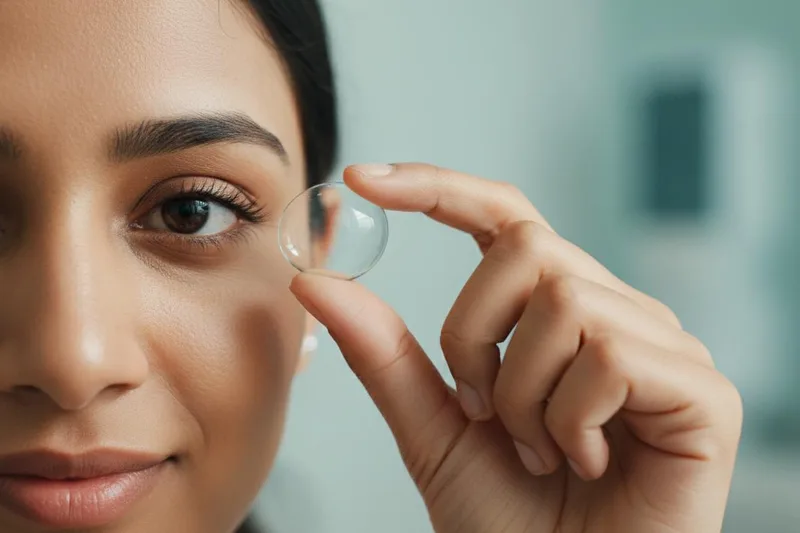
You've probably heard of contact lenses, or maybe you've used them. Most of the time, we see them as small, soft lenses that fit snugly over the black eye. But did you know that some people with certain eye conditions cannot wear regular lenses. Today, we're going to talk about a slightly different, special type of lens that can help in such cases. These are called scleral lenses.
So what are these scleral lenses?
Simply put, scleral lenses are also a type of contact lens that is worn on the eye. However, they are slightly larger than the soft contact lenses we usually see. And the biggest difference is that they do not rest directly on the sensitive black part of the eye (cornea).
Imagine that the cornea of your eye is like a small, spherical hill. A regular lens sits on top of this hill. But a scleral lens sits on top of this hill and rests on the surrounding white part of the eye (sclera). That's why it's called a "scleral" lens.
A small gap is created between this lens and the cornea. This gap is not just left there. Before we put this lens in your eye, we fill it with a special saline solution (preservative-free saline). What happens is that the entire time you wear it, your cornea is submerged in this solution. It's like a little fish in water. This provides amazing relief, moisture, and protection to the eye.
These are made of a special material that is a bit stiff, but allows oxygen to pass through. In medical terms, we call these 'Rigid Gas-Permeable' (RGP) lenses. Because they don't change shape, they can provide very clear vision even for people with irregularly shaped corneas.
Another thing is that because these lenses are large, their edges rest just below the eyelids. So they are less likely to fall off as easily as regular lenses, and there is less chance of dust and other objects getting into the eye.
In what situations are scleral lenses used?
Ophthalmologists recommend scleral lenses as a treatment for a variety of conditions. They are sometimes used to correct vision problems that cannot be corrected with glasses or regular contact lenses.
Let's see from the table below what kind of people these lenses are mainly useful for.
| Condition or cause | A simple explanation |
|---|---|
| Corneal Diseases | These are particularly effective for conditions such as Keratoconus , where the cornea protrudes forward in a cone shape. While regular lenses are not suitable for eyes with such an irregular shape, scleral lenses provide very clear vision. |
| Severe Dry Eye | For those who often experience dry, irritated eyes, the liquid inside these lenses can keep their eyes moist throughout the day. This provides great relief. |
| Severe Refractive Errors | These lenses can provide clear vision to people with high powers that cannot be corrected with regular eyeglasses or contact lenses. |
| Damage to the surface of the eye due to other diseases | These lenses can also help protect the eyes from serious conditions such as Graft vs. Host Disease (GvHD) and Stevens-Johnson Syndrome, which can cause severe damage to the surface of the eye. |
| Corneal Scarring | If the surface of the cornea has become scarred and uneven due to an eye injury, these lenses can smooth out the surface and provide clear vision. |
| For instilling medicine into the eye | Sometimes, a medication needs to be in contact with the surface of the eye for a long time. In such cases, the medication can be mixed with the liquid that fills the lens and applied to the eye. |
What are the advantages of these scleral lenses?
There are many benefits to using these lenses, which is why doctors recommend them in special cases.
- Very clear and sharp vision: Even severe vision problems that cannot be corrected with regular soft lenses can be corrected with these RGP lenses. Many people say that their vision is very clear and sharp when they wear these lenses.
- They don't move around easily inside the eye: Because these lenses are large and their edges rest under the eyelids, you don't have to worry about them falling out even when you're running, jumping, or playing sports.
- Greater eye protection: Since these lenses cover a larger area of the eye, they provide better protection from external factors like dust and wind.
- Keeps the eyes moist: As I mentioned earlier, this is a huge relief for those who suffer from severe dry eyes, as the liquid inside the lens helps keep the eyes moist and healthy throughout the day.
- Surgery can even be avoided: People with conditions like severe keratoconus may need to undergo corneal transplant surgery. However, using scleral lenses can delay or even eliminate that surgery.
So aren't there any disadvantages to this?
Like anything, these lenses can have their own set of drawbacks and inconveniences. But the best part is that most of these are avoidable and manageable.
- It takes some time to get used to: Because these lenses are large, they may feel a little difficult to put on, take off, and clean at first. It may take a week or two to get used to it. Your doctor will advise you to wear them for a few hours a day at first and then gradually increase the amount of time you wear them.
- A little more expensive: Compared to regular contact lenses, scleral lenses are a little more expensive. This is because they are not something you can buy in a store. They need to be specially measured for your eyes and made to fit you.
- A little daily maintenance is needed: When wearing these lenses throughout the day, the liquid inside can accumulate small particles of dirt and debris. Therefore, most people have to remove the lenses at least once a day, clean them, fill them with new liquid, and then put them back in.
- It may take several attempts to get the perfect fit: It can be difficult to get a comfortable lens that fits your eyes 100% the first time. You may need to try it on a couple of times. This is normal, so don't worry.
What time should I see the doctor?
If you wear scleral lenses, it is very important to have regular eye exams as recommended by your eye doctor. Also, if you experience any of the following, let your doctor know right away.
- If the lens feels tight or tight.
- If there is a difference in the clarity seen through the lens.
- If the lens is constantly moving around inside the eye.
- If the lens is difficult to remove.
Remember this: It's normal to feel a little strange and uncomfortable when you first wear scleral lenses. But you should never feel pain. If your eye hurts, becomes red, or discharges, remove the lens immediately and do not put it back in. Pain is a sign that something is wrong.
How long can this lens be used?
If properly cared for, a scleral lens can last from one to two years . This depends on the material the lens is made of, the condition of your eye, and how you use it. Your doctor will tell you more about this.
How long can you wear these in a day?
This also varies from person to person. At first, you may not be able to wear them for more than a few hours. But with time, most people can comfortably wear them for 10-12 hours or more . You can easily wear them for even longer by removing them mid-day, cleaning them, and reinserting them.
Very important: Use only the solution recommended by your doctor to clean your lenses. Do not, under any circumstances, wash them with tap water or saliva. Doing so can damage the lenses and cause serious eye infections.
How do you put scleral lenses in your eyes?
This is a little different than putting in regular contact lenses. It may be a little difficult at first, but once you get used to it, it will become very easy for you.
1. Wash your hands: First of all, wash your hands thoroughly with soap and water. This can help prevent germs from getting into your eyes.
2. Fill the lens with the solution: Hold the lens in your hand like a small cup (with the inside facing up), and fill it with the saline solution your doctor gave you. You need to fill it in well until it overflows a little . If you fill it too little, an air bubble can get trapped between the eye and the lens. If that happens, you will have to remove it again and start over.
3. Hold the lens: Place the tips of your index, middle, and thumb of your right hand (if you are right-handed) together, and balance the lens on top of them. (Some people use a special applicator for this).
4. Adjust your posture: Lean forward and tuck your chin into your chest. Your face should be straight and parallel to the floor. This position will help keep the lens fluid from spilling onto the floor.
5. Make the eye bigger: Pull the upper eyelid up firmly with the index finger of your left hand. Pull the lower eyelid down firmly with the middle finger of your right hand (the hand holding the lens).
6. Bring the lens closer to the eye: Now slowly, without shaking the liquid, bring the lens straight up and touch it to the eye.
7. Release the eyelids: When the lens touches the surface of the eye, first release the finger that was holding the upper eyelid. Then release the finger that was holding the lower eyelid. The two eyelids will close above and below the edges of the lens.
8. Final check: Now stand up straight and look in the mirror to see if there are any air bubbles inside. If not, you're done! Do the same for the other eye.
At first, you may feel a little scared when you see this big lens. But its usefulness lies in its shape and size. Your doctor will teach you how to put it in and take it out. After a while, you won't even notice that it's in your eye . You'll be able to see the beautiful world clearly without worrying about eye problems.
Take-Home Message
- Scleral lenses are not like regular contact lenses, but are a larger type of lens used to treat specific eye conditions such as keratoconus and severe dry eyes.
- These are comfortable for the eye because they rest on the white part of the eye (sclera) rather than the sensitive black layer of the eye (cornea), and the fluid inside keeps the eye moist and protected.
- If your eye hurts, becomes red, your vision changes, or you experience extreme discomfort, remove the lens immediately and call your eye care professional.
- Use only the solutions recommended by your doctor to clean and refill your lenses. Do not use tap water, bottled water, or saliva for any reason.
- Although wearing lenses can be difficult at first, it will become easier with practice. Don't hesitate to ask your doctor if you have any problems.


💬 Comments (0)
No comments yet. Be the first to share your thoughts here.
Add Your Comment